GREAT BARRINGTON — Elected officials in town are pressing ahead to address the issue of poor water quality that has bedeviled the Housatonic section of Great Barrington now for several years.
At a community meeting last night with customers of Housatonic Water Works, the small private water company serving the village, the town manager and members of the selectboard emphasized that they’re aware of the problem and are doing everything they can to address it.
See video below of Monday’s community meeting of the selectboard and customers of Housatonic Water Works:
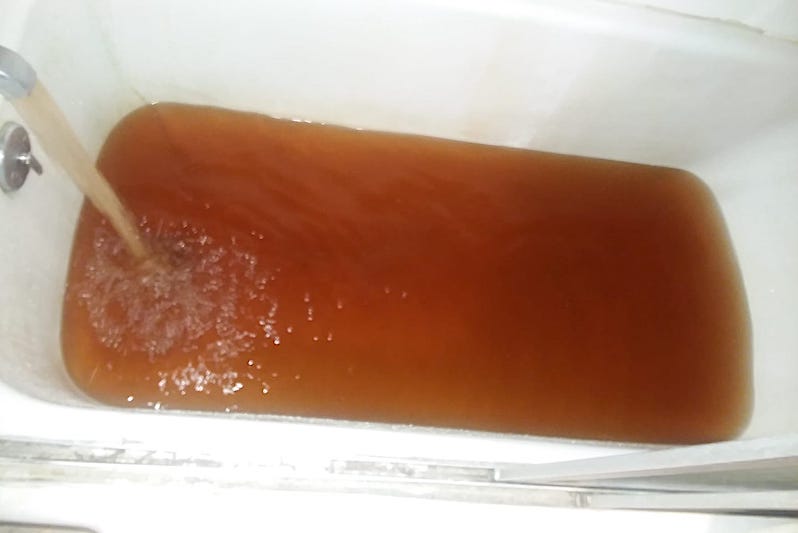
The problem plaguing the system is brown and roily water so discolored that it fouls clothing in washing machines and stains sinks and toilets. Brian D. Harrington, deputy regional director for the bureau of water resources at the state Department of Environmental Protection (DEP), told the board last year that the state is primarily concerned with water quality and rates, but not “esthetic” issues such as brown water.

The state Department of Public Utilities (DPU) regulates the rates that private water companies can charge, but the issue of how the water looks coming out of the tap appears to be a gray area. If a proposed rate increase is too high, the DPU steps in. If the water is a health hazard, the DEP can mandate improvements that address the problem.
The troubled private water company serving 824 customers and a total population of roughly 1,400 users in the Housatonic section of Great Barrington has been plagued with problems for years. Complaints have centered around deferred maintenance, chronically discolored water, a lack of communication with customers, and pressure in the company’s fire hydrants insufficient to fight a large fire in the village.
“We know the state says the water is safe to drink, but we understand that the residents are concerned about the appearance of the water,” board chair Steve Bannon said. “We think water should be safe to drink and esthetically pleasing. It also should not ruin residents’ clothing or stain their bathtubs.”

Town Manager Mark Pruhenski laid out four possible scenarios to get a handle on the problem. Most of them involve the town acquiring the tiny private water company, which has 17 miles of water mains and 55 fire hydrants:
- Acquire HWW and operate the system as an enterprise fund, meaning it’s a user-paid system similar to the town’s sewage treatment plant
- Acquire HWW — for a monetary price or perhaps not — and hand the system over to an independent water district serving HWW’s existing customer base. That would be a similar model to the Great Barrington Fire District, the quasi-public entity that supplies water to most of the rest of the town of Great Barrington. This would require special legislation on Beacon Hill.
- The town acquires HWW and “works with the Fire District to potentially merge those two systems”
- The town would have little or no involvement at all, which means Housatonic Water Works would remain a private entity and the town would work with regulators” and HWW to improve water quality through capital improvements to the system. “Basically, it’s the status quo, but with the town playing a more active role than it has in the past,” Pruhenski said.
“Full disclosure: none of these options will happen overnight,” Pruhenski, himself a Housatonic resident, told the 29 attendees. “Three of them require that the town acquire the system, which could take several months to years, and would also require town-meeting approval which … presents its own challenges since Housatonic Water Works serves a much smaller portion of the overall town.”
The town has commissioned two engineering firms to assess the condition and value of the system. Earlier this year, AECOM, an infrastructure consulting group, recommended improvements to the HWW system that would cost more than $30 million. If HWW were to raise its rates to pay for the needed infrastructure improvements, it would create an enormous imbalance in annual water rates between HWW customers and fire district customers in the rest of the town.
By fiscal year 2042, for example, HWW customers would be paying $3,711, while fire district customers would be paying only $834. The Mercer family, which owns HWW, has said that state regulators would never approve the dramatic rate hikes necessary to finance the needed upgrades.
Meanwhile, DPC Engineering told the selectboard in August the eventual owner of HWW will be confronted with tens of millions of dollars in deferred capital expenses. As a stand-alone utility, depreciation has pushed HWW’s value today down to a mere $5.8 million. A previous estimate of needed capital improvements pegged the cost at $31 million, leaving HWW with a negative value of $25.2 million — a figure a DPC engineer called “an ugly number.”
Kirk Street resident Suzie Fowle, a former member of the town planning board, asked Pruhenski whether it has been determined which parts of the HWW system had the most discoloration. Pruhenksi did not know, but said he and his staff would look into it.
Fowle also wanted to know why any acquisition of HWW would require town meeting approval. Pruhenski said a town meeting vote is required for the expenditure of funds and for any acquisition of real property.

In response to a question from Pat Hollenbeck about fire hydrants, Great Barrington Fire Chief Charlie Burger said the hydrants supply sufficient pressure for a standard structure fire, but not for a large blaze. In response to further questioning, Pruhenski said the town pays HWW nearly $45,000 per year for access to the hydrants.
Housatonic native Dave Long recalled the history of the Mercer family with the town. If Great Barrington wanted to force a sale of the HWW, it wouldn’t be the first time the town had tangled with the Mercer family over eminent domain. Current HWW treasurer Jim Mercer’s father owned land across Route 7 from Monument Mountain Regional High School.
Frederick J. Mercer purchased the 27-acre property in 1973 for $78,000 and “subsequently developed it into one of the first fully-permitted landfills in the state,” the Berkshire Eagle reported in 1995. Fred Mercer operated the facility privately for 14 years and, in 1988, he started leasing it to the town.
“One year later, the town acquired the property by eminent domain after negotiations to purchase it from Mercer proved fruitless,” the Eagle reported. “The town took the parcel in June 1989 and offered Mercer the sum of $476,200, which he said was ‘grossly inadequate.'”

Fred Mercer sued on the grounds that the town did not pay fair-market value, as it is required to do in property seizure by eminent domain. In October 1995, after a trial of some two weeks, Mercer won a judgement in Berkshire Superior Court of $1.8 million.
“It’s a fair verdict,” the elder Mercer told the Eagle.
“Some of this is beginning to feel an awful lot like the closing of the dump,” Long said of the situation with HWW. “In the end, the town bought the dump, turned it into a transfer station and indemnified Fred from any of the choices that he made in running that dump for the town … Fred developed this into a municipal [water] system and left the pieces for the town to pick up. I don’t have a huge appetite to basically bail that out, given multiple histories.”
Pruhenski outlined the next steps for the town. The board and staff will continue to explore options for the acquisition of the system, meet with HWW and state officials, and “investigate other legal pathways.”

The selectboard and staff will also be exploring filtration options and whether the town could use any portion of the $2.1 million in funds it is receiving as part of the American Rescue Plan Act “to provide grants to affected homeowners as a short term solution.” Indeed, the selectboard announced today that it is holding a meeting on Nov. 1 to gather input from the community “on how to best deploy” those federal funds.
“We will additionally seek out other funding mechanisms for capital upgrades through grants and low-interest loans,” Pruhesnki explained. “We’ve started having those conversations with our legislators and asked for help with that.”
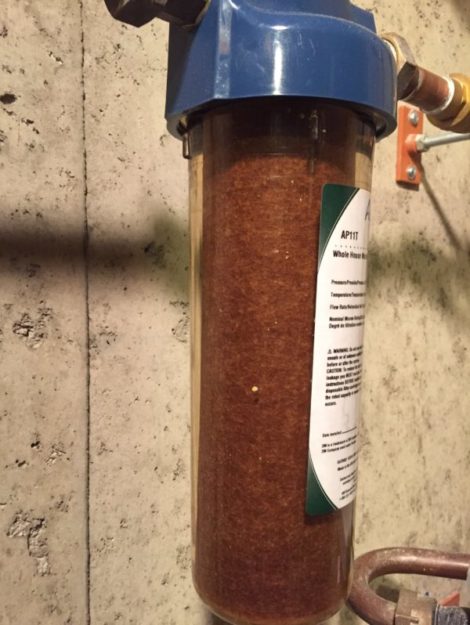
The town is also reaching out to the office of state Attorney General Maura Healey for possible help and is in talks with the DPU about exploring the possibility of rate relief for affected customers, some of whom have felt compelled to install expensive filtration systems or private wells.
Pruhenski also reminded attendees that there is a trove of information about HWW on the town’s website and that customers are invited to an information session that the company is holding Thursday, Oct. 14, at 6 p.m. An open letter from Jim Mercer to customers, along with instructions on how to join the meeting remotely through Zoom, can be found here.