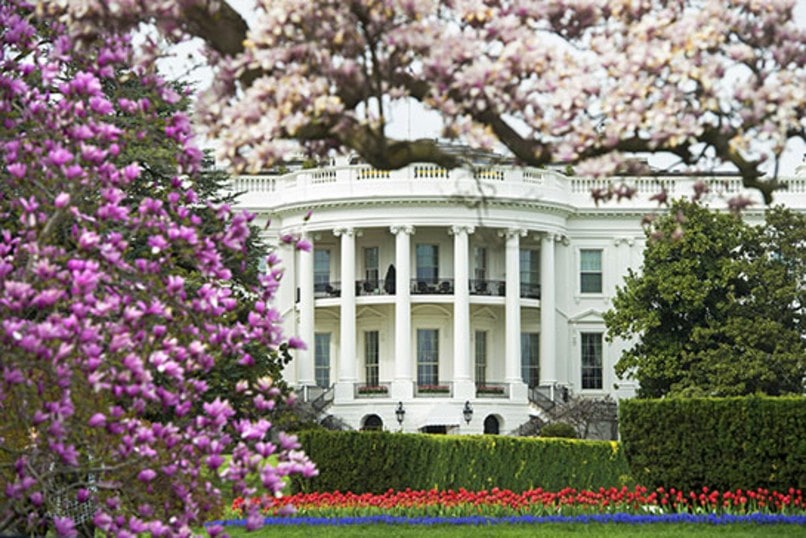
About Connections: Love it or hate it, history is a map. Those who hate history think it irrelevant; many who love history think it escapism. In truth, history is the clearest road map to how we got here: America in the 21st century.
I despair of this White House. Perhaps they don’t look as if they know what they are doing, but it is far worse. Far worse: They know exactly what they are doing, and are content to mislead. Their goal is to create a media moment. It begins with constant comment: “The White House is readying a pen for the president.” After all, a veto is anticipated.
I heard but I did not see that there was a ceremony in which a pen was produced and used. For what?
It is a simple string of facts. There are seven steps: A bill is proposed in Congress, it is debated in committee, they write it up and both houses vote. When both houses vote in the affirmative, the bill is delivered to the White House for the president’s signature.
If the president signs it, the bill becomes law. That does require a pen. A veto does not. A veto is in fact and by definition the absence of a signature. If POTUS does not sign the bill, it is not law. It can be returned to Congress for an override—a two-thirds vote. Or Congress can decide to rewrite it in a way that might curry favor with the executive branch.
The first veto was executed by our first president. In 1792, Washington vetoed a bill that would have allowed more representatives in the House, with a disproportionate number coming from northern states. The veto is a significant part of the checks and balances granted early in the Constitution.
There are two kinds of veto: regular, when the president returns the bill to Congress unsigned; and pocket veto, when the president does not sign the bill and figuratively puts it in his pocket—that is, does not return it to Congress. In either case, there is nothing to sign and no need for a pen with which to do it. There was a president—Jackson, I think—who liked to write the word “veto” across the bill, but not his signature.
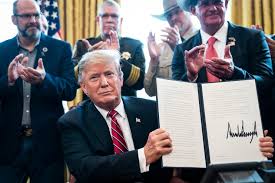
Is that what Trump did? I don’t think so. I think what he did was create a ceremony because it is a good media moment. I think he was handed a pen, took the pen, wrote something on something—something without meaning or importance, except he created a fiction. Many who do not know about a veto, its definition or execution, were thrilled by the vision of POTUS signing his first veto.
Untruth from the White House to the public is rife. Actually, it is more subtle than Twitter rants riddled with identifiable lies. Constant lies are undermining our government—misinforming the public—making us all a tad dumber and a titch less able to defend our government and our way of life.