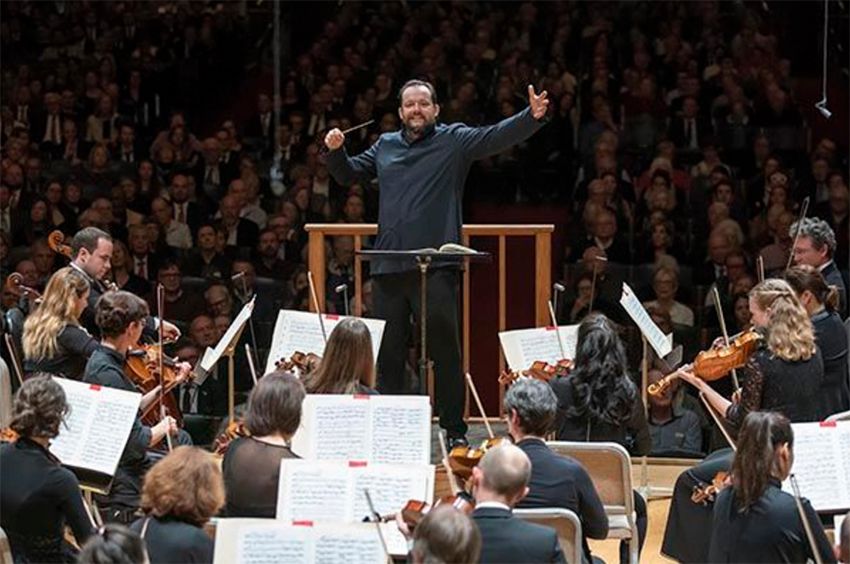
Boston — The Boston Symphony Orchestra announced Friday that it has canceled the 2020-21 winter/spring season and Holiday Pops 2020 Series at Symphony Hall due to COVID-19 safety concerns.
In earlier statements this year, the orchestra announced the COVID-19-related cancellation of the last seven weeks of the Boston Symphony Orchestra’s 2019-20 season, the 2020 Boston Pops season, the Boston Pops Fireworks Spectacular, and the summer Tanglewood season. In July, the BSO announced cancellation of the fall portion of its 2020-21 Symphony Hall season, which would have included 14 programs in 37 concerts between Sept. 16 and Nov. 28.
The initial set of cancellations is expected to incur a $30 million revenue loss for the orchestra’s fiscal year ending in August. Losses accruing in the 2020-21 winter/spring season represent an entirely new financial catastrophe.
This is all terrible news, but no one who regularly reads a newspaper will be surprised by it. In late September, the Metropolitan Opera announced its entire season canceled. A few days before the BSO made its announcement, the New York Philharmonic canceled all its concerts through June, calling the pandemic the single biggest crisis in the orchestra’s 178-year history. And on Oct. 15, the Chicago Symphony Orchestra announced its cancellation of all concerts scheduled from Jan. 7 through March 30, 2021. The same story, of course, is playing out all over the world with countless orchestras, for whom the pandemic is no less than an existential threat, taking desperate measures in an attempt to survive. That means lost jobs and broken dreams for an awful lot of people.
Looking for silver linings — formerly an activity reserved for the Pollyannas among us — has lately become a sensible survival tactic for a great number of people, including BSO management. They really have gotten this skill down to a fine science, announcing new online content almost every time they’re forced to deliver bad news. And don’t forget that members of the BSO have already proved chamber music’s suitability for mid-pandemic, socially distanced performances. They pulled it off beautifully over the summer with a series of recitals shot at Tanglewood’s Linde Center for Music and Learning: The programs were wildly inventive, the performances brilliant.
The good news this week from the BSO is, in fact, spectacularly good: A safely scaled-down orchestra will start recording new content at Symphony Hall beginning Wednesday, Oct. 28 — the same day the BSO will make announcements about it — marking the musicians’ first return to the Symphony Hall stage since concert cancellations began March 13. That’s hugely encouraging, because it means a drought of live concerts is not the showstopper we might have expected. Now we know for sure that there will not be a music-making drought in Boston this year or next.
Artistically speaking, the new content is no trifling matter: The Boston Symphony Orchestra is a Grammy Award-winning ensemble with a fully equipped recording studio located beneath Symphony Hall. The band has everything it needs to crank out high-quality recorded products and, as one of the top reading orchestras in the world, it can do so very quickly. Moreover, the players have been champing at the bit for many months now. They cannot stop making music. Within weeks, we’ll get to see and hear them (online) performing together at a level that we’ve possibly never witnessed before. It will be bittersweet, but make no mistake: When you next see members of the Boston Symphony Orchestra performing together at Symphony Hall — even if it’s only half the members — you will experience a thrill that’s been missing from your life for a very long time.