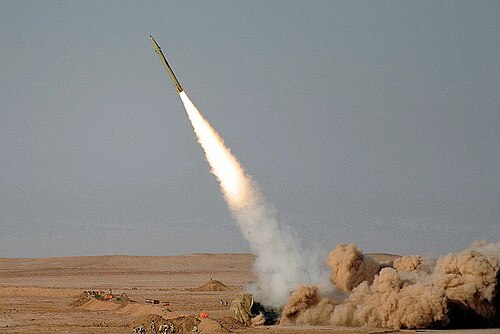
Those who take us to war always forget to tell us what the war will cost. Yes, in dollars and cents, but also in lives, in what those who fight will lose in body and mind, and how many innocents will never be the same.
President Trump, mirroring his lack of taste in ballrooms and gold-adorned bathrooms, has armed himself with a grandiose and unseemly nickname for his war: Operation Epic Fury. His choice of names says everything about how he ignores the real costs of his decision to take us to war:
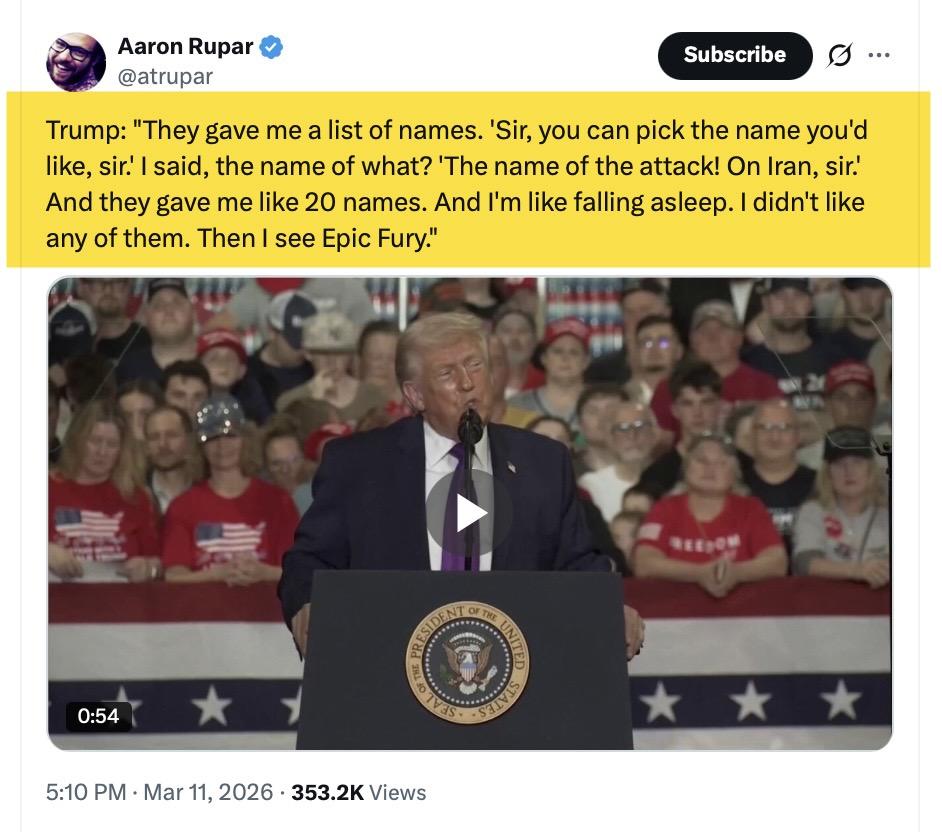
Clearly, he liked the name enough to wake up. He then told his Kentucky audience: “I said, ‘I like that name. I like that name.’” The Deccan Chronicle reports that he then reminded them: “‘It is only good if you win, you know, you can only—and we’ve won, let me tell you, we’ve won,’ he said, adding, ‘You know, you never like to say too early you won, we won, we won, but in the first hour it was over.’”
Donald Trump, of course, is unlike our other leaders who, while they lied, still tried to meet the moment with a somber seriousness. In just days, he has manifested an almost blasé, completely inappropriate attitude that becomes ever more incongruous as the losses mount. Losses for us, for the Iranian people, Israeli civilians, now the Lebanese people, and a host of innocent bystanders. He offers the press and the public a series of ever-changing assessments, as if he were playing a video game without consequence. And so, it is understandable that many Americans do not really appreciate that he is actually sending the most extraordinary and most powerful armed force to fight a very real war that seems to be enveloping the entire Middle East.
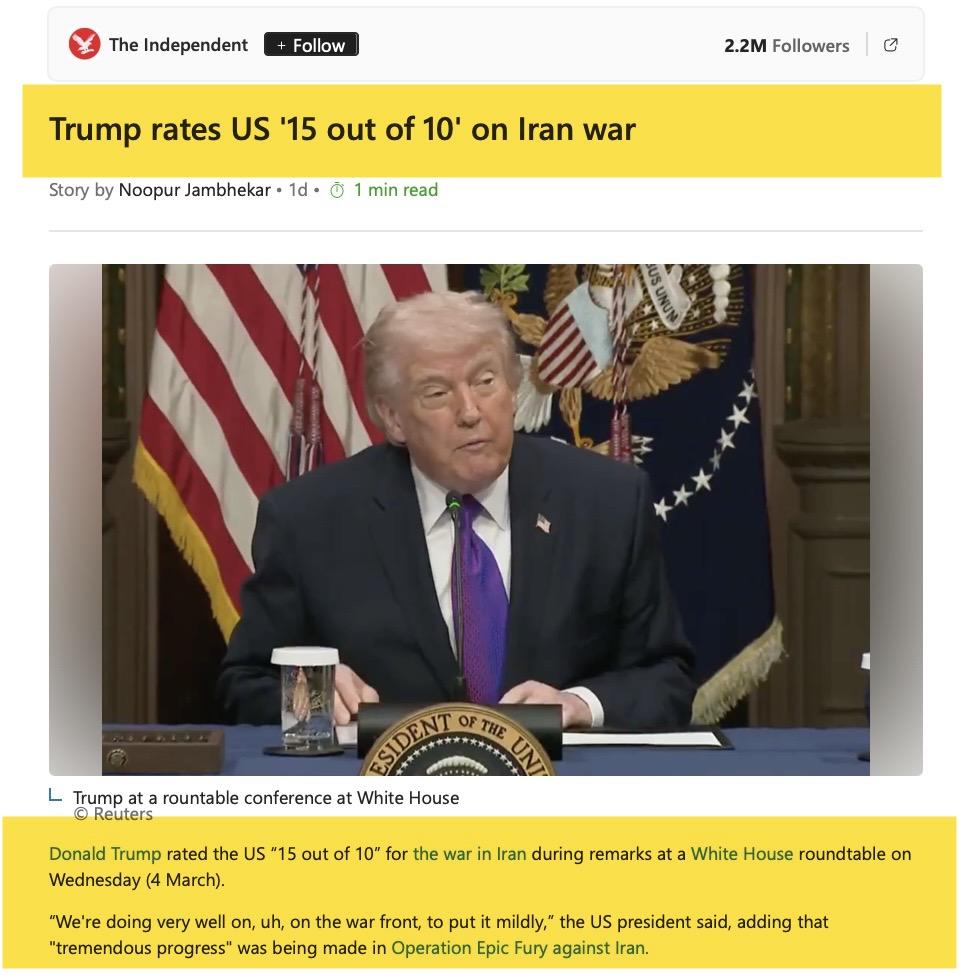
He is keeping score. Like Call of Duty. Or maybe a new game, like FIFA World War Three. The UK Independent reported this interchange:
‘We’re doing very well on, uh, on the war front, to put it mildly,’ the US president said, adding that ‘tremendous progress’ was being made in Operation Epic Fury against Iran. Boasting of the American military’s performance, he said, ‘Somebody said, on a scale of 10, where would you rate it? I said, about a 15.’
Yes, unsurprisingly, 15 on a scale from one to 10 is more than tremendous for Donald Trump. Impossible for any president other than him to beat. I am sure he is quite convinced that even the fake news would concede that this is our best war ever.
Now, maybe some of you might be thinking that I made this up. He couldn’t possibly be comparing war, with its accompanying death and destruction, to your everyday customer feedback or to Survey Monkey, but of course he did:
But despite the administration’s continuing attempts to ignore the costs, reality has crept in. As The Independent pointed out while Donald Trump was giving himself the 15 out of 10, “Joint US-Israeli attacks have killed more than 1,000 people in Iran, while Iranian strikes on American military installations in the Gulf caused the deaths of at least six US soldiers.”
Of course, there are different realities for those on the receiving end of the bombs and for those who send them. So, here at home, there is an air of unreality to this war. While the Iranians, the Lebanese, the Israelis, and various folks throughout the Arab world are dealing with drones and rockets and air raid sirens, closed airports, oil depots on fire, we in the United States, blessed by distance, are treated to the rhetoric of triumph.
If Donald Trump and his secretary of war had their way, everybody would call this war the “good news war.” Fact is, Donald Trump doesn’t want to call it a war. This is what he told the American people on February 28, 2026:
A short time ago, the United States military began major combat operations in Iran. Our objective is to defend the American people by eliminating imminent threats from the Iranian regime. A vicious group of very hard, terrible people. Its menacing activities directly endanger the United States, our troops, our bases overseas, and our allies throughout the world …
They’ve rejected every opportunity to renounce their nuclear ambitions, and we can’t take it anymore. Instead, they attempted to rebuild their nuclear program and to continue developing the long range missiles that can now threaten our very good friends and allies in Europe, our troops stationed overseas, and could soon reach the American homeland. Just imagine how emboldened this regime would be if they ever had, and actually were armed with nuclear weapons as a means to deliver their message.
For these reasons, the United States military is undertaking a massive and ongoing operation to prevent this very wicked, radical dictatorship from threatening America and our core national security interests. We’re going to destroy their missiles and raze their missile industry to the ground. It will be totally again obliterated.
[Emphasis added.]
Twice he referred to “operations” before finally acknowledging this operation might have consequences. But he quickly turned it into a “mission.” He admitted:
The lives of courageous American heroes may be lost, and we may have casualties. That often happens in war. But we’re doing this not for now. We’re doing this for the future. And it is a noble mission. We pray for every service member as they selflessly risk their lives to ensure that Americans and our children will never be threatened by a nuclear-armed Iran.
[Emphasis added.]
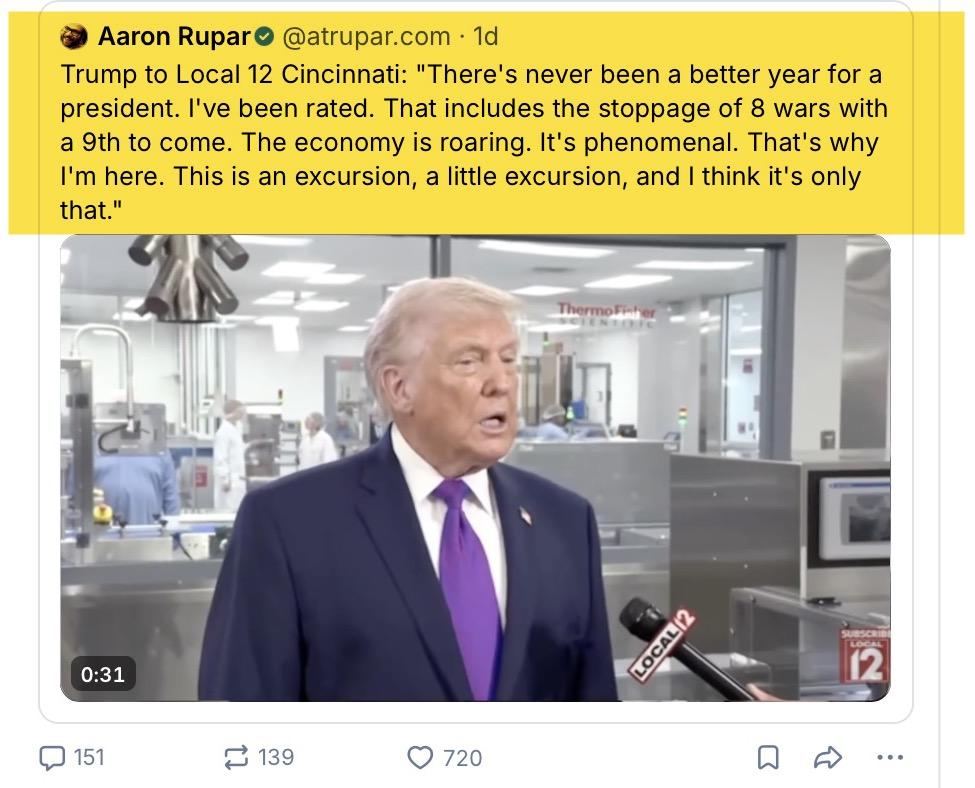
Just recently, the president simultaneously graded himself, asserted that the economy had supercharged itself, and claimed the glorious mission had somehow demoted itself:
Meanwhile, these days, Donald Trump can barely walk in a straight line. He can barely manage a complete thought. His body betrays him, with his neck and hands seemingly deteriorating in public view. And so, Pete Hegseth has become the cheerleader in chief. Am I hallucinating, or has Hegseth imbibed an extra dose of testosterone to help him make his case? Certainly, being the secretary of defense just didn’t do the trick—he needed to be the secretary of war. Puffed up, pumped up, in the weight room, tattooed like some speed-infused, born-again heaven’s angel. Now his is the American face of our all-out, take-no-prisoners commitment to kick the shit out of Iran.
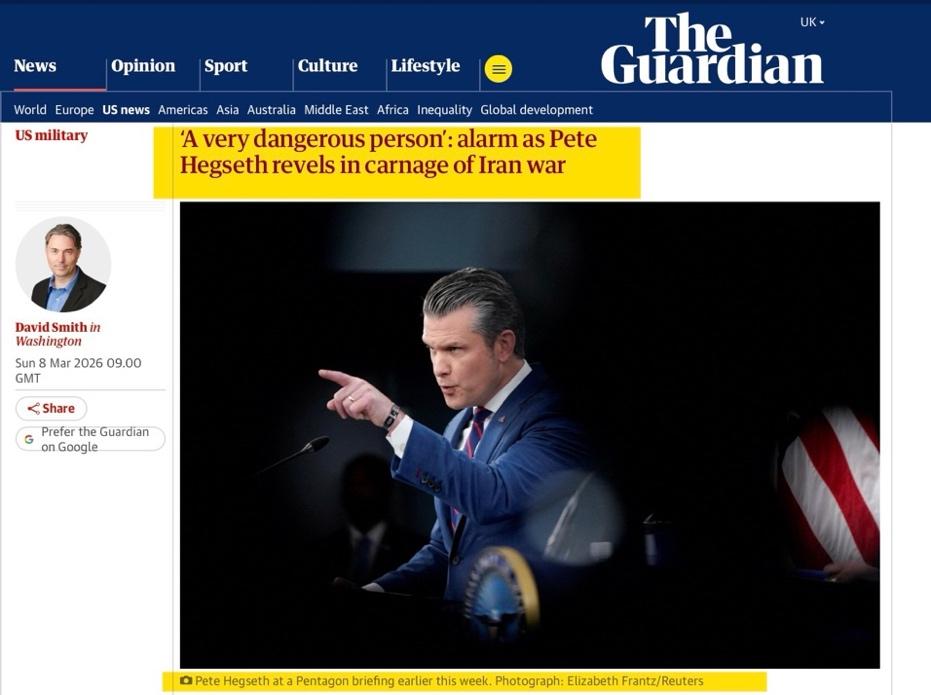
The UK Guardian puts it his way:
Brash and bellicose, he sounded more like a cartoon bully than a sombre statesman. ‘Death and destruction from the sky all day long,’ Pete Hegseth, wearing a red, white and blue tie and pocket square, bragged to reporters at the Pentagon near Washington. ‘This was never meant to be a fair fight, and it is not a fair fight. We are punching them while they’re down, which is exactly how it should be.’
[Emphasis added.]
Hegseth could not hide his fierce desire for the fight:
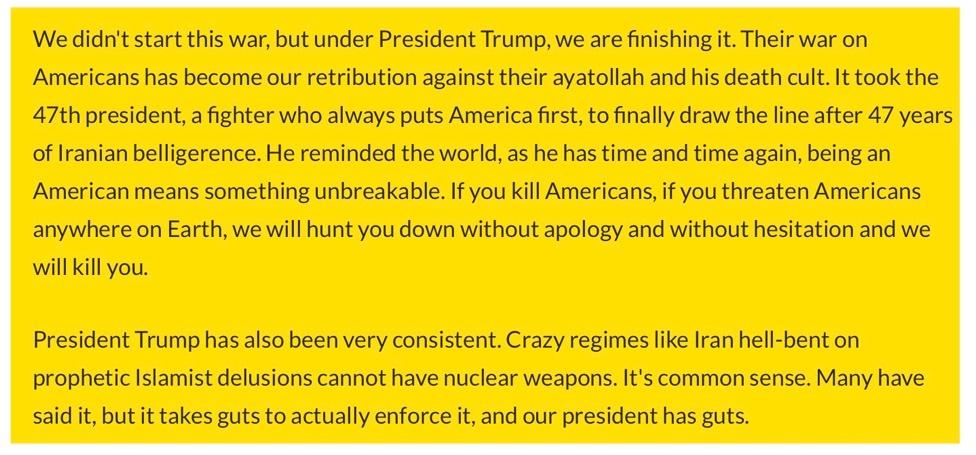
Clearly, gone are the days of war as a last resort. It is retribution time. The Guardian continued:
Hegseth, 45, a former Fox News TV host who now commands the world’s most powerful military, has this week become the face of Donald Trump’s war in Iran … [and] has rapidly transformed the Pentagon into the staging ground for a ideological and religious crusade. With machismo, Christian nationalism and callousness toward the lives of US troops, they say, Hegseth’s puerile displays on TV are aimed at sating Trump’s desire for a warmonger worthy of the manosphere. This was reinforced by a lurid social media video that intersperses clips from Hollywood blockbusters such as Braveheart, Gladiator, Superman and Top Gun with Hegseth and real kill-shot footage of the attacks in Iran.
And so the White House’s new version of “Justice The American Way” is blowing Iran to smithereens:
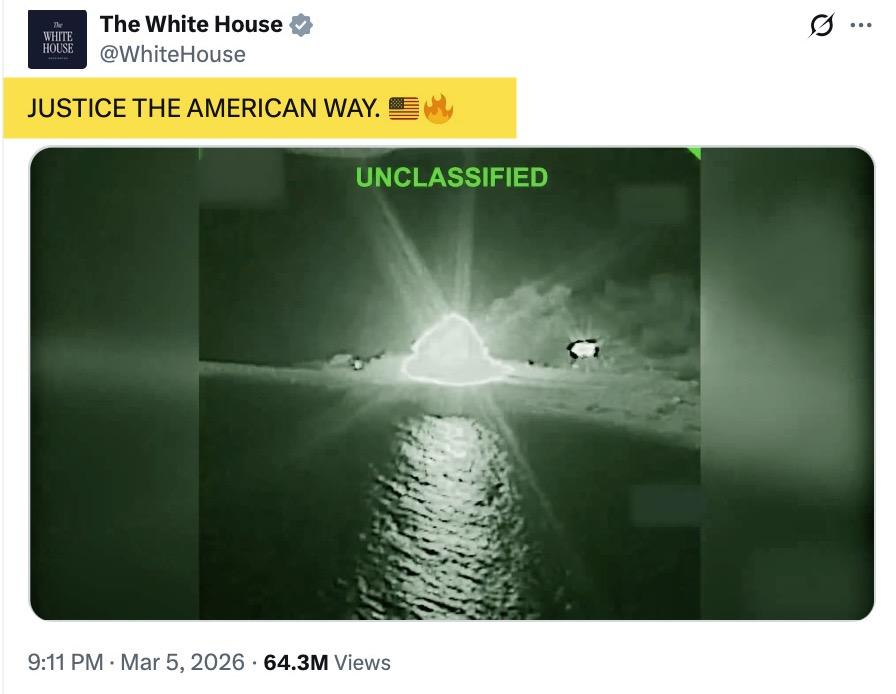
Back to the Guardian:
Janessa Goldbeck, chief executive of Vet Voice Foundation, a non-profit advocacy organisation, said: ‘Pete Hegseth is a very dangerous person. He’s a white Christian nationalist and has the arsenal of the United States government at his disposal and a permission slip from President Trump to deploy carnage wherever he wishes against whomever he wishes.’
Hegseth’s rise would have been unthinkable under any other commander-in-chief … After leaving Princeton, Hegseth joined the US army national guard as an infantry officer. His service included deployments to Guantánamo Bay in Cuba and tours of Iraq and Afghanistan. He later revealed in a book that he told soldiers under his command in Iraq to ignore legal advice about when they were permitted to kill enemy combatants under their rules of engagement.
Hegseth became chief executive of Concerned Veterans for America, a conservative advocacy group, but departed in 2016 amid allegations of financial mismanagement, sexual impropriety and personal misconduct …
Now, in his first week guiding the nation through a murky new Middle East conflict, Hegseth has largely forgone the solemnity of a traditional defence secretary in favour of the performative antics of a partisan broadcaster revelling in the US’s capacity to inflict violence.
For years he had cultivated a hypermasculine ‘muscleman’ aesthetic designed to play to Trump’s sensibilities and the rightwing media ecosystem. Now, faced with a geopolitical crisis that demands nuance and strategic foresight, he appears to many to be out of his depth.
Goldbeck, a Marine Corps veteran who was deployed overseas as a combat engineer officer, commented: ‘I wish I could say how cavalier, obtuse and hopeless Secretary Hegseth is at leading the Pentagon. I can’t even muster the words to describe his self-adulation, matched only in scope by his apparent moral depravity.’
I want to say a word about how tragically ironic it is that in some ways all three major parties to this war each profess a separate and contradictory messianic vision. Each side possesses, even cherishes, supreme confidence that they alone are right and destined to prevail. You’ve got fanatical Muslim clerics; Netanyahu, an Israeli Child of God; and born-again Hegseth, member of an arch-conservative, patriarchal church that believes women should submit to their husbands. All faced off against one another and willing and able to annihilate all who stand in their way.
All seem to have no problem taking their countries to war, quite willing to absorb whatever casualties might be required to triumph. Here at home, President Trump and his secretary of war have hardly acknowledged the numbers of the wounded or the growing costs of this war—not to mention the mounting deaths of those caught in the crossfire.
But because they are remarkably thin-skinned, they cannot help but whine—or, worse, attack—when anyone levels a legitimate question or concern or expresses anything that resembles criticism or anything they regard as insufficient celebration.
Donald Trump has always been unwilling to acknowledge those who pay the steepest price for war. Remember his refusal to honor those who died during D-Day; his dismissal of Gold Star families; his cruel description of veterans as suckers and losers; and his unforgivable denial of John McCain’s bravery: “He’s a war hero [only] because he was captured. I like people who weren’t captured.” Trump’s desire to discount their deaths is matched by Hegseth’s ultra-macho attempt to make their sacrifice a mere matter of fact, no big deal. They both have tried their best to preempt any serious consideration of casualties.
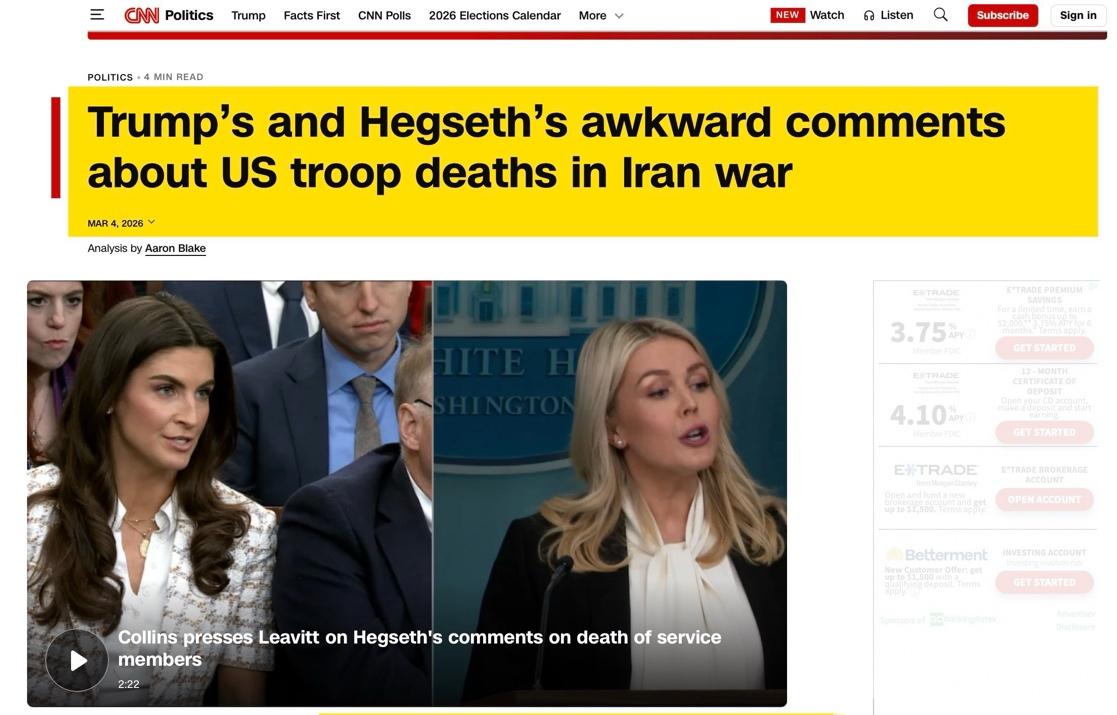
CNN explained:
The specter of troop deaths — there have already been six — is indeed a somber variable that appears likely to test Americans’ limited tolerance for a war that they don’t seem particularly keen on. But it’s especially a problem for Trump. He has many talents as a politician, but speaking about dead and wounded service members is decidedly not among them. In fact, it’s a real blind spot.
And because of his choice of foreign conflicts, that weakness faces a harsh spotlight. The war with Iran is now less than a week old, and Trump and his administration have already made multiple awkward comments about the deaths of US soldiers.
After the first three deaths were reported, Trump told NBC News on Sunday: ‘We have three, but we expect casualties, but in the end it’s going to be a great deal for the world.’
Trump was immediately inserting those deaths into a cost-benefit analysis. Then in a video posted to social media the same day, he again seemed to ask for people’s understanding about the subject. ‘And sadly, there will likely be more [deaths] before it ends,’ Trump said, before adding: ‘That’s the way it is. Likely be more.’ He then added: ‘But we’ll do everything possible where that won’t be the case.’
[Emphasis added.]
That these deaths are going to be a great deal for the world implies that the American people signed onto this deal or that the rest of the world—besides Israel and Saudi Arabia—somehow agreed with this precipitous decision to go to war.
It used to be that presidents would assure the American public that the most difficult decision they would have to make would be the decision to go to war. Well, if you have been watching Donald Trump’s continuing trips to Mar-a-Lago to play golf, you might imagine that signing off on Operation Epic Fury hardly fazed him at all. And it is clear that this war has not inconvenienced him in the slightest. He still manages to get in his 18 holes.
To double-down, President Trump then went out of his way to assure us that while other presidents might have had to put down their golf clubs to concentrate on their war plans, he on the other hand could easily multitask. Those other guys just could not make a decent putt and bomb the bad guys to smithereens all at the same time. Now Trump is a sports guy, and he, of course, knows about how Major League pitcher Jon Lester all of a sudden could not accurately throw to first. Or about Jarrod Saltalamacchia, the catcher who for a while just could not throw the ball safely back to the mound. And those Biden/Obama-like presidents before him, when it came to sending troops to beat the hell out of Iran, well they just had the yips. Not him.
He has always been a gamer. Probably because he had a continuing battle with those debilitating bones spurs that kept him out of Vietnam. And, of course, there was his exhausting, Epstein-like journey seducing and abusing young women. All of which had taught him to face adversity head on, to persevere no matter what. This war—like Vietnam for him, thanks to father Fred—was easy because you could send others to fight and die. Yes, indeed. No yips for Trump, just “Yippee ki yay, let’s do this! Let’s go to war!”
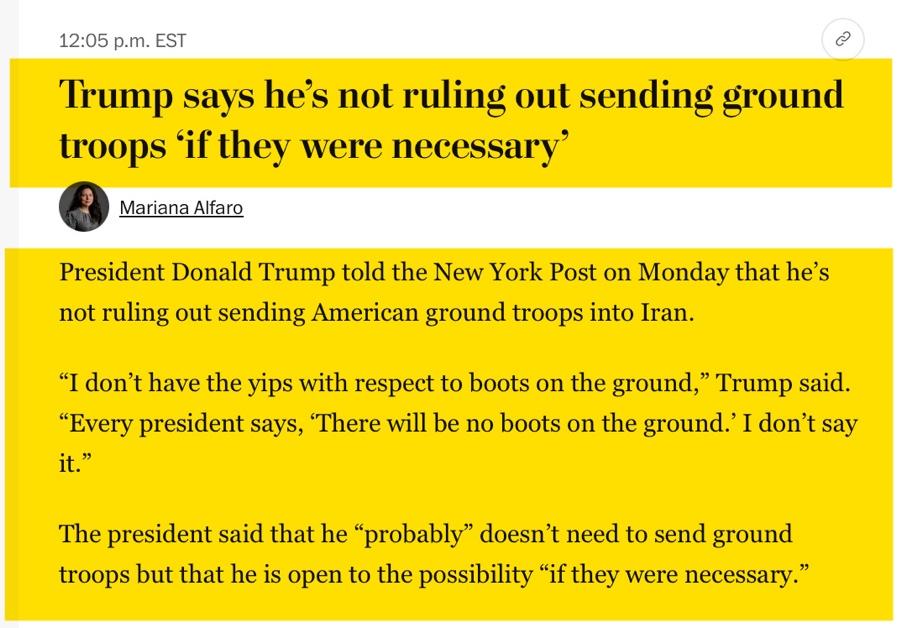
Now, of course, there are those who fervently wish he had the yips, had some foresight. But you must know by now he pays his critics no mind. He has a bevy of yes men (Marco and Stephen and even Lindsay Graham) and yes women like Karoline Leavitt ready and willing to praise him to the hilt. Above all, there is Secretary of War Pete Hegseth, fueled on adrenaline and the “Apocalypse Now” smell of napalm in the morning, chiding the press for bringing up the American dead.
CNN pointed out: “Many Democrats harshly criticized Trump for his ‘the way it is’ remark, suggesting it betrayed a certain callousness — as if this was just the cost of doing the business of war.”
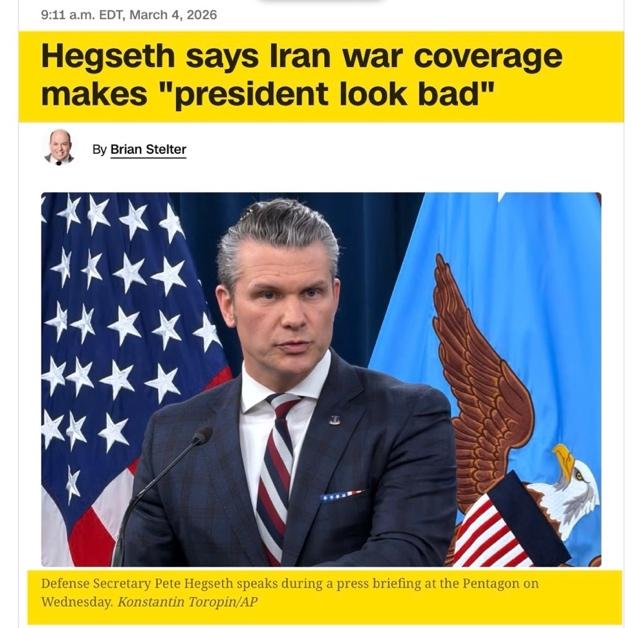
Then, according to CNN:
US Defense Secretary Pete Hegseth reverted to his past talking points about ‘fake news’ Wednesday while touting the US military’s accomplishments. Hegseth suggested that the press prominently covers service member casualties to ‘make the president look bad,’ an incendiary claim that injected partisan politics into a wartime Pentagon press conference. Hegseth said the ‘the fake news misses’ that ‘we’ve taken control of Iran’s airspace and waterways without boots on the ground.’ …
Hegseth then alluded to the Iranian drone strike in Kuwait that killed six service members. ‘When a few drones get through or tragic things happen, it’s front page news,’ he said. ‘I get it. The press only wants to make the president look bad. But try for once to report the reality. The terms of this war will be set by us at every step.’
[Emphasis added.]
So, it seems as if the administration is determined to downplay any of the real and appreciable costs of this war. And when it came time for the president to meet the caskets of those who actually died, he dressed as if he was headed out to a NASCAR race. And though they claimed it was a simple error, FOX News decided to help him by not showing what he was actually wearing. They used an old photo. As if he were not really wearing that white cap to meet the caskets of our fallen service members. The same cap he had recently worn to the golf course.
Some could not help but comment. Joyce Vance, who served as the United States attorney for the Northern District of Alabama from 2009 to 2017, wrote the following for Civil Discourse:
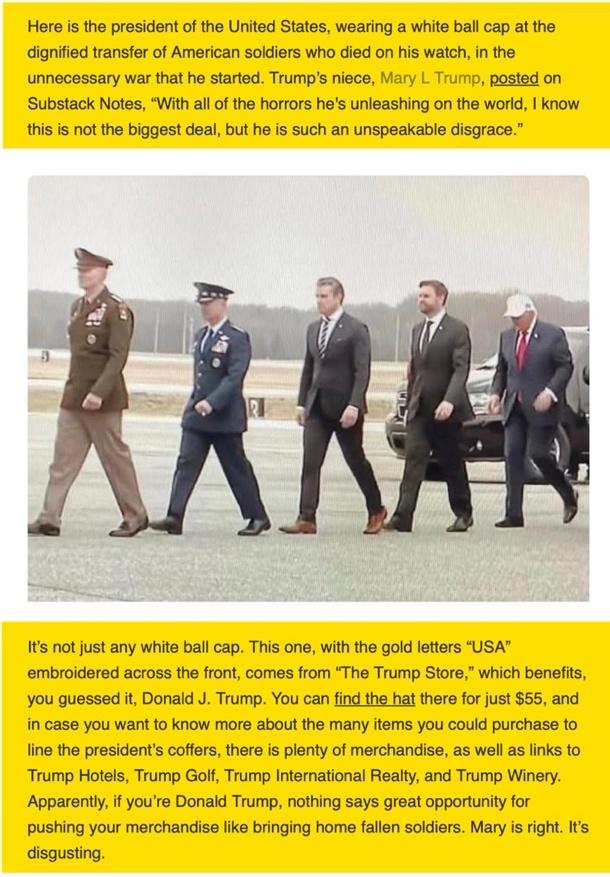
Here is how The Daily Beast put it:
President Donald Trump made a bold accessory choice while attending the dignified transfer of six U.S. service members killed in his war with Iran. Trump, 79, stood as six coffins covered in American flags were solemnly carried from an aircraft to a waiting vehicle at Delaware’s Dover Air Force Base on Saturday afternoon. On Trump’s head sat a gold-embroidered white hat with the letters ‘USA’ on the front, ‘45-47’ on one side, and the American flag on the other.
The six service members, all part of the 103rd Sustainment Command, were killed by an Iranian strike in Kuwait on Sunday, March 1. They were Capt. Cody A. Khork, 35; Sgt. 1st Class Noah L. Tietjens, 42; Sgt. 1st Class Nicole M. Amor, 39; Sgt. Declan J. Coady, 20; Major Jeffrey R. O’Brien, 45; and Chief Warrant Officer 3 Robert M. Marzan, 54 …
Based on publicly available images, the president’s baseball cap, which he has never worn during a dignified transfer, drew immediate outrage. No other U.S. president has worn a baseball hat during a dignified transfer, based on publicly available images …
Political strategist Chris D. Jackson wrote, ‘Trump just wore a campaign hat to a dignified transfer for fallen U.S. soldiers that were killed during his Iranian blunder. These are the same people who spent weeks attacking Biden for briefly glancing at his watch,’ Jackson continued. ‘The hypocrisy is absolute. There is no bottom for these people.’
Others were quick to point out that Trump’s hat broke with military custom for those in civilian dress. Guidance from the Veterans of Foreign Wars states for military funerals, ‘It is appropriate (and a visible sign of respect) to remove the hat or headdress and place it over your heart.’ …
During the transfer, when not saluting, Trump — who was reportedly warned by intelligence officials that his plans for an Iran war would likely fail to achieve his stated goals of regime change in the country—could be seen fiddling with his jacket buttons and lapel as he bowed his head.
Following the death of the six service members on March 1, Trump said, ‘Sadly, there will likely be more before it ends. That’s the way it is.’ Later in the week, he reiterated that sentiment in an interview with Time Magazine, ‘…You know, we expect some things. Like I said, some people will die. When you go to war, some people will die.’
I am reminded of Vietnam, when America—so many, many miles away—would watch the war for a few minutes a day on the nightly news. Night after night, with the occasional speech from the politicians and generals about the progress we were making. In some ways, it was so very easy not to know we were at war. But, of course, it was the American soldiers and the Vietnamese people who could not escape the war. And it was only because the lies were so egregious and the reality so much worse than the rhetoric that ever so slowly the American people began to understand the true costs of that war. Ultimately, the war-makers could not hide the dead and the wounded, and as the soldiers came home, they told their friends and their families what Vietnam was really like. Approximately 2.7 million Americans served in Vietnam. Let me ask you, as you look at Vietnam and America today, do you really think the deaths of 58,220 members of the U.S. military were worth waging that way? At the cost of 75,000 Americans severely disabled out of the 304,000 wounded.
As for our so-called enemies: The Encyclopedia Britannica estimates there were 2 million civilian deaths and approximately 1.1 million North Vietnamese and Viet Cong fighters killed. Overall, the total number of Vietnamese casualties is often cited to be between 3 million and 4 million. If you know anything about the Vietnam War, the scale of our massive bombing campaign, the napalm, the poverty of the Vietnamese, you know it was never a fair fight. But because it was their land and their pride and we were the invader, they fought us for years and years to a standstill. Until we gave up.
Maybe you will be as dismayed as I am by this:
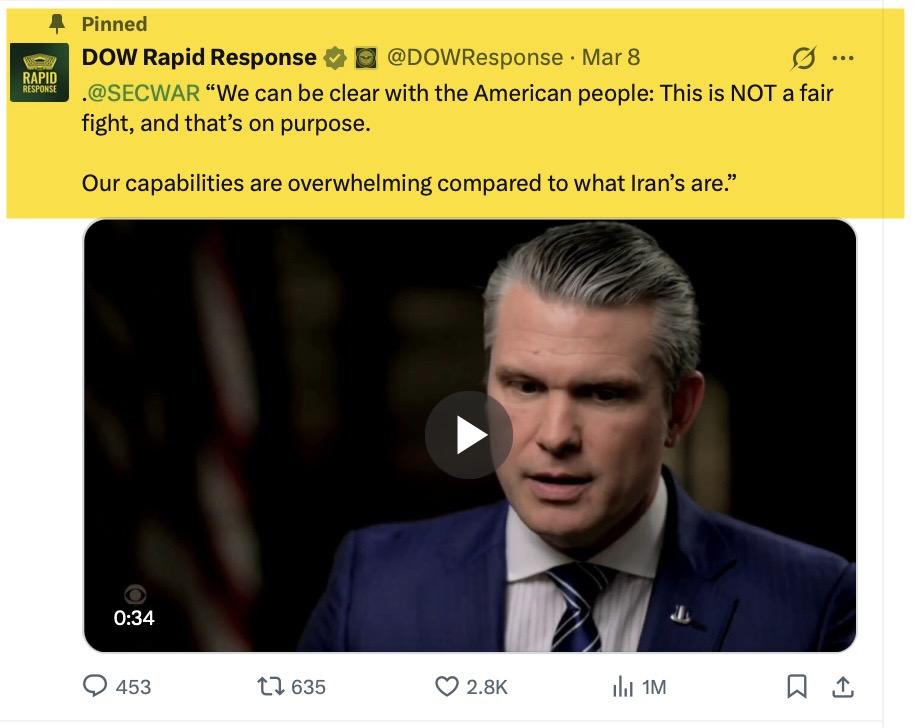
And this:
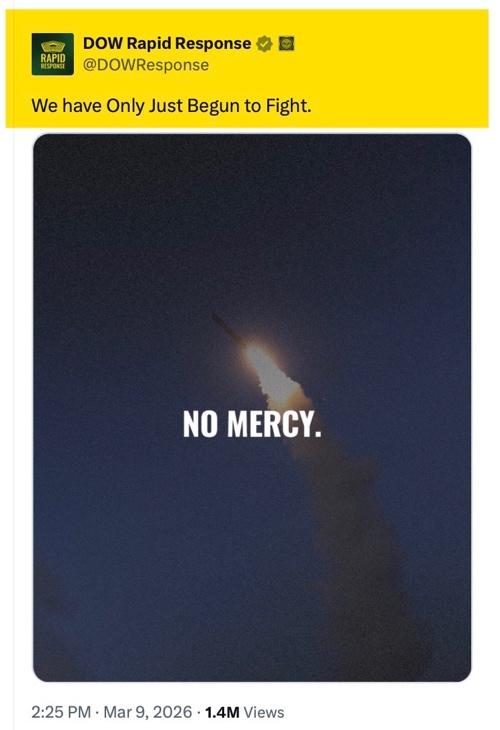
Trump and Hegseth and their supporters will do everything in their power to hide the cost of war. But like it or not, this is our war. These are our leaders. It is our tax money that has bought the bombs.
You can argue that the Iranian ayatollahs are so evil they must be stopped. You can argue the bombs are an appropriate answer. But we owe it to all to acknowledge what is actually happening—to them and to us.
Personally, I am heartbroken that the Iranian people, the primary victims of the regime, will invariably have to suffer the collateral damage of the bombs, of the fires, of the indiscriminate merciless vengeance exacted by our leaders. Because, no matter what the politicians and the generals say, innocent Iranian civilians will be twice penalized. How many ordinary, blameless Iranians will die for every ayatollah we eliminate? And the same is true of the Israeli innocents, the Lebanese, those throughout the Middle East.
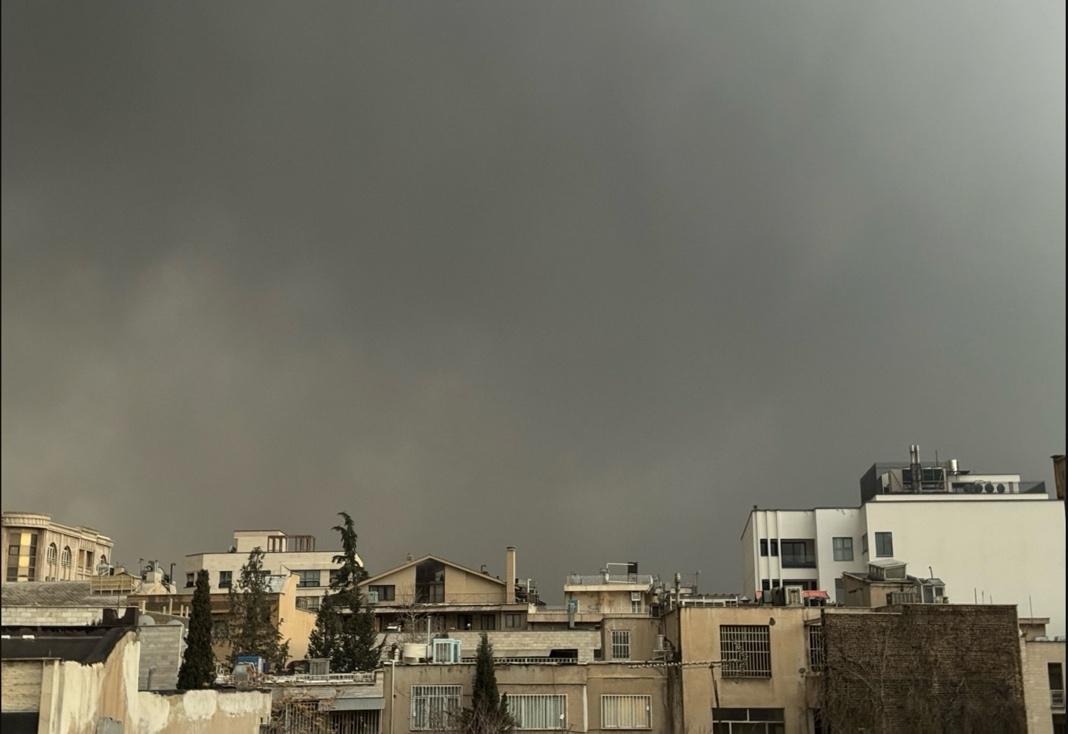
Look at the sky over Tehran, a city of close to 10 million people. How many of those now forced to breathe toxic air are executioners and not victims?
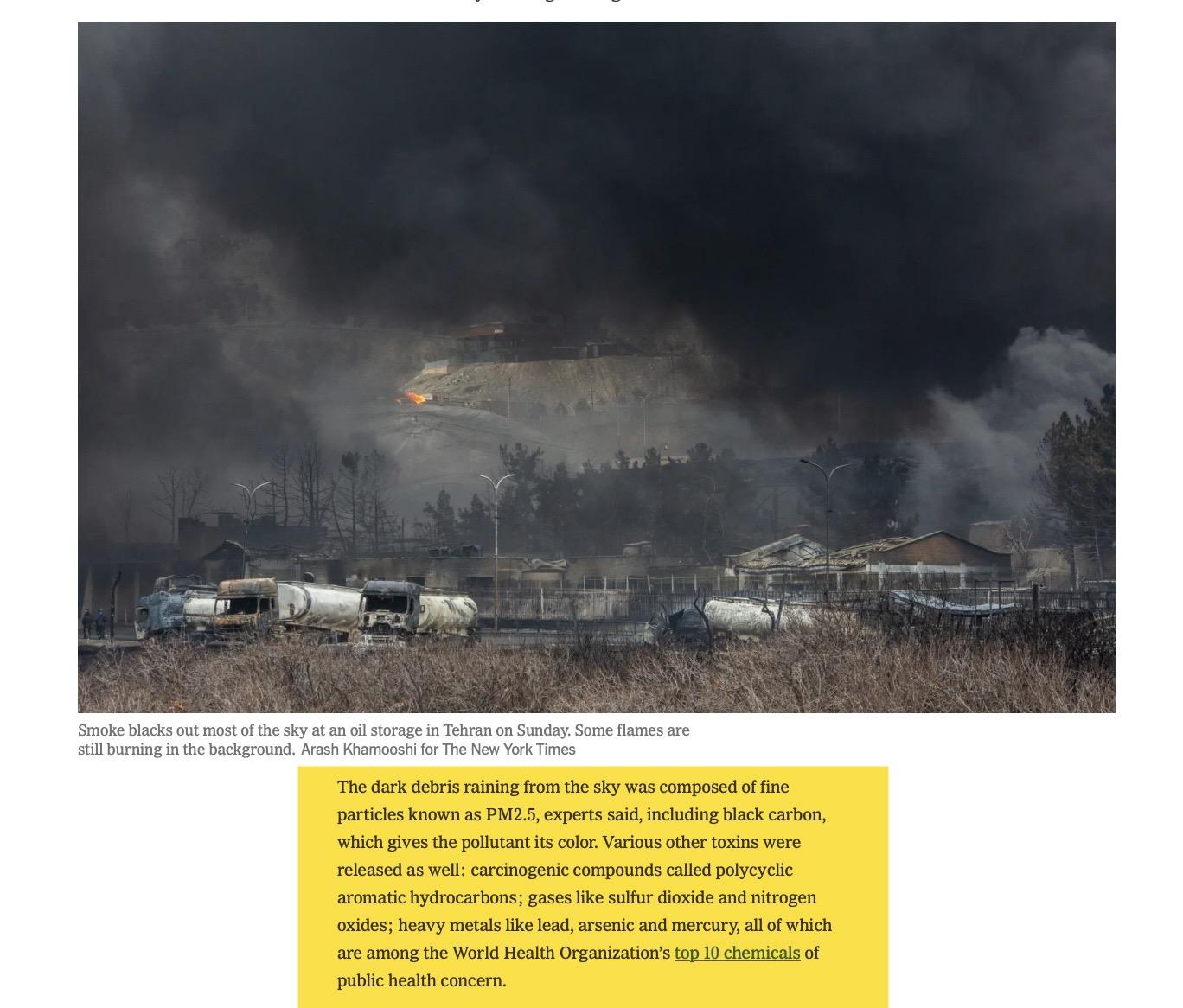
According to The New York Times:
Soon after dark plumes of smoke began settling over Tehran early Sunday morning, residents noticed a bizarre phenomenon: black rain. Some also reported a thick, oily film covering their cars and roofs like paint.
Then the migraines, dizziness and coughing set in. Health experts were not surprised. Iranian fuel depots had just been hit as American and Israeli forces intensified their campaign against the Iranian government. Jonathan Levy, chairman of the environmental health department at Boston University School of Public Health, called it a ‘flashback’ to the first Gulf War, when burning oil fields in Kuwait set off a vast array of health consequences.
Only a day after the strikes in Tehran, the health effects were being been felt miles from the depots. One resident told The New York Times that she had awoke to a pitch-black sky and gone outside. When she got back home, her face was itchy and covered in ‘black dots,’ she said.
After just 15 minutes in a car, another Tehran resident developed burning eyes and airway congestion. ‘It almost feels like tear gas in the air,’ she said. ‘The war has entered our throats.’
Burning oil releases enormous quantities of carbon dioxide, according to Marsha Wills-Karp, a researcher at Johns Hopkins Bloomberg School of Public Health who focuses on environmental determinants of disease. That gas quickly displaces oxygen, which is why people near the site of a burn often show early signs of suffocation. The heart rate increases, breathing speeds up, and people may experience headaches, dizziness, and the strong sensation that they cannot get enough air.
Journalist Jaime León, a resident of Tehran, posted this picture on X:
Thanks to the reporting of Tim Mak at Iran War Dispatches, I have been able to get a sense of what life is like on the ground in Isfahan, Iran. Here is the story of Ali, whose name has been changed:
Ali went to work on Monday morning. Soon after he arrived, the medical center he works in told employees to go home. Heavy shelling had begun again in Isfahan. ‘The windows of my house were shaking in the morning. I tried to stay away from windows and wait until it was over so I could go to work, it was nothing special,’ said Ali.
Isfahan has become one of the central targets of the U.S. and Israeli campaign against Iran’s nuclear program. The city is home to a major nuclear facility believed to hold much of the country’s enriched uranium, making it a strategic target as the U.S. considers sending special forces to secure Iran’s enriched uranium.
But for the millions of people who live there, the strikes are not abstract geopolitical maneuvers. They are a daily reality that interrupts work, school, and ordinary routines as residents try to maintain some semblance of normal life while bombs fall around them.
For Ali, an engineer in his thirties, daily life can be interrupted at any moment by the sound of bombs.
Ali and his friends and family don’t discuss the dangers of living near the Isfahan nuclear center very often. After the first nine days of the war, some parts of his daily routine are intact. He still goes to the supermarkets for groceries, where most of the necessary products are available. People are still driving around the city, but on heightened alert, always cautious about air raid sirens and constantly reading the news.
Other aspects of life in Isfahan have turned around entirely. Classes have been suspended, with schools closed at least until Nowruz, the Persian New Year, which falls on March 21. His new life reminds Ali of a scene from the film And Life Goes On about the aftermath of an earthquake in Iran. In the movie, he recounts, people set up a television on earthquake ruins to watch a football match. ‘That is exactly the situation now,’ Ali said.
But at any moment, a catastrophe can snap anyone out of their attempt to preserve normalcy.
Strikes in Isfahan are not limited to nuclear targets. Israel struck Isfahan Airport during the second weekend of the war, targeting strategic assets including Iranian fighter jets and air defense systems.
Ali’s close friend’s home was destroyed over the weekend. ‘I felt sad and happy at the same time—all I thought was that at least they were alive,’ Ali said. The family has moved in with relatives as they decide what to do next. So far, Ali’s own home has not been damaged.
I wonder at the stupidity of inflicting such damage. The president and the politicians talk about regime change as if it is like changing a Band-Aid. As if the decision to wipe out the ayatollah and his henchmen allows them to close their eyes to what they are doing to a nation predominantly made up of innocents. Collateral damage beyond imagination. What do you imagine the Iranian people think of America? Those who poison their air and kill their schoolgirls. How much better are they than the IRGC? Is this new punishment being sold as liberation any better than life was under the tyrants? Had anyone in Washington even asked this question?
Now, of course, we will hear people talk about how cynical and corrupt the Iranian leaders must have been to locate their nuclear facilities and military bases in the midst of civilian neighborhoods. So, really, what did they expect? What were the people who lived there thinking?
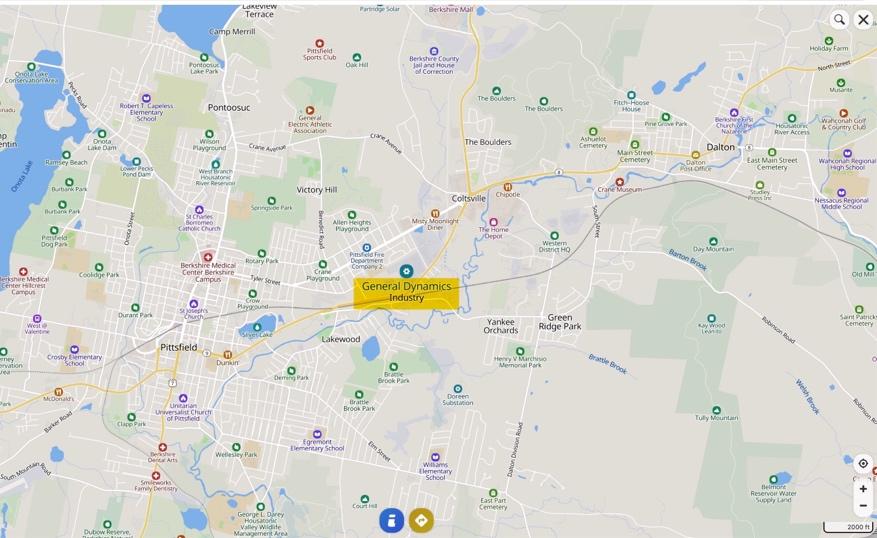
So I will put the question to you. What do you imagine would happen to the people of Pittsfield if the enemy decides to take out General Dynamics? If the enemy decides it is a legitimate military target? Do the people of Pittsfield even know what they do at General Dynamics? Do you know? Well, the folks looking for a defense job surely do.

What might happen to the students of the Robert T. Capeless Elementary School? To the students at the Crosby Elementary School? To those shopping at Home Depot or Stop & Shop, at Allendale? If the enemy decides they cannot afford to fight fair. If the enemy declares, “No Mercy!”
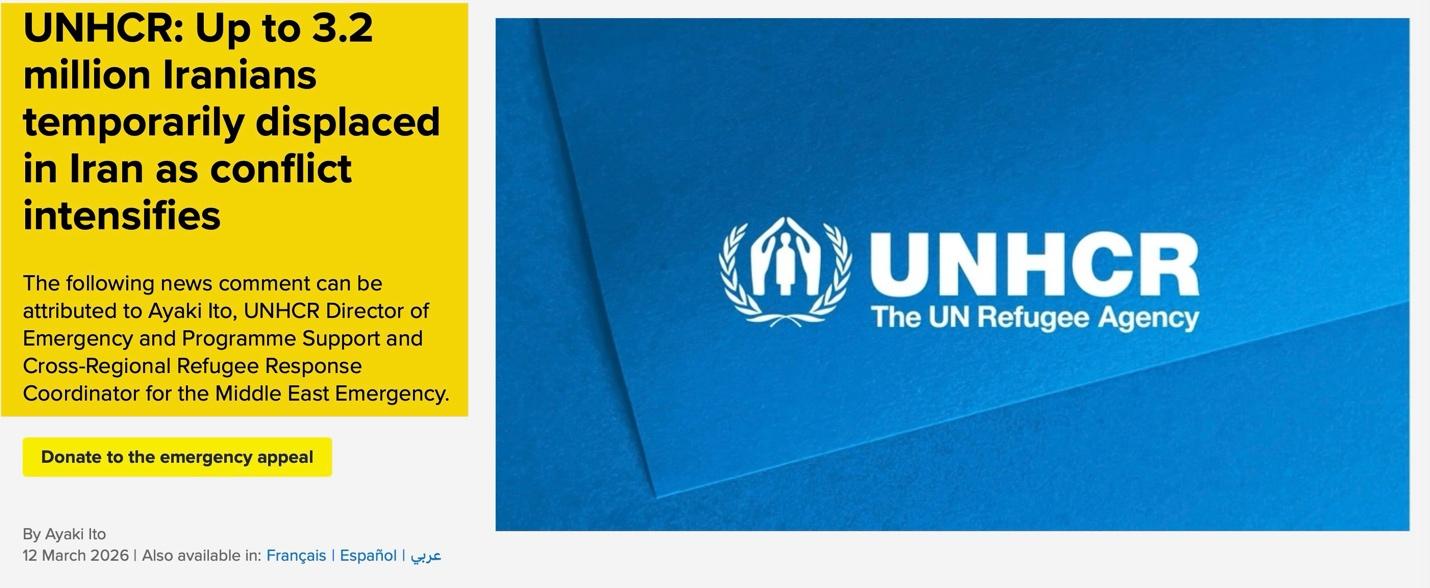
Pete Hegseth won’t tell you this, but the United Nations Commission on Refugees will:
Just maybe it is time for all of us to start adding up the costs of this war.