With parts one and two of “Sue Monsanto, save Lee,” I hope you have gotten a clearer picture of both the history and present status of our PCB problem.
For a moment, I want to go back to what turns out to be a very important year: 1970. The scientific reality that hydrocarbons like Aroclor were poisoning the global environment began to overwhelm Monsanto’s rhetoric, and environmental regulators were slowly beginning to take notice. Monsanto reached out to its customers in a coordinated attempt to maintain its profits and buy some time. Elmer Wheeler of Monsanto met with GE on January 21 and 22, 1970:
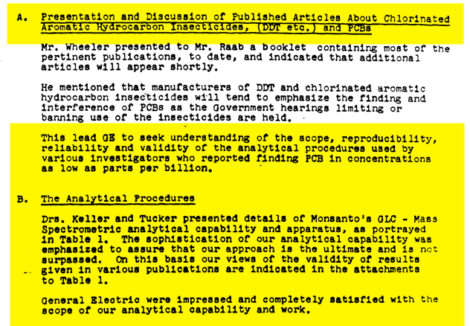
Monsanto states:
In essence results reported by Mr. Wheeler on chronic animal toxicity tests and animal reproducibility studies underway are not as favorable as we had hoped or anticipated. Particularly alarming is evidence of effect on hatchability and production of thin egg shells regards white leghorn chickens. The studies involved Aroclor 1242, 1254 and 1260. Some of the studies will be repeated to arrive at better conclusions. (Emphasis added.)
If these notes are accurate, and if GE was completely satisfied, it appears that Monsanto never fully shared with GE its knowledge of—and GE never fully appreciated—the reliability of several studies showing why its Aroclor (Pyranol) needed to be kept from leaving their factories, or the details of what actually happened with the PCBs that made it to the environment.
On February 18, 1970, Donald A. Olson, director of sales at the Monsanto Functional Fluids Group, wrote to other customers:
It is claimed that the PCBs found strongly resemble chlorinated biphenyls containing 54 [percent] and 60 [percent] chlorine by weight. Products which are sold by Monsanto under the trade names of Aroclor® 1254 and 1260 do contain chlorinated biphenyls … As your supplier of Aroclor® 1254 and 1260 and formulated products containing 1254, we wish to alert you to the potential problem of environmental contamination as referred to in the newspaper and magazine articles …
(See the referenced article below.)
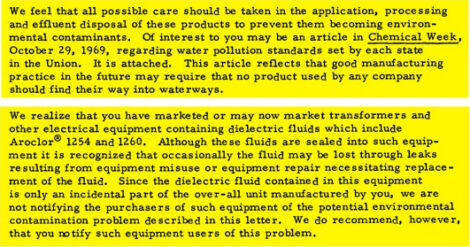
As always, Monsanto parsed its words and actual environmental contamination became potential. Here is Chemical Weekly’s 1969 listing of water quality standards for Massachusetts:
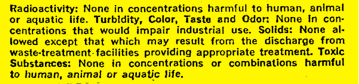
No toxic substances should be released in Massachusetts that would prove harmful to human, animal, or aquatic life.
Monsanto was trying to have it both ways: acknowledging the PCB problem to some while denying it to others. After all, almost all this guidance to be extra careful had been advocated by Dr. Schwartz in June 1936—then rigorously disregarded. That same day, Papageorge wrote Dr. Continelli at the Buffalo Children’s Hospital asserting that Monsanto had no knowledge of the harmful effects of their Aroclor:
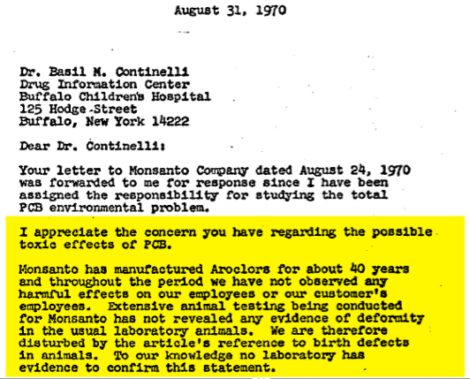
Meanwhile, the February 1971 “Conference in the Matter of Pollution of the Interstate Waters of Escambia River Basin” named the Monsanto Chemical Plant as the source for PCBs in Escambia:
Our first transect was about two miles above the Monsanto Plant and we found no Aroclor 1254 in the surface or bottom water sediments. At the Monsanto weir in Escambia River we found 0.4 of a part per billion in the surface water and 0.2 in the bottom water. Fifty yards below this point, 0.5 parts per billion on the surface and it was not detectable in the bottom.
The document continues:
… it does appear from these first samples that Aroclor is contained in sediments a little deeper than the surface … At zero to 2 inches from the surface we had 78.0 parts per million at the weir, 2 to 4 inches 30.0 parts per million, 4 to 6 inches, 6.1, and 6 to 8 inches 0.4.
MR. REED: Mr. Chairman, may I interrupt?
MR. WHITE: Yes, Mr. Reed.
MR. REED: Tom, this doesn’t sound like a short-term leak to me if we are getting stratification levels like this. This sounds like a long and continued discharge into the bay to build up. Admitted, these are preliminary figures, but this is not — this is a stratification that is deep. (Emphasis added.)
With Escambia, two realities became crystal clear: Monsanto’s Aroclors had made it to the waterway, and while levels appeared to be minimal in the water column, the PCBs had settled in the river sediment where they did significant damage. This was critical information and accurately described what was happening with PCBs in waterways throughout the nation, including the Housatonic. Yes, Monsanto was suggesting to customers that they take care not to let the Aroclors make their way to water. But what they didn’t make clear was that the Aroclors weren’t moving through the water column and out to sea—as most might have assumed—but were congregating in the sediments and bank soils where they contaminated the living things that came in contact with them.
It is also clear that, despite this now undeniable knowledge, Monsanto never did anything to take effective action to remediate this problem—a problem they had caused for decades and continue to cause as long as their toxic Aroclors remain present.
A revelatory 1972 interview with Elmer Wheeler provides insight into what was going on within Monsanto:
[W]e were told—that the material that the Swedes had identified was specifically polychlorinated biphenyl in probably March or April 1967 … Initially, we ignored the significance of the Swedish work. We just couldn’t believe that based on the uses of the Aroclor, based on the stability of it and based on the lack of solubility, that these things could conceivably begin to show up in the environment as did the chlorinated pesticides … Almost a year following April 1967 the British published information that tended to confirm the Swedish work—again, however, without being so specific in their analytical techniques that true identification was without question. I guess it was late February 1969 that the you-know-what hit the fan when Professor Risebrough out at Berkeley published his paper indicating that he had found PCB’s in birds and fish on the California coast …
Wheeler also talks about the new understanding that came with the 1968 acquisition and use of “a gas liquid and spectrophotometer … able to detect the presence of PCBs in all types of samples at low levels …”
Here is an excerpt from that interview:
INTERVIEWER: So, as I understand it, he took water, things of that sort, and then tested them to see if he could determine if PCBs were present in them?
WHEELER: Yes. And in order to do that, he deliberately contaminated them and then ran them through the instrument to see if his numbers matched the input …
INTERVIEWER: Did he do any analysis on material that he hadn’t contaminated deliberately with PCBs? …
WHEELER: … They did go out and get some soil samples around the plants, soil near the operation and so on.
INTERVIEWER: And did they find that these soils had PCBs in them?
WHEELER: Yes … [and] they were able to feel more confident of the numbers …
INTERVIEWER: Was he surprised that there were PCBs in the environment?
WHEELER: Oh, yes …
INTERVIEWER: So as I understand your answer, Dr. Keller’s surprise was with respect to the extent that the PCBs had migrated from the factories? …
WHEELER: That was one of the surprises.
INTERVIEWER: What other surprises did he have?
WHEELER: The other surprises, as you proceeded further from the plant, the composition of that PCB would change, indicating that something was affecting the lower chlorinated PCBs …
Wheeler described a 1969 pesticide symposium at Oregon State University:
[S]ome of Risebrough’s more vocal adherents were there … Real hippy types with long hair, clean but raggedy jeans, sandals or bare feet and any time Risebrough would take a crack at industry, they would applaud and of course the local TV and press were just swarming around these activists every opportunity they had …
The upshot of this meeting was that, on the evening of the first day, Marsh and I were having a drink before we went to dinner and Marsh said, ‘Elmer, these people are going to put Monsanto out of the PCB business’ and I said ‘I’m beginning to think you are right.’ Fancher had the same reaction. We came back from that meeting and sat down with … the people that were involved in what was going on in the PCB area at that time and out of that came a task force of 5 or 6 of us to put together the then current status of our knowledge about PCB’s and predictions as to the future. We issued a report which was intended to be a preliminary draft of the deliberations of that group. That was about October 15. It got fairly wide distribution and subsequently we got a call from one of Dick Stohr’s counterparts in the Law Department which said, ‘call back all of those reports and burn them.’ It was redistributed to some 12 people with the legend on the front ‘ATTORNEY CLIENT PRIVILEGE.’ This led to a review in November of the whole situation before the Corporate Management Committee which was the agency of the Board …
Yes, of course, burn all reference to the inconvenient reports or acknowledgment of what was really happening with Monsanto’s Aroclors. But Monsanto didn’t exactly have to worry yet about the EPA. The U.S. Interdepartmental Task Force on PCBs submitted its report “Polychlorinated Biphenyls and The Environment” in May 1972. It was clear U.S. regulatory agencies still didn’t fully appreciate what Monsanto knew. And it is evident they still hadn’t adequately done their own definitive tests or accurately extrapolated all the medical and scientific data available from the late 1930s on up. The EPA was still underestimating the severe risks that PCBs posed to human health and the environment:
PCBs should be restricted to essential or non-replaceable uses which involve minimal direct human exposure since they can have adverse effects on human health. There currently are no toxicological or ecological data available to indicate that the levels of PCBs currently known to be in the environment constitute a threat to human health, but additional experiments are underway to evaluate the impact of low level, long-term exposure to PCBs.
EPA then made a series of statements based as much on politics and economics as on environmental science: “PCBs have been used so widely over such a long period that they are ubiquitous. Even a total cessation of manufacturing and use of PCBs would not result in the rapid disappearance of the material, and ultimate disappearance from the environment will take many years … Prohibition of PCB discharges into water will result in the reduction of such residues …
The use of PCBs should not be banned entirely. Their continued use for transformers and capacitors in the near future is considered necessary because of the significantly increased risk of fire and explosion and the disruption of electrical service which would result from a ban on PCB use. Also, continued use of PCBs in transformers and capacitors presents a minimal risk of environmental contamination. The Monsanto Company, the sole domestic producer, has reported voluntarily eliminating its distribution of PCBs to all except manufacturers of electrical transformers and capacitors. (Emphasis added.)
Monsanto had made a fortune selling Aroclors everywhere they could, and yes, for the moment, they were still able to sell, but they knew they had to prepare for the day they couldn’t.
Several developments affected us in Berkshire County. As the world better understood the growing devastation of PCB contamination on the environment, corporate lawyers focused on issues of liability. As Monsanto contemplated withdrawing from the manufacture and sale of its Aroclors, GE still had a thriving business and still depended on Aroclor 1254. Monsanto decided to leverage that dependency. While GE had earlier refused Monsanto’s request to accept all liability, it now relented. An April 18, 1972 Monsanto document explains:
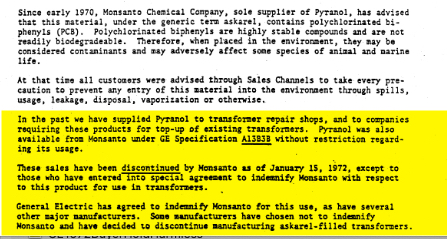
As Monsanto put it:
These sales have been discontinued by Monsanto as of January 15, 1972, except to those who have entered into special agreement to indemnify Monsanto with respect to this product in transformers … General Electric has agreed to indemnify Monsanto for this use …
Not surprisingly GE passed on the indemnification requirement to its customers:
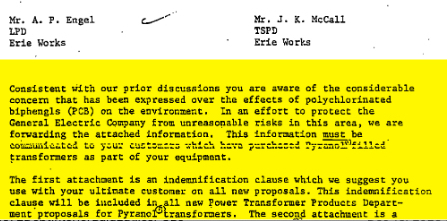
Having faced the liability issue, Monsanto now had to deal with the large quantity of PCB oil they had sold to others. And GE had to figure out a way to deal with the used PCB oil in transformers and capacitors it had previously sold but now needed repair. Monsanto built its incinerator in 1970:
This incinerator was designed, and was demonstrated, to destroy PCB wastes at 99.9998 percent efficiency. By September, 1971, this unit was in continuous operation and was destroying both waste from our production and PCBs returned by customers as they converted to non-PCB replacements. When phaseout from nonelectrical applications was complete, the incinerator was used to destroy waste PCB which was collected from ongoing dielectric use.
GE built Puff and burned its own Pittsfield Pyranol and Pyranol from other GE plants and then charged others to burn their PCB oil. According to a deposition with Monsanto’s Papageorge on April 27, 1999, by the middle of 1977, “the amount of material being returned had reduced to the point where it was perceived not to be needed any longer because there were commercial units available …”
In its “PCBs: A Report on Uses, Environmental and Health Effects and Disposal,” Monsanto offers itself the benefit of every doubt as it explains its last years in the PCB business:
At least as late as a 1975 press conference, the EPA reiterated it would not ask Monsanto to stop production because that would shut down the electrical power industry and the railroads in short order. The EPA objective was to find a way to proceed without shutting down the country. That was precisely the objective to which Monsanto had been committed since 1970 …
Because PCBs were reported in the environment and tests indicated they could accumulate in the food chain, Monsanto voluntarily decided to terminate sales of chlorinated biphenyls to open applications — those which could result in losses to the environment. Plasticizer and carbonless paper applications fell into this category … High operating pressures cause hydraulic systems to leak. Monsanto therefore alerted users to manage wastes to eliminate PCB discharge to the environment. As new hydraulic fluids were developed in 1971, we terminated sales of those containing PCBs …
Although a variety of effects of PCBs has been postulated from research of widely varying quality, there is no evidence of environmental levels of PCBs being a major human health hazard. However, it became apparent that the public perceived risks associated with continued PCB dielectric use and preferred to forego its undoubted functional benefits. Therefore, in October of 1976, we advised dielectric customers that it was our intent, consistent with their progress with substitute products, to terminate chlorinated biphenyl production and sale by October, 1977 … Monsanto’s decision to withdraw from the PCB business was based on concerns about environmental presence rather than health effects … (Emphasis added.)
Monsanto, all those years ago, seemed to have come to the conclusion that Mother Earth couldn’t sue them, that the shrimp, oysters and eagles wouldn’t ever be able to hold the company accountable. I am, I must remind you, a journalist and a story-teller, not an attorney, but I wonder if an indemnification agreement signed by a party ignorant of all the relevant facts still prevails. Or might GE have a case that Monsanto hadn’t been completely forthcoming about what it had learned at Escambia, about what would happen if/when its Aroclors had left GE’s factories and made it to the Hudson and Housatonic Rivers. Would GE have agreed to indemnification if it had known Monsanto’s Aroclors could move through the water column then gather in the bank soils and river sediments and with modest amounts poison fish, mink, eagles and ducks?
Years after it had signed the indemnification agreement, GE had its own Escambia moment. EPA wrote:
In December 1996, EPA issued a Unilateral Administrative Order under the Superfund law to GE to remove highly contaminated sediment and bank soil in the area adjacent to GE’s Building 68, which is on the banks of the River in the Upper ½ Mile Reach … in 1997 and 1998 GE excavated and disposed of 5,000 cubic yards of heavily contaminated sediment (average PCB concentration of approximately 1,534 parts per million, or ‘ppm’) from a 550-foot section of the river and 2,230 cubic yards of heavily contaminated bank soil (average concentration of surficial soil of 720 ppm and average concentration of subsurface soil of 5,896 ppm) from a 170-foot stretch of the river bank.
At Escambia, researchers found contamination levels of 78.0 parts per million. Here in Pittsfield, the Building 68 site had average levels of 1,534 ppm.
Having sat across from and engaged with some of them, I know how very talented GE’s attorneys are. Perhaps because it was Monsanto’s Aroclors that settled in the sediments and bank soils, they might argue that Monsanto reimburse GE for some of the many hundreds of millions of dollars the company has already spent remediating the first two miles of the Housatonic and for what the EPA estimates will be $576 million to clean up the next installment of 1.13 million cubic yards of contaminated soil and sediment from the Rest of River. Couldn’t GE divert some of that money to underwrite the costs of shipping Housatonic River PCBs out of state?
As for us, the ordinary citizens of Berkshire County, there is a growing understanding of PCB exposure. As the World Health Organizations’ 2016 “Assessment of Polychlorinated Biphenyls and Polybrominated Biphenyls” explains:
The reason that PCB and PBB mixtures in the environment today differ from the original commercial products is that after release into the environment, the congener composition changes through partitioning, chemical transformation, and bioaccumulation. Partitioning refers to processes by which different congeners separate into air, water, sediment, and soil. Some congeners tend to volatilize or disperse as aerosols, providing an effective vehicle for long-range transport. Congeners with low chlorine or bromine content tend to be more volatile, and also somewhat soluble in water. (Emphasis added.)
And, in fact, previous epidemiological studies of PCB exposure focused on workers “exposed to the ‘fresh’ product, by inhalation or dermal contact, while studies in the general population assessed individuals exposed primarily through intake of contaminated food, for which the exposure profile is difficult to assess.” But as time went on, we have learned so much more about bioaccumulation and volatilization.
Today, and this is particularly relevant to those living near the Housatonic River and other PCB-contaminated waterways in the Commonwealth, “exposure is to complex mixtures originating from commercial products that have been altered by environmental processes (i.e. weathering, transport, and bioaccumulation).”
And WHO notes: “Harrad et al. (2006) have suggested that inhalation may account for 4-63 [percent] (median, 15 [percent]) of overall exposure in humans.” (Emphasis added.)
Dr. David Carpenter of the Institute for Health and the Environment at the University of Albany was an invited specialist consultant for the WHO Assessment and testified as well for the plaintiffs in the Monsanto Anniston, Ala. cases. Dr. Carpenter’s recent research has focused on the volatilization of PCBs and the marked increase in disease shown in those who live near PCB-contaminated waterways like the Hudson River and toxic-waste sites.
Dr. Carpenter has demonstrated how exposure to PCBs has affected members of the Mohawk Akwesasne Nation in New York State:
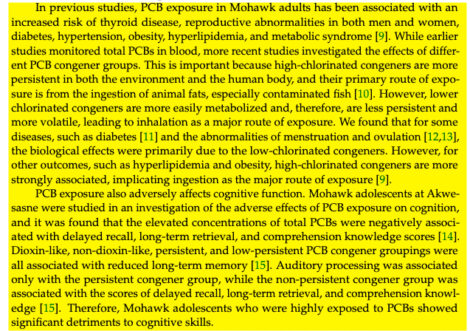
Remember Monsanto’s surprise in the late 1960s when their newly sophisticated testing regimes revealed that “the composition of that PCB would change, indicating that something was affecting the lower chlorinated PCBs.”
Here is another study written by Dr. Carpenter and his colleagues: “Exocrine pancreatic cancer and living near to waste sites containing hazardous organic chemicals, New York State, USA – an 18-year population-based study.” And here is a selection where Dr. David Carpenter highlights the health risks of volatilization and its impact on cancer, heart disease, hypertension, and diabetes:
[T]hese studies provide support for the conclusion that inhalation of PCBs is the major cause of the elevated rates of hospitalization. The implications of these studies are significant for several reasons. First, these results suggest that living near a PCB-contaminated waste site poses risk to health, and by extrapolation this applies also to attending a school with elevated PCBs in the air … (Emphasis added.)
Close to home, Dr. Carpenter and his team conducted indoor air testing coupled with PCB blood testing in Pittsfield:
Pittsfield still has large landfills with PCBs, and air, soil and water still contain high concentrations of PCBs. While most monitoring of PCBs levels in environmental and human samples have focused on the more persistent congeners, our group has increasingly become concerned about vapor phase PCBs and with inhalation of PCBs as being a significant route of exposure. While many of the more volatile congeners are not persistent in the human body, if PCBs are present in air, especially indoor air, the exposure will be continuous and may pose health hazards that are not adequately identified by measurement of more persistent congeners in blood. (Emphasis added.)
Most Berkshire residents are unaware that they and their families may very well have paid—and continue to pay—a price in increased illness for Monsanto’s and GE’s repeated unwillingness to adequately warn not only the workers but those who live close to the GE complex and the Housatonic River itself of the dangers of exposure to Aroclors.
Let’s revisit the troubling results of the 1997 Housatonic River Area PCB Exposure Assessment Study conducted by the Massachusetts Department of Public Health. A quick note: While PCB levels in fish tissue and river sediments are often measured in parts per million (ppm), PCB levels in human blood is measured in parts per billion (ppb).
Sixty-nine of 1,529 participants agreed to blood testing.
Total serum PCBs, which were classified as Aroclor 1260, ranged from non-detectable to 35.81 ppb, with a mean of 5.44 ppb and a median of 3.93 ppb … In addition, residents who were not chosen for the study but who were concerned about exposure to PCBs were offered the opportunity to volunteer to participate in a separate effort …
The mean PCB blood level for Pittsfield adults aged 18 to 64 was 4.22 ppb, and for those older than 65, it was 10.56 ppb. The mean PCB blood levels for those aged 18 to 64 living nearby the Housatonic was 3.56 ppb, and for those 65 and older, it was 5.78 ppb.
MDPH stated:
The serum PCB levels found among participants of both studies were generally within typical background estimates for a non-occupationally exposed U.S. population. ATSDR reports that, for U.S. populations without occupational exposure, mean serum PCB levels were usually between 4 and 8 ppb, with 95 [percent] of the individuals having concentrations less than 20 ppb. Since the results of this study represented individuals with the highest risk of exposure, it is reasonable to assume that serum PCB levels of most non-occupationally exposed residents in the HRA communities are within the US background range, though individual differences may likely occur. (Page 2, emphasis added.)
But, in fact, MDPH misstated the national background level for serum PCBs. Soon after the report, James Cogliano, former chief of the EPA’s Quantitative Risk Methods Group, told a Pittsfield audience that the accurate figure for the national background level of PCBs in the blood was actually 0.9 to 1.5 ppb. So, in fact, those 18 to 64 years old in Pittsfield had more than three to four times the national background level of PCBs in their blood, while those in Pittsfield 65 and older had more like seven to 10 times the levels of PCBs in their blood. So, contrary to what MDPH and GE were telling them, there were many reasons to be concerned.
This inaccuracy has provided false comfort for too many. And GE took immediate advantage, publishing a series of full-page ads in The Berkshire Eagle, including this patently false assertion by GE CEO Jack Welch that there was absolutely no reason to be concerned about PCBs.
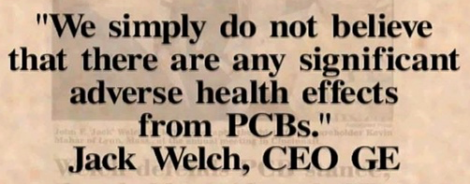
On May 1, 2006, all 11 practicing pediatricians in Pittsfield wrote a letter to Mayor Ruberto stating:
Recently, a Berkshire Eagle article (dated Tuesday, April 25) declared the Allendale School ‘safe’ from PCBs … While it is true that the most likely way to become exposed to PCBs is through our food supply (and that probably holds true even for those of us who live next to a PCB contaminated site), those who live or go to school next to a PCB hazardous waste site face an additional threat from airborne PCBs. This may occur from breathing PCBs, both in the form of suspended particles in the air (dust) and as an invisible vapor (volatilized).
Average ‘background’ PCB air levels in uncontaminated regions are about 1 nanogram/m3. A number of PCB air levels measured at GE’s On Plant Consolidation Areas have been substantially higher than that. The EPA claims that PCB air levels less than 50 nanograms/m3 (that is 50 times higher than background) do not expose children to excessive health risk. We do not share their comfort level. We feel that the EPA’s risk assessments are based on limited data. This data does not consider the latent health effects of endocrine disruption nor the fact that children will be exposed to additional PCBs through their food. In addition, no safe PCB exposure level has yet been determined for children … (Emphasis added.)
As for “Sue Monsanto,” the issue of volatilization came to a head in November 2023:
Three schoolteachers in Washington state who sued the chemical company Monsanto over exposure to materials in fluorescent lights have been awarded $185m … The teachers, who worked at the Sky Valley education center in Monroe, Washington, said they suffered brain damage from exposure to polychlorinated biphenyls, or PCBs, in the fluorescent lighting at the school. ‘This is a big step in holding Monsanto accountable,’ the teachers’ attorney, Rick Friedman, said in a statement.
Law firm Friedman Rubin wrote:
… the Washington State jury found Pharmacia LLC liable for selling polychlorinated biphenyls (PCBs) without providing adequate warnings, resulting in neurological injuries, endocrine disruption and cognitive impairment to the plaintiffs, which included five teachers, a librarian and a custodian. All seven plaintiffs recovered damages including two of the teachers who developed rare cancers … The verdict comes after nearly two months of trial and two weeks of deliberations. Of the $165 million verdict, $49.8 million is for compensatory damages, while $115.3 million is for punitive damages.
They noted that in July “Friedman Rubin and PCVA were instrumental in securing a $72 million verdict on behalf of another set of former Sky Valley employees who also sustained life-long injuries from PCB exposure at the school.”
According to Courtroom View Network:
The teachers blamed their health problems, which include severe fatigue and cognitive difficulties, on exposure to PCBs from 2011 to 2015. They claim Monsanto, the sole company to manufacture PCBs, did so despite knowing they posed a risk to the public prior to being banned in the 1970’s [sic].
As for other successful legal actions against Monsanto, the state of Washington filed a complaint in 2016 alleging that there was a long list “of water bodies within the state of Washington that are contaminated with Monsanto’s PCBs, as measured in fish tissue or sediment PCBs in the environment.”
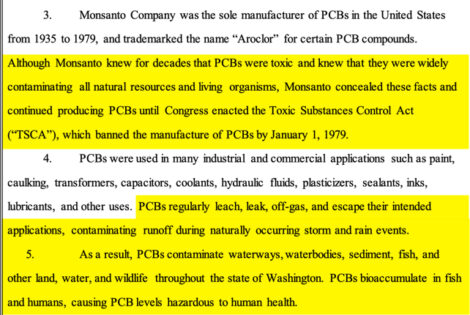
The complaint continued to list the many waterways, large and small, whose fish and river sediment are now contaminated by Monsanto’s PCBs.
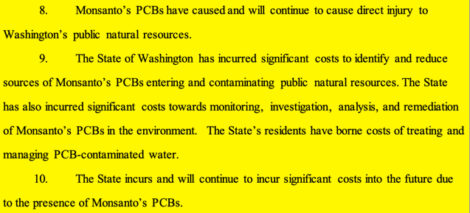
The following claims of Washington are particularly relevant to the contamination of the Housatonic River, along with the extensive lands owned by the Commonwealth, including the 874 acres of the George Darey Housatonic Valley Wildlife Management Area that borders the Housatonic, and our interests in protecting the Housatonic ACEC:
16. Monsanto’s PCB contamination constitutes injury to the State’s public natural resources and to other property and waters of the State, for which the State seeks damages, including on behalf of itself and on behalf of its residents in its parens patriae capacity.
17. The State has a quasi-sovereign interest in and trustee obligation to protect the State’s public natural resources, including lands, aquatic lands, waters, wildlife, fish, and other natural resources.
18. The State has a proprietary interest in protecting all property owned by the State and has an interest in remediating the contamination of its exclusive property and in preventing future contamination …
20. Injury to public natural resources caused by Monsanto’s PCBs has resulted in loss of public use and enjoyment of those resources. The economic value of these natural resources, as well as the cost of restoring them, is substantial.
Washington explains: “The State brings this suit pursuant to RCW 7.48.010, et seq. and any other applicable codes or forms of relief available for monetary damages and removal of the public nuisance caused by Monsanto’s PCBs.”
Washington also makes clear that as “trustee of certain public natural resources, including certain lands, aquatic lands, wildlife, and state waters within state boundaries including but not limited to 3 million acres of state trust lands and 2.6 million acres of state-owned aquatic lands in public trust,” they have “standing to bring this lawsuit as trustee of all aforementioned public natural resources.”
As the state of Washington maintained, so too is our Commonwealth’s property contaminated by Monsanto’s PCBs and located throughout the state, including in Berkshire County. And yes, Monsanto’s products containing PCBs were sold and used in Berkshire County.
Utilizing some of the internal memos I have referred to previously, the state of Washington asserted that Monsanto’s interest was not in adequately addressing the ramifications of its careless distribution of PCBs but in maintaining the market they had come to rely upon. On June 24, 2020, the state of Washington announced that they had won a judgment of $95 million dollars.
In January 2018, the state of Oregon sued Monsanto for damages related to PCB contamination of Oregon’s land, waters, fish, and wildlife. They stated:
Between 1929 and 1977, Monsanto was the only company in the United States to manufacture PCBs for widespread commercial use. Monsanto distributed PCBs widely, including throughout Oregon, for use in a broad array of products ranging from electrical equipment to lighting ballasts, from paint to caulking.
Oregon Attorney General Ellen Rosenblum won “a historic $698 million dollar settlement with the Monsanto Company (Monsanto) for their role in polluting Oregon with PCBs (polychlorinated biphenyls) for the past 90 + years …” The statement on the Oregon Department of Justice’s website reads:
‘This is a huge win for our state,’ said AG Rosenblum. ‘PCBs are still present throughout Oregon — especially in our landfills and riverbeds — and they are exceedingly difficult to remove, because they ‘bioaccumulate’ in fish and wildlife.
You can read the Consent Judgment here.
Pennsylvania filed suit in December 30, 2021 claiming:
Despite that Monsanto knew early on of dangers associated with PCBs, and/or knew or should have known that PCBs ‘substantially persist in the natural environment rather than break down over time’; … that they ‘would inevitably volatilize and leach, leak, and escape their intended applications, contaminating runoff during naturally occurring storm and rain events and entering groundwater, waterways, waterbodies, and other waters, sediment, soils, and plants, as well as fish and other wildlife’; and ‘that PCBs bio-accumulate and bio-magnify in animal tissue, including in fish tissue and human tissue, and [pose] an increasingly hazardous threat to the health of the Commonwealth’s residents … Monsanto nevertheless continued to market and sell its products containing PCBs …’
As the Pennsylvania Pressroom reports:
The Shapiro Administration has secured $100 million through a consent agreement with the Monsanto Company, Solutia INC., and Pharmacia LLC to resolve claims related to their production of products containing polychlorinated biphenyls (PCBs), which damaged waterways and other natural resources across Pennsylvania …
In Virginia, on September 12, 2023, WRIC-TV reported, “Attorney General Miyares has announced an $80 million settlement with Monsanto …”
On June 16, 2023, the state of Vermont sued Monsanto, with the legal help of Attorney Matthew Pawa, who represented our Rest of River Committee and managed to give the U.S. Court of Appeals for the First Circuit quite the false impression that the citizens of Lee still supported the confidential agreement he negotiated. Having worked hard to deny the Housatonic River Initiative’s desire for a more extensive cleanup and to pressure GE and the EPA to opt for transporting PCB-contaminated waste off site rather than burden Lee with a massive PCB dump, Pawa now seems to be as interested in helping Vermont as he was in thwarting Lee.
Vermont’s suit claims:
All ten sections of Lake Champlain and the entire 7-mile reach of the Hoosic River is considered impaired for PCBs on Vermont’s most current 303(d) Impaired Waters List. Because of this, Vermont has a fish consumption advisory for all of Lake Champlain and the Hoosic River. The accumulation of PCBs in natural resources, and fish in particular, poses a public health threat to the citizens of Vermont …
Monsanto never advised the State or the public that Old Monsanto’s PCB mixtures or products would inevitably leach, leak, off-gas, emit, discharge, and release PCBs from their ordinary and intended applications and from disposal sites, regardless of the nature of the application, to contaminate Vermont’s waters, sediments, soils, lands, air, fish, and wildlife. Monsanto issued no public warning or instruction about such issues or the health and environmental hazards presented and, indeed, as alleged above, denied that such hazards exist in their communications with public entities and the public more generally …
Causes of Action – Count 1 – Public Nuisance: Defendants or their predecessors intentionally designed, manufactured, distributed, marketed, and sold PCBs and PCB-containing products with the knowledge that they inevitably and foreseeably caused or created environmental contamination, indoor air contamination, property damage, and unreasonable health risks when used as intended …
Defendants’ or their predecessors’ conduct causes and continues to cause harm to Plaintiff. Plaintiff has suffered and will continue to suffer damage from Defendants’ PCBs and PCB-containing products. This harm is severe and greater than Plaintiff should be required to bear without compensation …
Defendants are under a continuing duty to act to correct and remediate the injuries their conduct, or that of their predecessors, has introduced, and to warn Plaintiff and the public about the human health risks posed by their PCBs and PCB-containing products, and each day on which they fail to do so constitutes a new injury to Plaintiff …
As I reviewed these lawsuits, I began thinking of our attorney general. And, as the front page of the Massachusetts attorney general’s website reminds us:
Attorney General Andrea Joy Campbell’s Office is an advocate and resource for the people of Massachusetts in many ways, including protecting consumers, combating fraud and corruption, investigating and prosecuting crime, and protecting the environment, workers, and civil rights.
The citizens of Berkshire County have suffered for decades from the irresponsible misuse of PCBs. These PCBs were manufactured by Monsanto and then irresponsibly used by GE. Monsanto and GE lied about the ongoing threats to public health and the environment posed by their toxic Aroclors. Clearly, both GE and Monsanto share responsibility for our PCB contamination.
Meanwhile, many citizens of Berkshire County regard the revised CERCLA order as insufficient. GE will save $200 million in transportation costs with the decision to force Lee to host the UDF, a massive PCB landfill. Now, in addition to the ongoing public nuisance posed by the continuing dislocation of the proposed remediation, and with constant volatilization of the remaining PCBs, we will all suffer again because of GE’s insistence on transporting PCB-contaminated soils and sediments through our towns and city streets by truck to the UDF. These realities will continue to present a continuing and imminent danger to our health. A continuing public nuisance, an environmental trespass.
While many of us in Berkshire County might not have fully appreciated the price we were paying all the years GE was misusing Monsanto’s Aroclors, we know now, thanks to studies by Dr. David Carpenter, that we suffer and will suffer from a continuing imminent danger.
Is it too much to imagine that the attorney general—taking into account all we have learned about the continuing public health threat of PCBs from the Housatonic—will act on our behalf.
Is it too much to imagine that the attorney general will act to enforce the following provision of Mass Law Chapter 21E and its provision, Section 142A, Pollution or contamination of atmosphere; prevention; regulations; violation; enforcement:
“Whoever violates any such regulation or any permit or plan approval or order issued thereunder: (a) shall be punished for each violation by a fine of not more than twenty-five thousand dollars, or by imprisonment for not more than one year, or both such fine and imprisonment; or (b) shall be subject to a civil penalty of not more than twenty-five thousand dollars for each violation. Each day or part thereof that such violation occurs or continues shall be a separate violation. The civil penalty may be assessed in an action brought on behalf of the commonwealth in the superior court. The commonwealth may also bring an action for injunctive relief in the superior court for any such violation, and the superior court shall have jurisdiction to enjoin such violation and to grant such further relief as it may deem appropriate.
Certainly, the residents of Lee will suffer the greatest nuisance as a result of Monsanto’s negligence as their property values decline at the very same time their public health is threatened more than most.
I have attended dozens and dozens of public meetings beginning in the early 1980s with the Massachusetts Department of Environmental Quality Engineering (DEQE), then its successor agency, the Massachusetts Departmental of Environmental Protection (DEP), and, of course, the EPA, and I have never heard them address Monsanto’s significant responsibility. These agencies spent decades negotiating with GE but not Monsanto. And while GE is removing a portion of the PCBs that contaminated the Housatonic River, too many will remain. As GE acts to fulfill its obligation to the agencies, and dredging commences, Monsanto’s Aroclors will be moving through our river system finding new places to settle. And as Monsanto discovered in 1970, the Aroclors will be changing and continuing to volatilize.
I have read too many words, written too many. For me, there is always the reality of a poisoned Rising Pond, but the enduring dream of a fishable, swimmable river.
Isn’t it time for Massachusetts Attorney General Andrea Joy Campbell and her staff of fine lawyers to follow the lead of other states? Isn’t it time for the Commonwealth to Sue Monsanto and Save Lee?