PITTSFIELD — On August 5, 1850, writers Nathaniel Hawthorne and Herman Melville met at a picnic with friends upon the slope of Monument Mountain. There, the pair purportedly took shelter beneath a rocky ledge during a passing thunderstorm; two days later Melville — holed up at his late uncle’s estate in Pittsfield, penning one whale of a tale — visited Hawthorne at his diminutive red farmhouse in Lenox. Hawthorne, basking in the success of “The Scarlet Letter,” was seeking respite from Salem, with his wife and toddler in tow. The serendipitous mountain meeting has been deemed the starting point of one of the most talked of friendships in literary history — or so America’s white, heteronormative history would suggest.
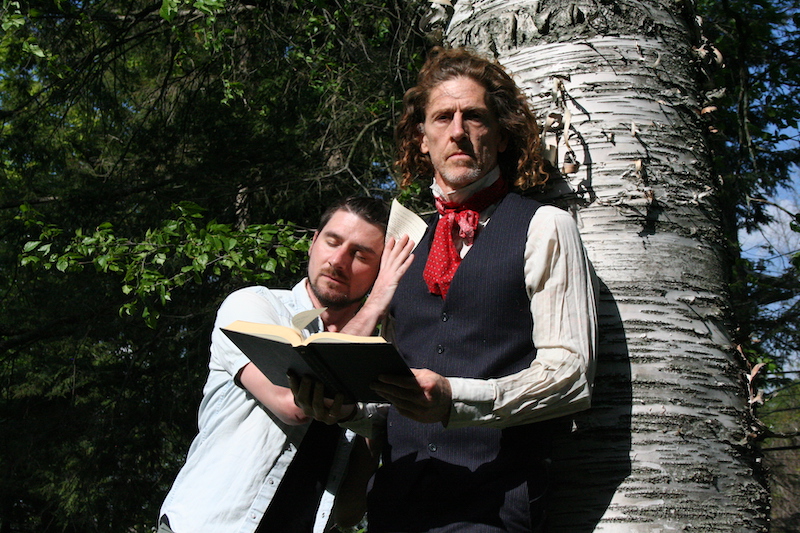
“ReWritten: A Love Story Lost,” conceived by Tom Truss and co-created and performed with Matthew Cumbie, explores queerness, creative process, and LGBTQ+ histories through the often-silenced and overlooked intimate relationship between the two American authors. The production — based on the lives, work, and (partially) still-existing correspondence between Hawthorne and Melville — uses movement, music, visual art, projection, text, and community engagement to reimagine an intergenerational queer love story that shaped American literature. The production, in residence at Housatonic’s Berkshire Pulse for the past two years, is being staged at Arrowhead August 13–15 at 7 p.m.
“It’s unusual, as there are about 1,800 of Hawthorne’s letters in a library somewhere … Harvard, to be exact,” Truss told The Edge, in a nod to correspondence from Hawthorne to Melville that has vanished; only the letters from Melville to Hawthorne remain. Hawthorne’s wife ultimately tore out pages from her husband’s journals, and crossed other portions out, lest they be discovered. This gave rise to multiple theories as to the whereabouts of the letters.
“We have absolutely no idea what actually happened,” said Rudy Ramirez, director of “ReWritten,” save for the fact that, “something happened between [Hawthorne and Melville] that affected them profoundly, and changed their art forever afterwards.”

The day the two writers visited in Lenox, Hawthorne put pen to paper, telling a friend: “I met Melville, the other day, and liked him so much that I have asked him to spend a few days with me before leaving these parts.” Afterwards commenced the writers’ written correspondence, serving to lessen the gap between them — a scant six miles in total — that persisted for 18 months during the most prolific period in their respective careers.
Paper was expensive, and unavailable to most in the 1800s. “It was a big deal to write a letter; it was a big deal to receive a letter,” said Truss. Twelve letters from Melville to Hawthorne remain. “The sheer fact that [these two] were in a letter-writing relationship was really interesting,” said Cumbie, citing the fact Hawthorne was 15 years Melville’s senior and they were at very different points in their careers (the latter having experienced what Cumbie calls “light fandom” while Hawthorne had just written one of the first mass-produced books in America).
Pointing to what he calls “the openness of possibility,” Ramirez reminds us that “this relationship took place in the years before homosexuality or heterosexuality were terms,” underscoring that any sexual relationship between Melville and Hawthorne would have been deemed “sodomy, [simply] an action” rather than who one was. “In so many ways, we are starting to return to a time of a lot more gender fluidity, a lot more fluid sexuality,” Ramirez continued, a movement stemming from those who refuse to define themselves too strictly. This, of course, begs an open-ended question, posed here by Ramirez: “What are the ways we can inscribe our own ideas, and our own history, onto that space of possibility — [while asking], what do those inscriptions do for us?”
Roma Flowers, projection designer, is presently reading Hawthorne’s “Twice-Told Tales.” “I’m going through [his] take on moral hypocrisy,” she explained, citing the fact that Hawthorne’s letters were destroyed, but that he wrote them in the first place. “That he wrote about [his relationship with Melville] is interesting to me,” Flowers said, drawing an ironic connection to the creator of Hester Prynne, who, once deemed an adulteress, is forced to pin a scarlet “A” to her gown (while Dimmesdale remains free from public scrutiny).
This, of course, begs another question: Was this simply a time of worrying how one was perceived by society? “No doubt it was,” said Flowers, adding, “still, in some way, [Hawthorne] participated.”
The performance tour at Arrowhead provides a fitting platform to further the conversation that inspired Cumbie and Truss to create “ReWritten” — namely, to explore what it means to be in a relationship and the understanding we gain of ourselves when we engage in this journey.
“As an artist, so much of the work I am interested in doing is centering queer stories, queer narratives, queer history, and for me, the gap we are looking at — these missing letters that hold such gravity in terms of what this relationship was and could have been — is also an opportunity, in some ways, to re-write our understanding of these relationships,” said Cumbie, who plays Melville opposite Truss’ Hawthorne.
What the pair of artists attempts is to bring audiences into a contextual understanding of what might have occurred by allowing them to go “on an actual, physical journey around the Arrowhead grounds,” Cumbie said of the far-from-ordinary production. “ReWritten” takes place in three “acts,” the first of which introduces the audience to Melville and Hawthorne.
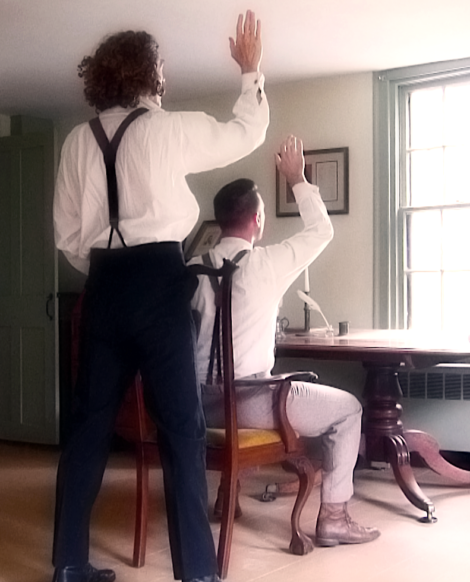
“We see their inspiration, how they affected one another, we see the tug-of-war between them, the possible falling in love, we hear a letter, and then there is a separation,” Truss said. The second act presents the audience with a choice: to find out what happened to Hawthorne, or Melville, but not both. On the “tour,” there is a solo piece; a group piece from community dancers (about the women in Hawthorne and Melville’s world, and their ultimate subjugation); and a film that elucidates Melville’s perspective of Hawthorne, and vice versa. The final act is the re-written portion: “It is much more blurry,” said Truss, who points to a conversation between the actors, and the authors, parts of which are largely gray — Cumbie and Truss slip back and forth into character, at times imperceptibly.
When the audience and artists are reunited, there’s a chance for Cumbie and Truss to offer their own interpretations of what could have happened — which, beyond conjecture, is imperative “for our understanding of queer histories, [and] this American literary canon that we have come to study and think about in school,” said Cumbie. “I know it would have changed my own understanding of [these authors’ works], and my relationship to learning, had I been given a chance to learn about this [history] as a young queer person.”

“ReWritten” is both timely and evergreen. Truss points to the mission of the Berkshire Historical Society, particularly at Arrowhead, part of which “is to reimagine the works of Melville and to look at them in a new way.” To do so, one must consider a new perspective.
“The power of the stories that we create for ourselves, and the power of the stories we tell ourselves, [allows us to] see ourselves and know ourselves more fully,” Cumbie said. “We’ve inherited these ways of thinking about Hawthorne and Melville and, largely, we’ve been told: this is what history is. I think history-telling and history-making are creative acts; at some point decisions are being made about what to omit and what to include, so it is a form of storytelling. It is not pure fact, even though that is what we are told to understand it as.”
No doubt, not everyone sees themself fully in the pages of “Moby-Dick” or other Melville works. “But we have this opportunity to re-write, and tell ourselves a different story, that does include us, that opens up new possibilities and new ways of being with one another,” Cumbie said.
It all boils down to a love story, and who among us can’t relate to that? “Hawthorne was scared to step into it; he’s the one who said ‘no’ to a dream,” Truss said. Melville, on the other hand, was rather nonplussed, and went on to dedicate “Moby-Dick,” published in 1851, to Hawthorne, “in token of my admiration for his genius.”
The irony of bringing this relationship to life, in the very space it was hidden, is not lost on the artists. For some time, they have been rehearsing in the studio at Arrowhead, where Melville wrote “Moby–Dick” (and where Hawthorne had his own private bedroom adjacent) all while tours of the historic property are taking place.
“Spaces [such as Arrowhead] can become codified into this particularly straight, white history of the United States,” Ramirez said. “There is something very beautiful about being able to stage this queer intimacy, through dance, in this space.
“This is not something new, that arrived in the 20th century one day,” Ramirez said of the themes explored in “ReWritten.” “We are really grateful to Arrowhead for making this space and assisting with these parts of Melville’s history that should not be torn out of journals, that should not be burned for the sake of a reputation.”
For tickets, click here or call 413-442-1793.