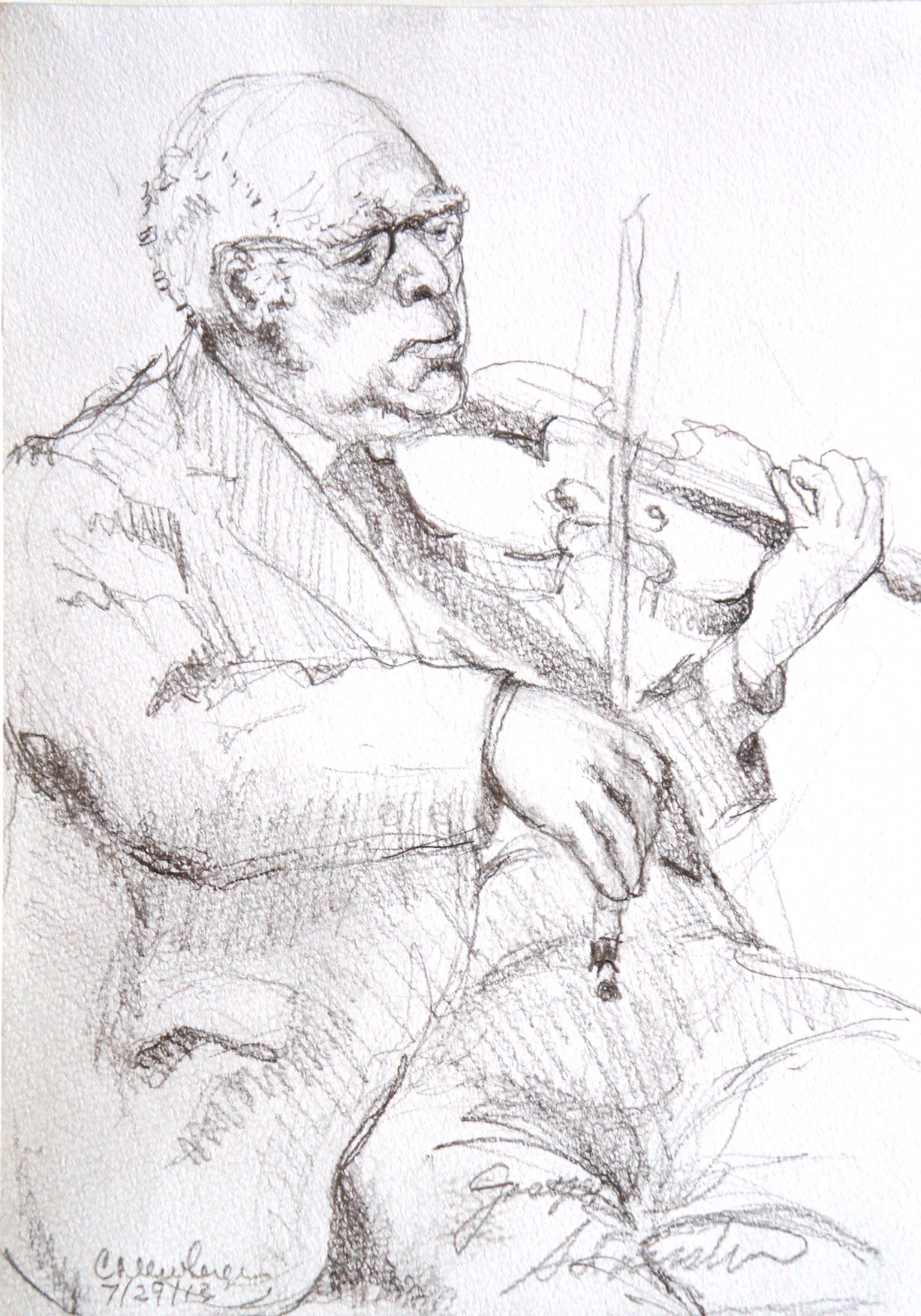
The legendary Boston Symphony concertmaster and conductor, Joseph Silverstein, who died unexpectedly on November 21 (read obituary here), was an uncommonly warm and unprepossessing man. Although I had admired his magnificent playing and leadership as concertmaster of the Boston Symphony Orchestra from the audience at Symphony Hall since arriving in Boston in 1969, it was only after Carolyn and I began to attend concerts in the Berkshires a decade ago that we met, unexpectedly, in the fourth row of the South Mountain chamber music concert hall in Pittsfield.
In the course of a string quartet with extensive and rich contrapuntal development, I heard an unexpected sourness. As I nudged Carolyn, on my left, who shared my quizzical expression at the apparent lapse of intonation, I saw out the corner of my eye, the woman on my right giving her male companion a reciprocal look. At the intermission, I turned to them and asked if they’d also noticed the problem in tuning. “No,” said the man, “that wasn’t a tuning problem. It was horizontal intonation.”
“Horizontal intonation?” I asked, “What’s that?” Patiently, he explained, that choices need to be made in playing lines of counterpoint, and priority typically goes to sustaining the integrity of each particular line. Inevitably, from time to time, as chamber music performers always regulate the forward arc of the notated lines, there come seeming collisions with other lines. For example, he noted, as you’re playing the last two notes of a scale, it’s usual to play the seventh note slightly sharp. This leans in to the tonic at the top. What’s more, he added, these were highly accomplished players who knew exactly what they were doing. Take it, he suggested, as another example of fine musical expression, rather than to criticize it as an error.
In response to my comment, “You must be an experienced musician,” he extended his hand, and replied, “I’m Joey Silverstein, and this is my wife, Adrienne,” with the same gracious warmth in which he couched his explanation.
Every fall when I attend the South Mountain concerts, I recall this lesson, and thank Joey for the insight. I also pause, and think of him, when I read critics’ assertions about intonation problems in chamber music concerts. (There were no few such in this last season.) That this lesson was given with such caring and kindness toward a total stranger by one of the most accomplished leaders of classical music was, for me, both a lesson in life as well as an important tool better to appreciate the interior world of chamber music.
Some six months later, during the following Spring, the advisory committee of the intensive, after-school children’s music program to which Carolyn and I are devoted, “Kids 4 Harmony,” was considering putting on a benefit concert to sustain the program. One of our members, the cellist, Ronald Feldman, also a Boston Symphony alumnus, conductor and professor, offered to ask Joseph Silverstein if together they might organize a quartet of leading players to perform, and, as well, to participate in a symposium on how music benefits children. Afterward, we thought the children themselves could perform. At this time, most of them had been playing fewer than two years.
The Kids 4 Harmony program, sponsored by Berkshire Children and Families and based at the Morningside School in Pittsfield, has the dual objective of developing excellence in musical performance, and promoting social and economic opportunity for the children, their families, and their community.
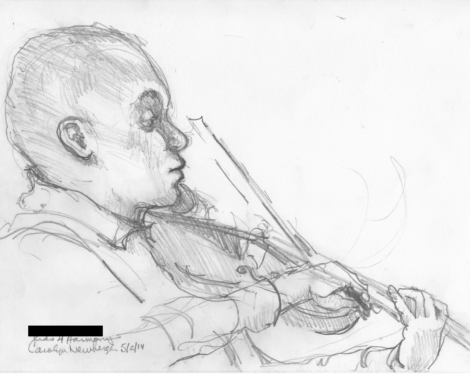
Joey immediately said “yes” to Ron’s invitation, and the concert, in the ballroom of the Crown Plaza Hotel in Pittsfield the following August, was a smashing success. Joey’s lending his name and his enthusiasm made it happen. And his comments at the symposium were revelatory.
What a task it is, he said, to learn to play the violin, where most of the children in this program begin. To make a beautiful sound, and to play a melody, requires holding the instrument and its bow correctly, reading the music accurately, and listening, listening, to the sound that you make. Playing with others in an ensemble (the basis of the pedagogy in the “El Sistema” movement, which began in Venezuela and produced the conductor of the Los Angeles Philharmonic, Gustavo Dudamel) requires a special kind of supportive collaboration, and a dedication to helping one another.
Joey’s wise words resonated perfectly with the children and their parents, and subsequently, they played their hearts out on Bach and Mozart, to clamorous applause.
In the reception afterward, Joey’s wife, Adrienne, approached the nine-year-old third grader who was the evening’s concertmaster. She said he was quite a fine young musician, and that if he kept it up, he might become a really fabulous violinist. The boy replied, “Thank you!” Adrienne continued, “See that man over there, he’s my husband, so I really know.” The boy responded, “Oh, he’s very talented!” Surely, this little boy had heard these words before, about himself.
Last summer, at Ozawa Hall on August 6, cellist YoYo Ma was joined by Leonidas Kavakos, violin, and Emanuel Ax, piano, for an evening of Brahms piano trios. The printed program noted that Kavakos was playing a Stradivarius. During the marvelous evening of music, his and Ma’s sonorities seemed perfectly matched.
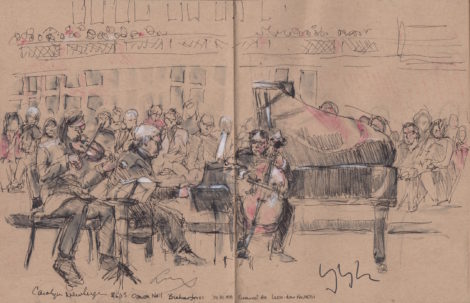
The following night, after Kavakos’s splendid performance of the Sibelius violin concerto with the BSO, I approached YoYo Ma at the intermission and asked if he had played his own Strad in the trio concert. Indeed, he said he had.
A couple of nights later, Carolyn and I found ourselves walking with Joey and Adrienne to yet another concert in Ozawa Hall. Just before he stopped to pick up his mail in the house across the lawn from Ozawa Hall, I asked Joey if he’d noticed the remarkable sympathy of their respective sounds during the Brahms concert, mentioning that although it wasn’t mentioned in the program, I’d learned that YoYo was playing his Strad, too.
Joey replied, “Those guys could be playing on cigar boxes, and it would sound just as good!”
This warm, ingenuous, and pithy communication, leavened with humor, is a lively example of Joey’s surpassing respect for his peers. Beyond his own virtuosity and fame, this was an extraordinarily generous man, supporting all our engagements with music, and expanding our horizons. To his widow, Adrienne, who so elegantly expressed her appreciation and respect for one young musician’s developing competency after one of Joey’s generous performances, go our respect and deep sympathy in this hour of loss.