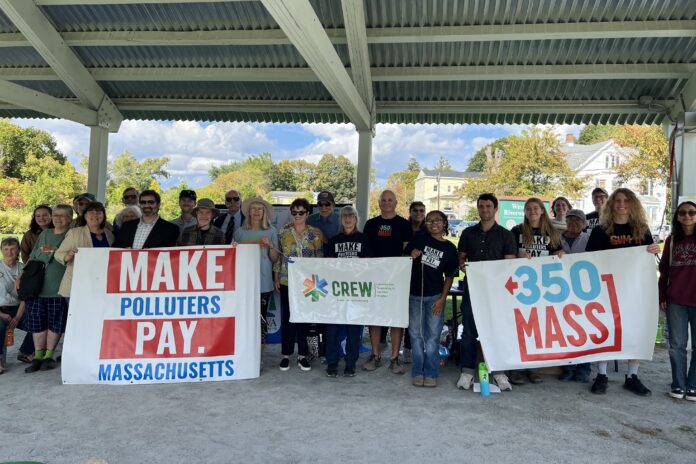
Pittsfield — Local environmental advocates and politicians gathered at Westside Riverway Park in Pittsfield on Saturday, September 27, for a community forum to raise awareness about the damaging toll that climate change is already inflicting on western Massachusetts and to speak out in support of proposed state legislation to make some of the world’s largest fossil fuel corporations help foot the bill.
The event, called “Bridges to the Future,” featured a slate of speakers that included State Sen. Paul Mark (D – Berkshire, Hampden, Franklin, and Hampshire District) and State Rep. Tricia Farley-Bouvier (D – 2nd Berkshire District), representatives of Berkshire-based environmental groups, and several student activists from the Five College Consortium. They highlighted some of the localized impacts of a changing climate—from wildfire smoke to flooding in the Housatonic River Valley—and explained why they are supportive of the legislation dubbed “Make Polluters Pay.”
“We’re pretty sick and tired of people making bajillions of dollars, and then we have to clean up their messes. That’s what this bill does,” Farley-Bouvier said. “Why should the Jack Welches of the world go off on their yacht, their wallets bulging, and we as taxpayers have to clean up the messes? It’s not OK.”
Mark also referenced the environmental damage caused by General Electric—the largest historical corporate polluter in Berkshire County—and said that holding polluters responsible for their harmful conduct is important. “GE was here, they took what they wanted and polluted where they wanted, and they left. And there’s been some recourse and some ability to hold them accountable, but for the most part we’ve been on our own,” he said.
Now more than ever, when it comes to addressing climate change and advancing clean energy, states and municipalities are truly on their own as the federal government has “abdicated its responsibility,” Mark noted.
The Trump administration has displayed an outright hostility to climate science and climate action and has actively worked to undermine renewable solar and wind energy. It has scrubbed climate data and reports from government websites and fired government scientists and civil servants; dramatically downsized federal agencies like the Environmental Protection Agency (EPA) and called for the elimination of the Federal Emergency Management Authority (FEMA); cancelled or clawed back grants and other funding for green projects; and has forced uneconomic coal-fired power plants to keep operating while trying to thwart the development of offshore wind projects—including one off the southern coast of Rhode Island that was 80 percent completed. Just last week in a rambling address to the United Nations in New York, President Trump falsely claimed that climate change is a hoax and a “con job” and that renewable energy is a “green energy scam.”
It is against this backdrop that local environmental and climate advocates assembled on Saturday. For some, the Trump administration’s actions have already impacted or threatened to impact some of their organization’s funding or their ability to access federal scientific data. Rose Wessel of Berkshire Environmental Action Team (BEAT), which supports a community air-monitoring program called Breathe Easy Berkshires that is funded through an EPA grant, said the program was almost targeted by DOGE—Elon Musk’s initiative to slash government agencies and government funding. Greenagers has also been threatened by DOGE cuts, according to the group’s Conservation Director Elia Del Molino. He said the organization has recently faced the termination of contracts with the National Park Service and AmeriCorps.
These changes are leaving a gap in the funding and resources necessary to tackle environmental challenges, local leaders say. “More and more as the federal government’s focus is shifting, we’re on our own here, and we need to get creative in finding ways that we can mitigate this damage and protect ourselves going into the future,” Mark told The Edge.
That is why Mark said that he supports the Make Polluters Pay bill, also known as a climate superfund. Vermont and New York passed their own versions of this legislation last year. Now, climate campaigners are hoping that Massachusetts and other states will join them.
The Massachusetts bill (S.588/H.1014), sponsored by State Sen. Jamie Eldridge (D – Middlesex and Worcester District) and State Reps. Steve Owens (D – 29th Middlesex District) and Jack Lewis (D – 7th Middlesex District), would charge the largest fossil fuel polluters—companies that have generated over 1 billion tons of climate pollution over the last 30 years—with helping to pay for climate-adaption costs incurred by the state, the amount of which is to be determined through a study. Revenue generated would go toward climate-resiliency projects statewide, and 40 percent must go toward projects that directly benefit environmental justice communities such as Pittsfield.
“What we find is that so many of our resources are going to the Boston metro region. And we need to make sure that we get our resources here,” Farley-Bouvier told The Edge. “This bill, the Polluters Pay bill, is one of the ways to do that. I’m particularly pleased that it is emphasizing environmental justice communities.”
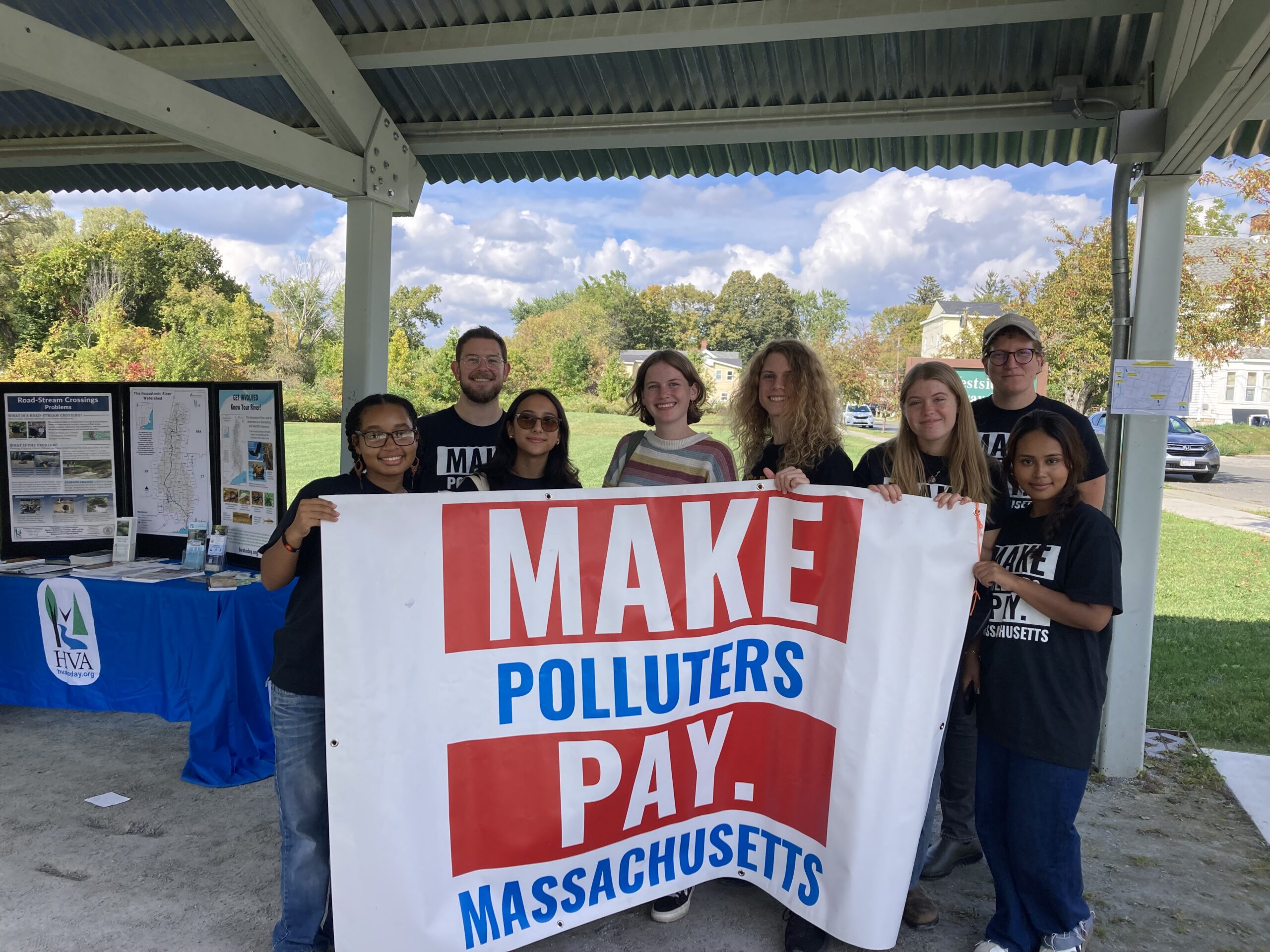
Tim Schowalter and Jessica Valatka, both 19-year-old students at the University of Massachusetts Amherst, were among a group of collegians who made the trip out to Pittsfield to attend Saturday’s climate event. Valatka said she supports the idea of making polluters pay because the state needs financial resources to help fund things like sustainable infrastructure, clean energy, and public transportation. And for Schowalter, it is about accountability for big corporations that have caused harm. “These companies are making life worse for so many people, and they have a responsibility to give back to those communities and mitigate that damage as much as possible,” he told The Edge.
Climate attribution studies have found that a relatively small handful of companies are responsible for the majority of industrial carbon dioxide emissions that are heating up the planet. Over 70 percent of historical emissions can be traced back to 78 entities, and 80 percent of CO2 emissions since 2016 are attributable to just 57 investor- and state-owned firms, according to the Carbon Majors database.
Fires, floods, heat waves already hitting Berkshire County
These heat-trapping emissions, primarily caused by fossil fuel combustion, are already resulting in widespread and increasingly severe impacts across the United States and around the world. Here in western Massachusetts, climate change is playing out locally through damaging flood events, heat waves, and even wildfires and wildfire smoke that exacerbates air quality issues.
The Butternut wildfire in Great Barrington last year was a reminder that these conflagrations can happen anywhere given the right conditions. At one point during that fire event, the wind shifted, causing an acute spike in particulate matter pollution from the smoke that prominently registered on BEAT’s air quality monitors, Wessel said.
“The thing about wildfires is that with climate being what it is, it is becoming more frequent. We just had a little bit of rainfall, but we’re still pretty much in a drought. It’s easy for another wildfire to start up here,” Wessel explained.
Wessel noted that we have also been affected by the wildfire smoke coming in from Canada and from out West.
Del Molino said that Greenagers had to develop smoke protocols for the first time last year as a safety precaution. The organization, which immerses youth in hands-on environmental stewardship projects, has also been affected by extreme heat, when the heat index rises over 100 degrees like it did for a few days here in June. “We were asking [these teenagers] to show up for work at 5:30 in the morning so that we could finish before 2 to 3 o’clock when it’s really, really hot,” Del Molino said. “So, the climate is certainly affecting us and our programming.”
Flooding is another concern that participants in Saturday’s event raised. “I remember being with the governor in Williamsburg and North Adams two years ago because of flooding. I remember [Tropical Storm] Irene and the devastating impact it had in towns like Hawley and Shelburne Falls. And just recently there was significant flooding in a micro-storm in the town of Chester and in South County,” Mark told The Edge.
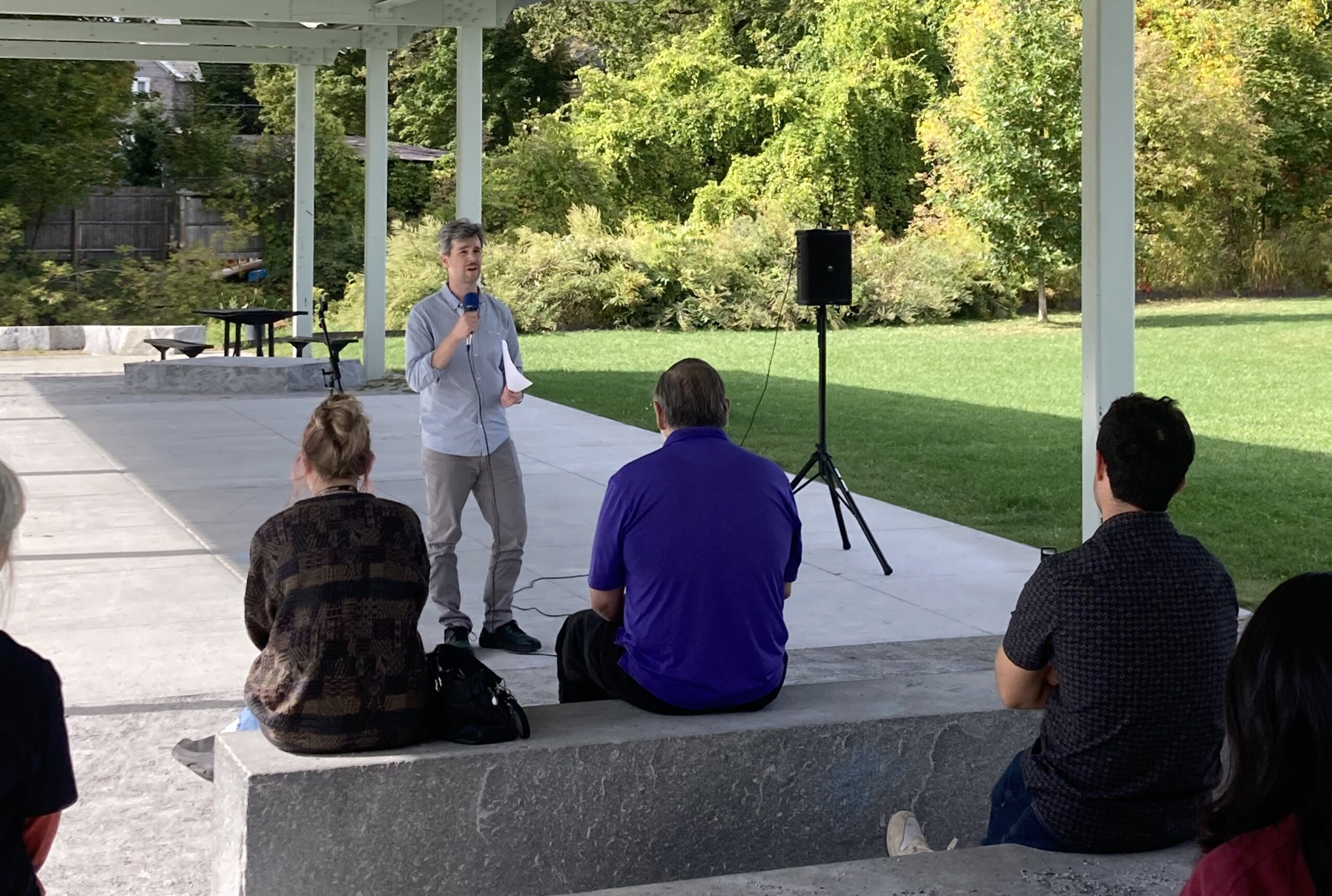
Erik Reardon, Berkshire watershed director of the Housatonic Valley Association, said increasing flood risk is a chief concern for his organization, which aims to help protect and enhance the Housatonic River watershed. “Flooding isn’t just a distant worry. It’s happening here in Berkshire County. And it’s happening with increasing frequency,” he said. “So much of our infrastructure, our roads, our culverts, our dams, they were built for storms of the past. They are not ready for the climate reality that we know we’re facing today.”
These storms not only bring greater risk of flooding, but they can overwhelm storm drains resulting in excess water, often carrying superheated runoff, to flow into local waterways like the Housatonic River, explained Cindy Delpapa of the 350 Mass Berkshire Node. She said there is a type of pavement that “lets water percolate through it much quicker, and it can go into the ground and not immediately run off.” But upgrading to this pavement costs money, and municipal and state budgets already tend to be stretched thin.
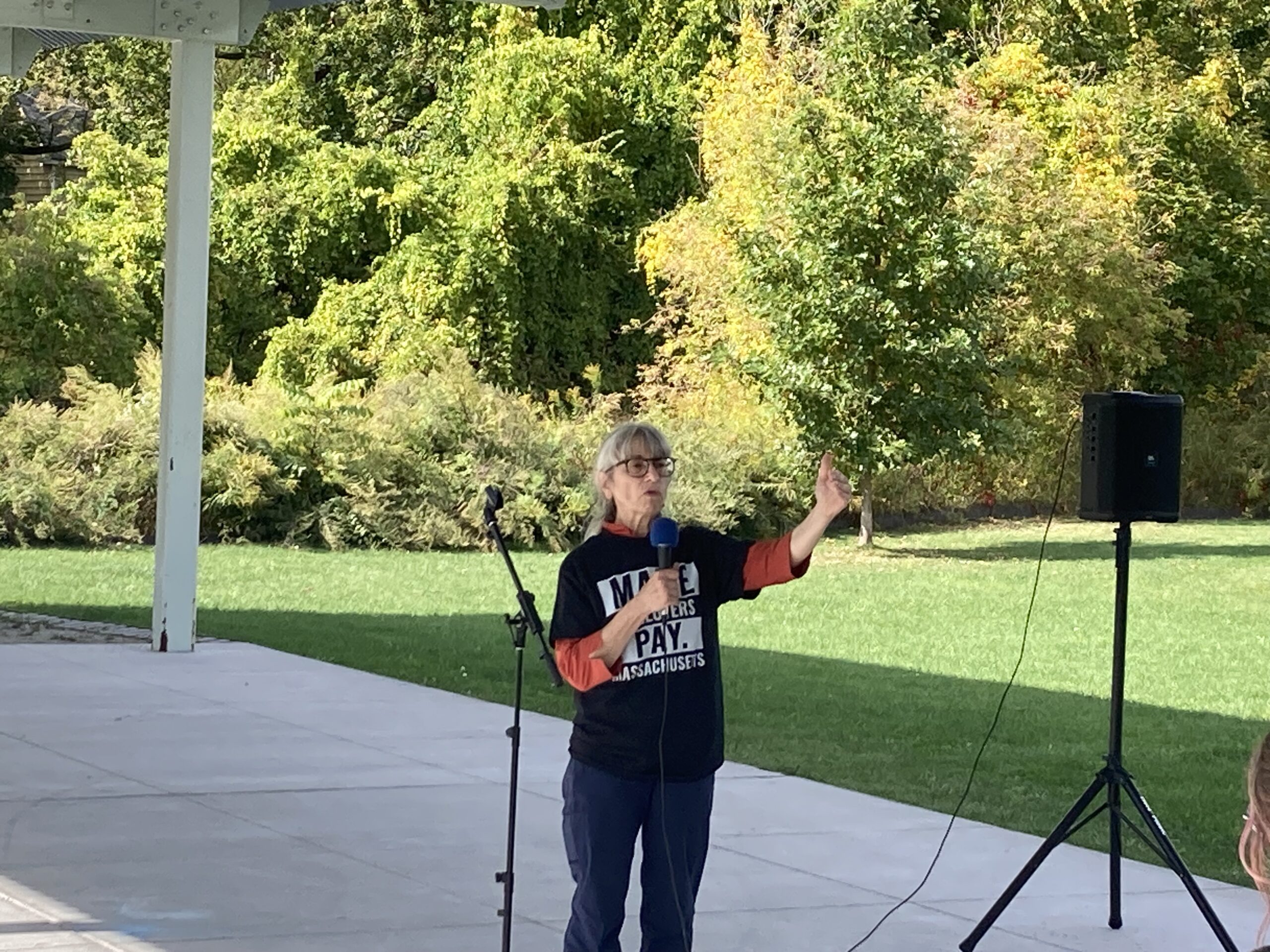
Other infrastructure and resiliency projects like removing aging dams and replacing culverts or restoring wetlands and tracts of forests also require funds to make them happen. That is where environmental advocates hope the Make Polluters Pay bill can come in.
“I support Make Polluters Pay, because it can provide the funding to help improve and protect what we in the Berkshires really treasure: our beautiful landscapes and our beautiful waterways,” Delpapa said.
“This piece of legislation is so important to create a sustainable future for young people in funding all of these things,” said Katherine Haycox, a sophomore at Smith College and leader of her campus’ chapter of the Sunrise Movement. “It creates a way of having economic sustainability of these solutions, which is going to be so important, especially with the uncertainty of the support we may or may not be getting at the federal level.”
Long road ahead
There is a long way to go, however, before this funding comes through, if it ever does. Previous versions of the bill have not advanced, but campaigners are hoping there will be a breakthrough this time.
“We are at a really important part of our campaign,” said Rachael Boyce of the organization Better Future Project and co-lead of the Make Polluters Pay Massachusetts campaign, which hosted Saturday’s event in partnership with BEAT, 350 Mass Berkshire Node, Housatonic Valley Association, and Food & Water Watch.
“Our bill is in the Environment and Natural Resources Committee, and we just had a hearing in the beginning of September,” Boyce added, noting the deadline for getting the bill through the committee is generally around the beginning of December. “So, we are in a big push right now.”
Mark, who is lead sponsor on another bill that would create a “green bank” to help fund green energy and decarbonization initiatives, said state lawmakers are currently working on an environmental bond bill. “The way more and more legislation is passing is that it ends up as part of these bigger packages,” he explained.
Even if the Make Polluters Pay bill makes it over the finish line, it is expected to face legal challenges from fossil fuel interests and other parties. The U.S. Chamber of Commerce and the American Petroleum Institute, as well as a coalition of Republican-led states and the Trump administration, are currently trying to get the climate Superfund laws in both Vermont and New York overturned through the courts.
Still, supporters of the Massachusetts bill say it is an important step to take to help alleviate the climate change cost burden on taxpayers and families across the Commonwealth. “I think it’s more than reasonable to explore alternative pathways for funding that climate resiliency and mitigation work so that it doesn’t singularly fall on the Massachusetts taxpayers,” Reardon said.
Boyce ended the Bridges to the Future forum with a call to action, encouraging people to join or support community organizations and to get involved in local organizing. “Every little bit matters. We can’t all do everything, but everyone can do something,” she said.
Showing solidarity is especially critical in these dark and trying times, Del Molino said. “It’s difficult. It’s unreal what we’re going through. But this sort of thing, gathering as community, all pushing together in the same direction, is what’s going to change it.”