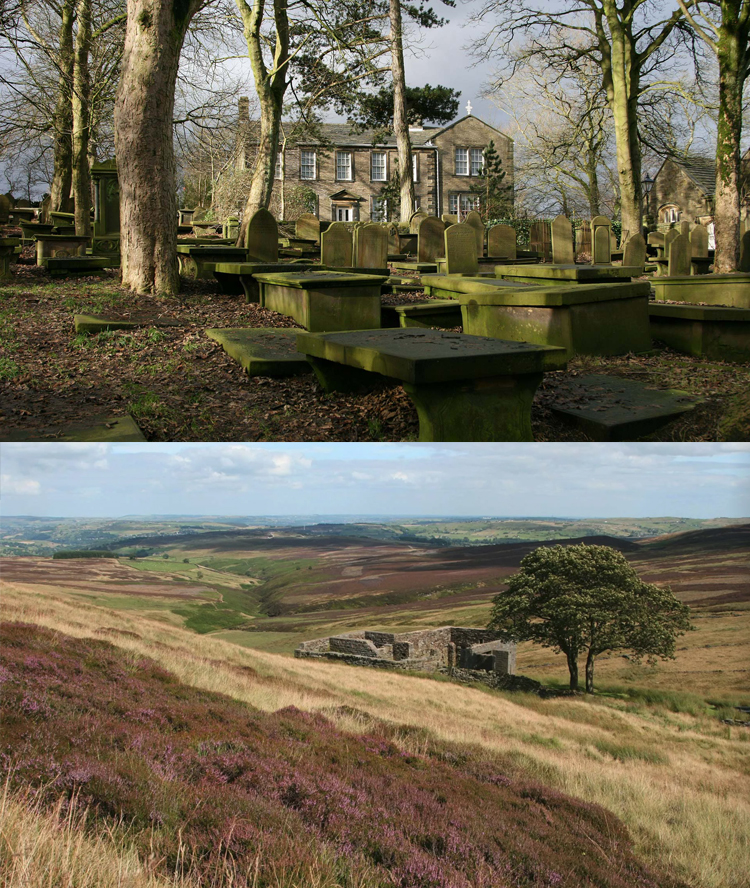
It was a dank and somber day when I visited Haworth Parsonage in West Yorkshire, England. It’s a land where the winters are long and cold, windy and cloudy. The front door of the Parsonage where the Reverend Patrick Brontë raised his family, opens onto a cemetery. The other side of the house overlooks a vast expanse of the wild but romantic Yorkshire moors.
It’s a setting that goes far to explain the warm togetherness of the Brontë family in their Parsonage and the comingling of hope and despair that runs through the Brontë writings.
There were six Brontë children, two of whom, Maria and Elizabeth, died before their poetic potential could be determined. The other children: Charlotte, Emily, Anne and brother Branwell became poets, novelists and painters . . . the most talented literary family ever to live under one roof.
* * *
As children, they were already deep in imaginative adventures. They invented and wrote about countries with names like Gondal and Angria. When their father brought home some toy soldiers, they were quickly given names and made part of the ongoing story-telling. They were writing actively during their adolescence.
In May of 1846, Charlotte, Emily and Anne published a book of their poetry which they self-financed. They brought it out under the cover of male pseudonyms: Curren (Charlotte), Ellis (Emily) and Acton (Anne) Bell as they felt masculine names might draw more attention and help sales. It sold two copies! But there were three positive reviews.
They then turned to novels, and 1847 became their annus mirabilis. In that one year Charlotte published Jane Eyre, Emily brought out Wuthering Heights and Anne presented Agnes Gray. With those classics they became poet-novelists, and their life’s reputations were assured.
* * *
Let’s meet our Brontë poets individually.
Charlotte (1816-1855) was the first-born and most versatile, a painter as well as a writer. She did her own illustrations for Jane Eyre. She developed long narrative poems and monologues that would become popular with the Brownings, but the poem below is more simple and lovely, or may I say, simply lovely.
We wove a web in childhood,
A web of sunny air;
We dug a spring in infancy
Of water pure and fair;
We sowed in youth a mustard seed,
We cut an almond rod;
We are now grown up to riper age-
Are they withered in the sod?
Are they blighted, failed and faded,
Are they mouldered back to clay?
For life is darkly shaded;
And its joys fleet fast away.
* * *
Charlotte and Anne were fine and worthy poets, Branwell perhaps a little less so, but Emily (1818-1848) was a great poet in every sense. Her explorations of the self, the imagination and the visionary are delivered with immaculate insight. Her choice of language is careful but colorful, and her lines have a smooth rhythmic flow. (At one time she taught music.) She is esteemed today for the beauty of her poetry and the grandeur of Wuthering Heights. Charlotte said of Emily: “Under an unsophisticated culture lay a secret power and fire that might have informed the brain and kindled the reins of a hero.”
Here is one of my favorite poems of Emily’s, and we will present four more in our attached video.
Often rebuked, yet always back returning
To those first feelings that were born with me,
And leaving busy chase of wealth and learning
For idle dreams of things that cannot be:
To-day, I will seek not the shadowy region;
Its unsustaining vastness waxes drear;
And visions rising, legion after legion,
Bring the unreal world too strangely near.
I’ll walk, but not in old heroic traces,
And not in paths of high morality,
And not among the half-distinguished faces,
The clouded forms of long-past history.
I’ll walk where my own nature would be leading:
It vexes me to choose another guide:
Where the gray flocks in ferny glens are feeding;
Where the wild wind blows on the mountain side.
What have those lonely mountains worth revealing?
More glory and more grief than I can tell:
The earth that wakes one human heart to feeling
Can centre both the worlds of Heaven and Hell.
* * *
Charlotte and Emily were imaginative writers, but Anne Brontë (1820-1849) was more of a realist. Her first novel, Agnes Grey, was based on her own miserable experiences as a governess. Her second book, The Tenant of Wildfell Hall, chronicled a fictional husband’s decline through alcohol and debauchery. It enjoyed substantial success and in style and substance could have been written today. Her poem, “Lines Composed in a Wood on a Windy Day” is a whirlwind of vigorous words: soaring, roaring, glancing, dancing, lashing, dashing.
My soul is awakened, my spirit is soaring,
And carried aloft on the winds of the breeze;
For above and around me the wild wind is roaring,
Arousing to rapture the earth and the seas.
The long withered grass in the sunshine is glancing,
The bare trees are tossing their branches on high;
The dead leaves beneath them are merrily dancing,
The white clouds are scudding across the blue sky.
I wish I could see how the ocean is lashing
The foam of its billows to whirlwinds of spray;
I wish I could see how its proud waves are dashing,
And hear the wild roar of their thunder to-day!
* * *
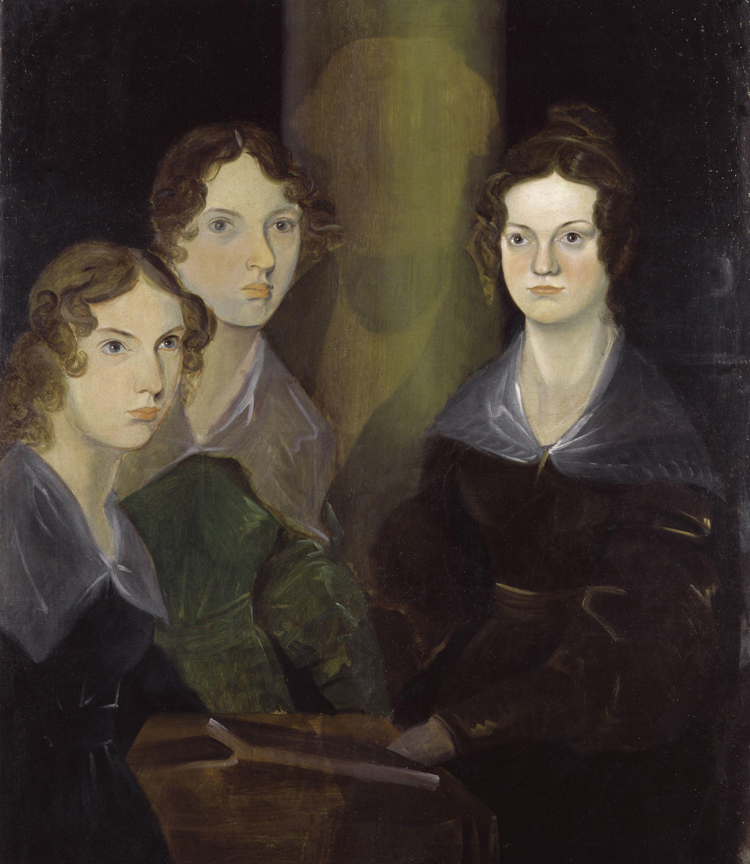
Branwell Brontë (1817-1848) is probably better remembered as a painter than a poet, and his portrait of his three sisters is the only group rendering of them taken in real life.
* * *
Originally Branwell placed himself between Emily and Charlotte, but later he painted it out. He had a troubled life, and alcohol and drug addiction led to his early death at thirty-one. This poem reflects his increasing despair.
I sit, this evening, far away,
From all I used to know,
And nought reminds my soul to-day
Of happy long ago.
Unwelcome cares, unthought-of fears,
Around my room arise;
I seek for suns of former years
But clouds o’ercast my skies.
Yes—Memory, wherefore does thy voice
Bring old times back to view,
As thou wouldst bid me not rejoice
In thoughts and prospects new.
* * *
And now a bit of a surprise. There was a fifth poet in the family! The Reverend Patrick Brontë who sired the six children and outlived all of them. Unbeknownst to many, he was also a published poet, born in Ireland and writing with an Irish flair, though primarily on behalf of religion and morality. Here are stanzas from one of his more secular verses, “The Spider and the Fly.”
The sun shines bright, the morning’s fair,
The gossamers float on the air,
The dew-gems twinkle in the glare,
The spider’s loom
Is closely plied, with artful care,
Even in my room.
Her silken ware is gaily spread,
And now she weaves herself a bed,
Where, hiding all but just her head,
She watching lies
For moths or gnats, entangled spread,
Or buzzing flies.
Ah, silly fly! will you advance?
I see you in the sunbeam dance:
Attracted by the silken glance
In that dread loom;
Or blindly led, by fatal chance,
To meet your doom.
Entangled! freed!-and yet again
You touch! ’tis o’er-that plaintive strain,
That mournful buzz, that struggle vain,
Proclaim your doom:
Up to the murderous den you’re ta’en,
Your bloody tomb!
But hark! the fluttering leafy trees
Proclaim the gently swelling breeze,
Whilst through my window, by degrees,
Its breathings play:
The spider’s web, all tattered flees,
Like thought, away.
Thus worldlings lean on broken props,
And idly weave their cobweb-hopes,
And hang o’er hell by spider’s ropes,
Whilst sins enthral;
Affliction blows-their joy elopes-
And down they fall!
* * *
Deaths came early for the Brontë children. Charlotte was the last surviving child and the only one to marry, saying:
“Poor Anne. Poor Emily. Poor Branwell. Poor Maria. Poor Elizabeth. Poor Aunt Branwell. Poor Mother. What a household of ghosts. Perhaps it was a good thing after all to be marrying and getting away from the parsonage for a while.” She died in pregnancy nine months later.
* *
VIDEO. Emily Brontë wrote: “I have dreamt in my life, dreams that have stayed with me ever after, and changed my ideas; they have gone through and through me, like wine through water, and altered the color of my mind.”
The members of the First Poetry Quartet present four of Emily’s best-loved poems, including “Mild the Mist Upon the Hill” and “No Coward Soul is Mine.”
CLICK ON THIS LINK FOR VIDEO: THE BRONTES OF HAWORTH