Editor’s note: Click here to read “Give My Regards to Broadway”: Part One, and here for Part Two.
Looking to the future, if you long for success as a Broadway lyricist, the first thing to do is be sure that your name starts with an “H.” My evidence: Oscar Hammerstein, E.Y. Harburg, Sheldon Harnick, Lorenz Hart, Jerry Herman, DuBose Heyward, Otto Harbach, all great lyricists.
Of course, if your name starts with a “B” as in Berlin, first name “Irving,” that’s okay, too. Irving Berlin was every Broadway songwriter’s favorite songwriter. Born in Siberia, he became the greatest writer of American popular music, capturing and often creating an idiom that came to represent what we used to call the spirit of America.
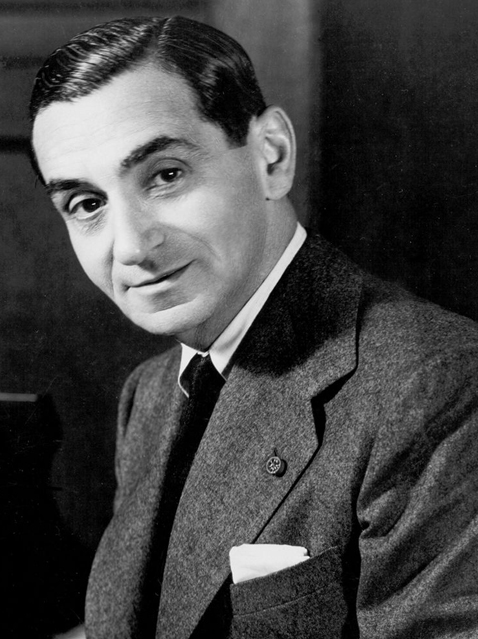
At the age of five, he and his family arrived and settled in New York, his parents barely eking out a living. As a teenager he was busking on the streets and then singing as a waiter. He started to plug songs and soon sold several of his own. His reputation grew steadily, especially when he wrote these words:
Come on and hear, come on and hear
Alexander’s Ragtime Band.
Come on and hear, come on and hear,
It’s the best band in the land
They can play a bugle call
Like you never heard before,
So natural that you want to go to war.
That’s just the bestest band what am, Honey Lamb.
Come on along, come on along,
Let me take you by the hand
Up to the man, up to the man
Who’s the leader of the band.
And if you want to hear the Swanee River played in ragtime,
Come on and hear, come on and hear
Alexander’s Ragtime Band
Jerome Kern said of Berlin, “Irving Berlin has no place in American music; he is American music.” And Berlin wrote of his love of country.
While the storm clouds gather far across the sea,
Let us swear allegiance to a land that’s free.
Let us all be grateful for a land so fair,
As we raise our voices in a solemn prayer:
God bless America, land that I love,
Stand beside her and guide her
Through the night with a light from above.
From the mountains, to the prairies,
To the oceans white with foam,
God bless America,
My home sweet home.
Whenever I asked my mother a question that had no measureable answer, she would reply, ”How long is a string?” or “How high is the sky?” Maybe she had channeled Irving Berlin who thought this to be one of his best lyrics:
How much do I love you? I’ll tell you no lie:
How deep is the ocean? How high is the sky?
How many times a day do I think of you?
How many roses are sprinkled with dew?
How far would I travel to be where you are?
How far is the journey from here to a star?
And if I ever lost you, how much would I cry?
How deep is the ocean? How high is the sky?
Berlin wrote words and music for twenty Broadway shows, including the great “Annie Get Your Gun,” and for fifteen Hollywood films. He lived to
the hearty age of 101. Could we call him prolific? Well, let me put it this way: a book called “The Complete Lyrics of Irving Berlin” is the second heaviest in my library, outweighed only by “War and Peace.”
* * *
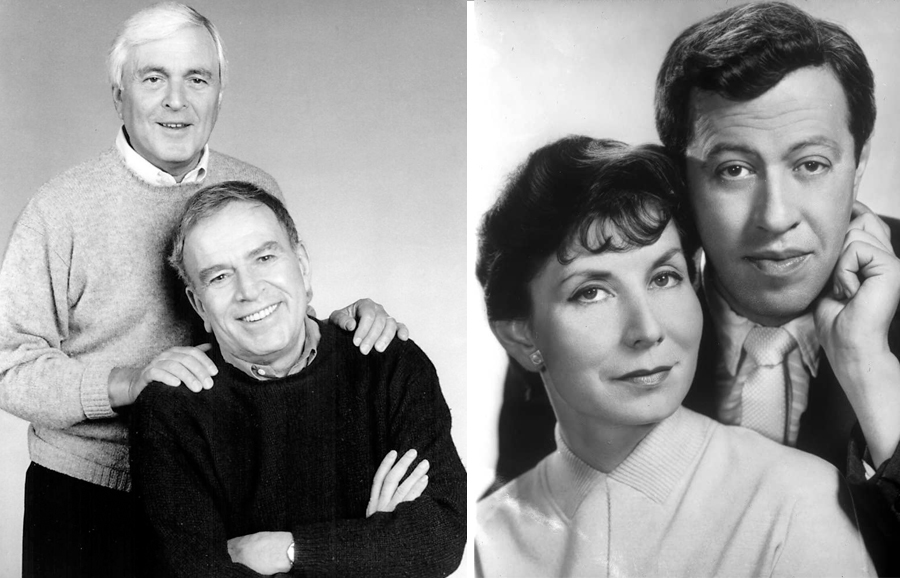
Thanks to Broadway, New York City has two anthems, both called “New York, New York” The first has lyrics by Betty Comden and Adolph Green, music by Leonard Bernstein.
New York, New York, a helluva town.
The Bronx is up, but the Battery’s down.
The people ride in a hole in the groun’.
New York, New York, it’s a helluva town!
Comden and Green had a 60-year writing partnership (They were married to other people but met every day to write.) Their hit shows included “On the Town”. “Wonderful Town” and “Bells Are Ringing”, from which show came this beautiful lyric:
The party’s over.
It’s time to call it a day.
They’ve burst your pretty balloon and taken the moon away.
It’s time to wind up the masquerade.
Just make your mind up the piper must be paid.
The party’s over.
The candles flicker and dim.
You danced and dreamed through the night,
It seemed to be right just being with him.
Now you must wake up, all dreams must end.
Take off your make up, the party’s over.
It’s all over, my friend.
Betty and Adolph were silent film buffs, and I sometimes played live piano accompaniments for their home screenings. Oh, and by the way, they wrote a movie you might have heard of, all about silent films becoming sound films. It’s called “Singin’ in the Rain”.
* * *
The second “New York, New York” anthem was written by John Kander (music) and Fred Ebb (lyrics), made famous by Frank Sinatra and in other settings, Liza Minelli.
Start spreading the news, I’m leaving today.
I want to be a part of it: New York, New York.
These vagabond shoes, are longing to stray
Right through the very heart of it: New York, New York.
Kander and Ebb are near the top of my list of favorite collaborators. They wrote two of the finest musicals of our time, “Cabaret” and “Chicago,” which is now the longest-running show on Broadway (27 years). As I write this column, a new musical has just opened, with music by John Kander, who is 96 years old, and, since Fred Ebb has passed away, with new lyrics by the leading Broadway poet of today, Lin-Manuel Miranda.
As a bit of tribute, may I offer a lyric by Fred Ebb that is unusual in that it can be sung with hope and optimism or can be equally effective when edged with longing and uncertainty.
Maybe this time, I’ll be lucky
Maybe this time, he’ll stay
Maybe this time
For the first time
Love won’t hurry away
He will hold me fast
I’ll be home at last
Not a loser anymore
Like the last time
And the time before
Everybody loves a winner
So nobody loved me
‘Lady Peaceful,’ ‘Lady Happy,’
That’s what I long to be
All the odds are in my favor
Something’s bound to begin
It’s got to happen, happen sometime
Maybe this time I’ll win.
* * *
Now a bit out-of-date but still important is Noël Coward, England’s answer to Cole Porter. Coward characterized himself as having “a talent to amuse.” and many of his songs demonstrate that. Here is a passage poking fun at British colonialism.
Mad dogs and Englishmen
Go out in the midday sun.
The smallest Malay rabbit
Deplores this foolish habit.
In Hongkong
They strike a gong
And fire off a noonday gun
To reprimand each inmate
Who’s in late.
In the mangrove swamps
Where the python romps
There is peace from twelve till two.
Even caribous
Lie around and snooze;
For there’s nothing else to do.
In Bengal
To move at all
Is seldom, if ever done.
But mad dogs and Englishmen
Go out in the midday sun.
* * *
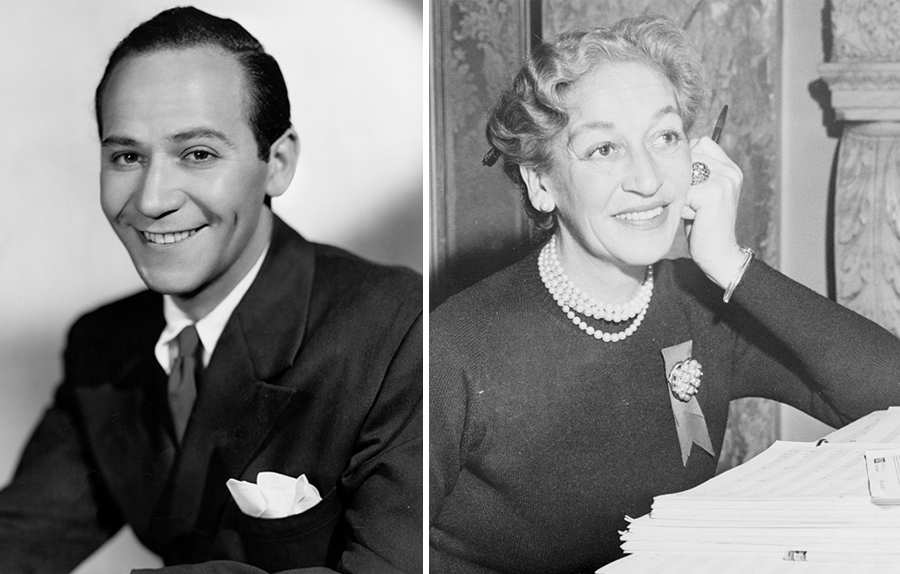
Lest you think that the lyric domain is mostly all men, let me salute Dorothy Fields, who wrote “If You Could See Me Now” from “Sweet Charity” and two super standards from among many: “I Can’t Give You Anything But Love” and “On the Sunny Side of the Street.” Barack Obama borrowed a line from Dorothy for his 2009 inauguration speech when he said, “We must pick ourselves up, dust ourselves off and begin again the work of remaking America.” And here is one of my Dorothy Fields favorites. Music by Jerome Kern.
Some day, when I’m awfully low,
When the world is cold.
I will feel a glow just thinking of you
And the way you look tonight.
Yes, you’re lovely, with your smile so warm
And your cheeks so soft,
There is nothing for me, but to love you,
And the way you look tonight
With each word, your tenderness grows,
Tearing my fear apart,
And that laugh that wrinkles your nose,
Touches my foolish heart.
Lovely, never, ever change,
Keep that breathless charm,
Won’t you please arrange it? ‘Cause I love you
Just the way you look tonight.
Of other poetic women, Richard Rodgers’ talented daughter Mary wrote the charming “Once Upon a Mattress” starring Carol Burnett; Carolyn Leigh wrote “I’m Flying” and other “Peter Pan” lyrics for Mary Martin; and Lynn Ahrens with her partner Stephen Flaherty gave us the rich pageantry of “Ragtime.”
* * *
* * *
One of the most hard-working lyricists was Frank Loesser (pronounced “lesser”) who produced over 700 songs while reportedly sleeping only four hours a night. Loesser’s creative range was impressive, from the colloquial wisecrackery of “Guys and Dolls” to the near-opera drama of “The Most Happy Fella.” His songs appeared in more than sixty Hollywood films, and you’ll likely recognize “Two Sleepy People” and “Baby, It’s Cold Outside” among them. During the Second World War he wrote “Praise the Lord and Pass the Ammunition.”
He created this bouncy lyric for a barber shop quartet:
I’m the cat that got the cream.
Haven’t got a girl but I can dream.
Haven’t got a girl but I can wish,
So I take me down to Main Street,
And that’s where I select my imaginary dish!
Standing on the corner,
Watching all the girls go by,
Standing on the corner,
Giving all the girls the eye.
Brother, if you’ve got a rich imagination,
Give it a whirl, give it a try.
Try standing on the corner,
Watching all the girls,
Watching all the girls,
Watching all the girls go by.
Loesser loved word-play and I was delighted to discover that he once lovingly taunted his brother as being the Evil of Two Loessers.
* * *
This column and the two preceding have celebrated my view of the finest Broadway lyricists. But I would like to mention briefly another five writers who deserve our recognition and appreciation.
Richard Adler and his partner, Jerry Ross, both wrote lyrics and music. When Ross died prematurely, Adler carried on alone. Their best shows were “The Pajama Game” and “Damn Yankees.” A highlight in Adler’s theatrical life was producing the show at Madison Square Garden where Marilyn Monroe sang her breathy version of “Happy Birthday” to President Kennedy.
* * *
Meredith Willson wrote only three Broadway shows, but “The Music Man” was a huge hit. Willson penned some fine lyrics, and his musicianship was impeccable. He was a flute player for five years with the New York Philharmonic.
* * *
Stephen Schwartz, well-regarded as a composer of animated film music, also has a major Broadway achievement. No other composer/lyricist has ever had three shows each achieve more than 1900 performances: “Godspell,” “Pippin” and “Wicked” (still running).
* * *
E.Y. “Yip” Harburg created shows like “Finian’s Rainbow” where his socio-political views could be mingled with whimsy and satire. But he was also a superb technician, and no less than Stephen Sondheim said this bit of playful pastoral was one of his favorite couplets:
Even the rabbits inhibit their habits
On Sunday in Cicero Falls.
Harburg wrote the lyrics for “The Wizard of Oz.” Not a bad credit!
* * *
In a previous column I mentioned Howard Dietz, the fastest-writing lyricist in the business.. I mention him again here because I want to celebrate my favorite couplet. Dietz wrote that “Hamlet” is a play where
A ghost and a prince meet,
And everyone ends as mincemeat.
* * *
And finally, one other mention, a little off the wall. Irving Caesar wrote successful lyrics for “No, No Nanette” including the song “Tea for Two.” But he is best remembered, at least by me, for this incident. Caesar was intimately involved with a musical of dubious quality. He conceived it, produced it, co-authored the story, wrote the lyrics and composed most of the music. After a set of dreadful reviews came out, Caesar phoned Oscar Hammerstein and said, “Alright, so they didn’t like it. But why pick on me?”
* * *
VIDEO. First, a little touch of Broadway magic as Karen Ziemba and Bebe Neuwirth sing (and dance) “Nowadays” from “Chicago.” Lyrics by Fred Ebb.
Then, Meredith Willson’s hell-bent-for-leather “Trouble” from “The Music Man.” The performer is Seth MacFarlane.
And finally, the very heart of Broadway. Irving Berlin’s “There’s No Business Like Show Business” sung by the legendary Ethel Merman. This performance is her motion picture version.
I hope you’ve enjoyed our theater columns. Until next time.
CLICK ON THIS LINK FOR VIDEO: GIVE MY REGARDS PART III