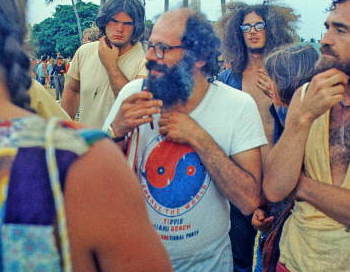
Yes, I know that it was a very long time ago and that he died in 1970 and that some/much of what he wrote is more than challenging, but how many of you had the chance to see/hear Allen Ginsberg, chanting, singing, prophesizing, calling out the madness that was swirling around us? Now, let me be clear that in these the days of Epstein revelations, and the ability of so many to assume the worst, my appreciation for his work is in no way an endorsement of what I know absolutely nothing about: his private life. And were he alive, he might say the same of me.
Anyway, before I so rudely interrupted myself, I was saying that I was lucky because mad gay poet/oracle that he was, he was especially generous with his time. He appeared several times at City College as we found every possible way to oppose the Vietnam War and fight for equal rights. While Bob Dylan stole/borrowed from Ramblin’ Jack Elliot and Woody Guthrie, Allen Ginsberg summoned Walt Whitman. And sometimes he channeled voices far more ancient. He did indeed “Howl”:
I saw the best minds of my generation destroyed by madness, starving hysterical naked …
who passed through universities with radiant cool eyes hallucinating
Arkansas and Blake-light tragedy among the scholars of war,
who were expelled from the academies for crazy & publishing obscene odes
on the windows of the skull,
who cowered in unshaven rooms in underwear, burning their money in
wastebaskets and listening to the Terror through the wall …
— Allen Ginsberg, “Howl,” from “Collected Poems,” 1947-1980
Simultaneously Jewish and Buddha-like, Allen Ginsberg conjured a compelling trance. Listening, I would slip in and out of comprehension as his words washed over me, and so I would go back to read, reread, and reacquaint over the next few days. But live and in person, there with him, was always mesmerizing. He was bearded then, dark eyeglasses, heretical, and despite delivering what most would regard as a sacrilegious and shocking message, he offered his reflections in a very biblical, religious way.
Of course, as a truth often is, his words were subversive in every sense. To be clear, this was his truth, not mine. And, because his was a universe, an underground, not known by many at that stultifying time and almost never acknowledged by the majority, he was the most unlikely of messengers to elucidate the American experience. Yes, I appreciate how ironic this claim is. But because the authorities and most “normal” Americans lived a life designed and committed to not ever encountering him and his brethren, he was a more objective witness to the egregious lies and hypocrisies of that life.
Remember, Ginsberg began writing in 1954 and performed “Howl” in 1956—at a time and place where Dwight D. Eisenhower prevailed.
I know from my own red-diaper history how obsessive the authorities can be about enforcing conventionality and demanding submission. Undoubtedly, the American myth is a crock, but chip away at it, deny it, worst of all mock it and you will find yourself in deep shit.
Here is how Wikipedia put it:
Best known for his poem ‘Howl’, Ginsberg denounced what he saw as the destructive forces of capitalism and conformity in the United States. San Francisco police and US Customs seized copies of ‘Howl’ in 1956 and a subsequent obscenity trial in 1957 attracted widespread publicity due to the poem’s language and descriptions at a time when sodomy laws made male homosexual acts a crime in every state. The poem reflected Ginsberg’s own sexuality and his relationships with a number of men, including Peter Orlovsky, his lifelong partner. Judge Clayton W. Horn ruled that ‘Howl’ was not obscene, asking: ‘Would there be any freedom of press or speech if one must reduce his vocabulary to vapid innocuous euphemisms?’
Many of you missed it, but so much of television in the 1950s promoted a fictional Christian and caring white America. While set in 1960, younger Americans might want to binge Jon Hamm’s “Mad Men” for a fictional behind-the-scenes look at how Madison Avenue helped to shape that mythology.
Of course, there were always contradictory messaging. A white man could be the quintessentially reliable dad of “Father Knows Best” or one of the heroes of “Gunsmoke,” “Wyatt Earp,” or “Have Gun — Will Travel”—a Marlboro Man through and through: single and self-sufficient, cigarette dangling from his lips, unhesitant to shoot. Women, though, were placed in the impossible position of looking at ease as they made the perfect, white-picket-fence roast plus two vegetables for her suburban hubby and their two kids. He, of course, had a tough day at the office, the tie slightly askew, and was always relieved to find dinner waiting. If the day had been manageable, he might even deign to do the dishes. And yet beneath the façade, there could be roiling discontent. She took Miltown, and he drank.
who were burned alive in their innocent flannel suits on Madison Avenue
amid blasts of leaden verse & the tanked-up clatter of the iron regiments
of fashion & the nitroglycerine shrieks of the fairies of advertising
— Allen Ginsberg, “Howl,” from “Collected Poems,” 1947-1980
Television in the 1950s was never intended to resemble real life. Gertrude Berg—who created Molly Goldberg of “The Goldbergs,” a sympathetic show about Jewish immigrants in the city—had to eventually submit to the pressure of CBS and her sponsors when her co-star Philip Loeb was denounced as a communist sympathizer. Loeb resigned and later committed suicide.
As always, there were different sets of rules for the haves and have-nots. So, of course, the power elite in America managed to find room for the cross-dressing, black-mailing tyrannical director of the FBI, J. Edgar Hoover, before whom so many cowered. Or Joseph McCarthy, the paranoid, sociopathic senator who never stopped ranting about and outing the supposed God-hating, death-to-America, Moscow-inspired commie spies. They were especially and insidiously dangerous because they so successfully blended in, even went bowling as they pretended to be your normal next-door neighbors. And yes, he had lists of them.
Not surprisingly, the America that had made a pact with segregation, with separate and unequal, hardly noticed our military interventions, led by the Dulles Brothers at State and the CIA, in Latin America, Africa and the Middle East. Not for you and me but on behalf of greedy corporations. This, of course, was yet another wave of U.S. intervention to protect corporate interests. Hadn’t U.S. Marines spent time from 1917 to 1922 ensuring the stability and protection of the sugar industry in Cuba? And so, the 1950s witnessed yet another outbreak of self-proclaimed American exceptionalism intertwined with rapacious greed. Unfortunately, for those who lived the places we interfered, it guaranteed the corrupt, incompetent, and tyrannical regimes of men like Batista, Somoza, and the Shah of Iran.
Here at home, Ginsberg saw and heard and created a soundscape of the treacherous, sometimes impossible world inhabited by outsiders like Black and gay Americans. “Howl” recreated the nightmarish reality faced by those trying to survive the madness or create something better. You might ask yourself how much heterosexual white men and women of the 1950s even knew about that world. Or, for that matter, if they had ever heard the transcendent horns of heroin-addicted Miles Davis or John Coltrane. Had they summoned up the curiosity to get off the subway or walk north on Fifth Avenue past the Museum of the City of New York to venture into Harlem? Separate and unequal meant separate in every respect. Unknown and unappreciated. Strangers in their own land.
How about we simplify matters and posit that some combination of rock and roll and the Montgomery bus boycott yielded a younger generation who found suburban life to be excruciating and stultifying and were lucky enough to be sent by their now middle-class parents to college, where they encountered Huxley and Kafka and Orwell.
Central to mythic America was the notion that we were the best. Hadn’t we had won World War II—the critical contribution of the Russians a distant afterthought? We were technologically ahead by leaps and bounds—or at least until Sputnik. Our bombs were the best—hadn’t we proven that in Hiroshima and Nagasaki? So often we were told that life was now affordable for all—except, in reality, milk adjusted for inflation in 2020 dollars cost about $9.00 a gallon and gas $2.60.
The fact is, as Ginsberg insisted, there was the undeniable accompanying terror. Like all my elementary school classmates, I wore a dog tag stamped with my name and address. I hedged bets that the tag might survive the Russian bombs if my body didn’t so that I could be counted among the dead. This was the byproduct of our insane nuclear arms race and defense strategy: We practiced squeezing our bodies beneath our desks, always told to face away from the windows. As if the flying glass was the main threat.
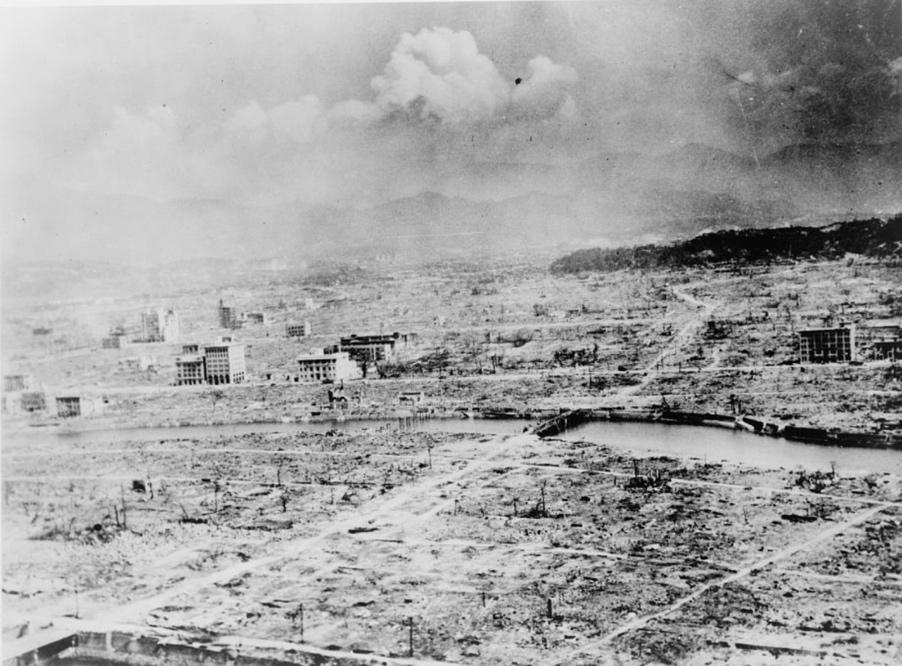
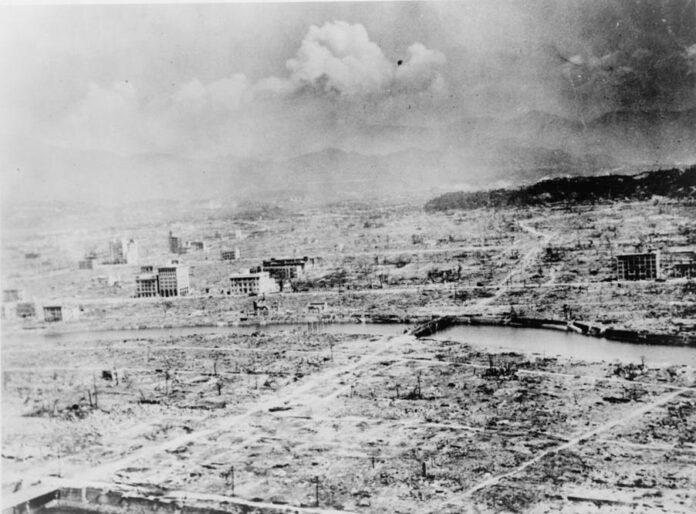
As if the photos of the flattened Hiroshima had never existed. They tried their very best to ignore and minimize the terror of nuclear annihilation, but it lingered. I grew up in a three-room apartment in the Bronx. No one we knew had the space, let alone the money, to buy a bomb shelter. But the absolutely remarkable thing is that somehow most of America absorbed the reality that Russia and the United States, mortal enemies and ruled by obviously flawed human beings, both had the capacity to wipe out life as we knew it. All hail the overwhelming ability of humans to deny the unpleasant.
Still, the human propensity toward violence prevailed. The dying days of the ’50s, though few noticed, gave birth to what was to become the Vietnam War, the terrible soul-wrecking tragedy of Vietnam, which was and remains to this day the curse that crippled us in so many ways. With cracks seen and unseen, Vietnam was the great calamity we have never fully reckoned with. Occupying an entire decade into the early 1970s, with the few who originally opposed the war growing over time into the many, suggesting, petitioning, marching, then screaming for an alternative, an end. Hey, hey, LBJ, how many kids did you kill today?
The new generation of the 1960s learned to substitute Mary Jane for Marlboros and, in between puffs and listening to “White Rabbit,” the Grateful Dead, then “In-A-Gadda-Da-Vida,” were continually confronted with the fear they might have to fight and die in Vietnam. They, it turned out, were decidedly more receptive to Allen Ginsberg than those of their parents’ generation.
It seems with “Howl,” like many a possessed bard, Ginsberg had glimpsed the future. Yes, years before they were living what they imagined was their very own unique present, Ginsberg had put to paper a version of how the peace movement would morph into the madness of the Weatherpeople, dreamt the drug-infused teachings/inventions of a Carlos Castenada, offered a look at the cataclysm caused by our seemingly unending assassinations, all the while speed and coke and smack and the acid alternatives to reality often turned from glorious to lethal.
As for the resistance, Ginsberg wrote:
who reappeared on the West Coast investigating the FBI in beards and
shorts with big pacifist eyes sexy in their dark skin passing out
incomprehensible leaflets,
who burned cigarette holes in their arms protesting the narcotic tobacco
haze of Capitalism,
who distributed Supercommunist pamphlets in Union Square weeping and
undressing while the sirens of Los Alamos wailed them down …
— Allen Ginsberg, “Howl,” from “Collected Poems,” 1947-1980
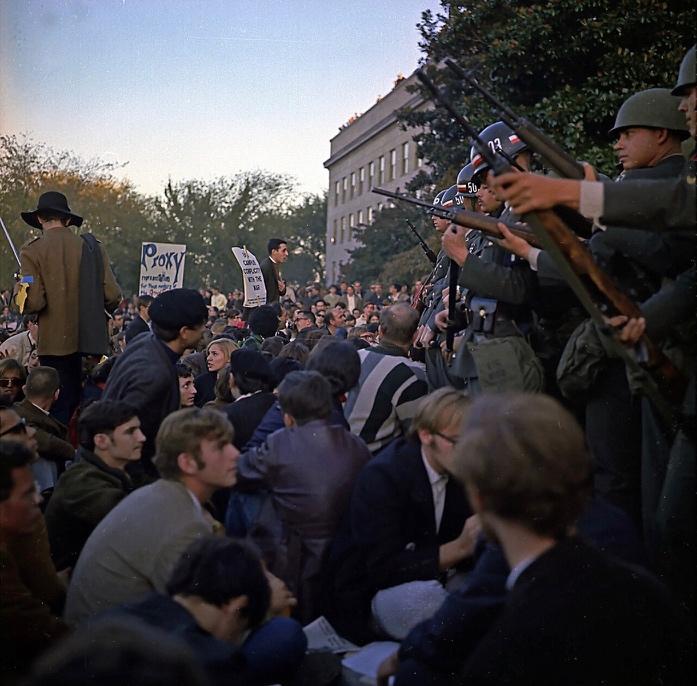
The National Mobilization to End the Vietnam War called for a demonstration on October 21, 1967, in Washington, D.C., Ginsberg, Gary Snyder, Timothy Leary, and others (including Yippies like Abbie Hoffman and Jerry Rubin) added an exorcism into the standard peace march and the attempt to levitate the Pentagon. We tried our best but never budged it:
And some tried flower power:
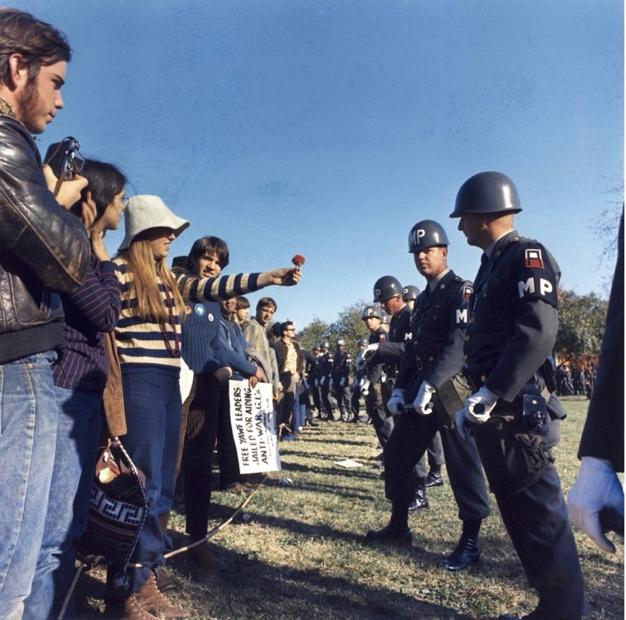
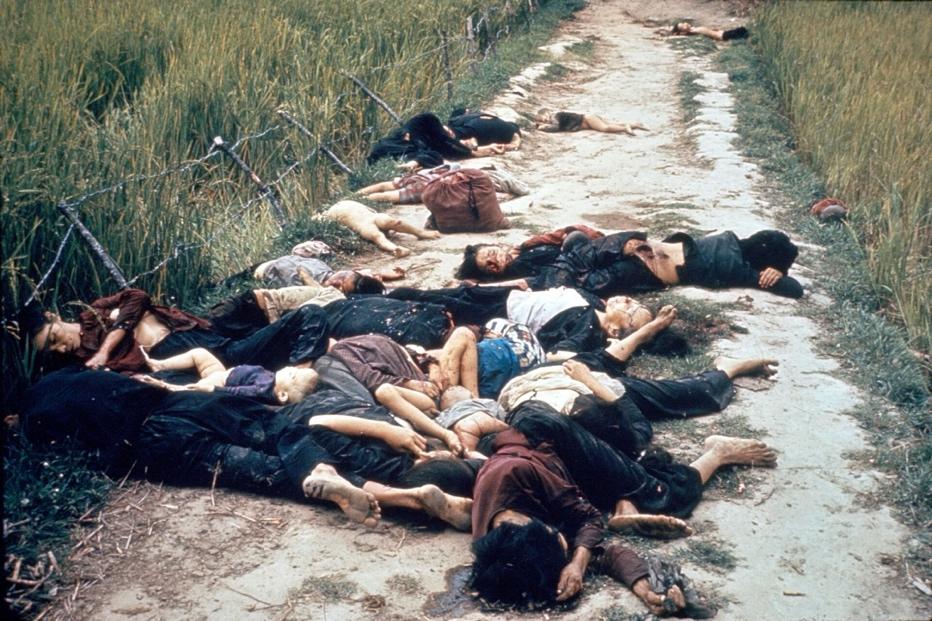
Yes, Ginsberg was right, so many leaflets were incomprehensible. But then again, his levitation didn’t do the trick. Martin Luther King was murdered, and many realized that, for the moment at least, nonviolence and the power of flowers to win peace had succumbed to tear gas and the gun. The war continued unabated:
So why “Howl” 2.0? Because more and more people I meet these days acknowledge their need to keep the increasing madness at bay. Older folks ever so reluctantly admitting that they are glad their end time is approaching. That ever since Trump, it seems impossible for them, for us, to ignore how effed the world is. Worse by the day. And, as their fear for their children grows, they truly don’t know what to say to them. Most advice seems inadequate to the challenge. Here at home, compassion is ridiculed and international concern is replaced by America First. Meanwhile, the bozos insist voting by mail is a danger.
And so many are more than willing to admit they hear “the Terror through the wall.” They just don’t know what to do. It’s not easy to accept that evil has re-emerged, reincarnated in its new MAGA manifestation. So intent is MAGA to destroy the little that is left of our morality. They demolish whatever progress we have made to instill equity and diversity. Who would have imagined that a candidate for the presidency, without the slightest bit of shame, regret, or apology, could proudly proclaim his penchant for sexual abuse. Show utter contempt for the Constitution. Mock our allies. Smash the melting pot. Extinguish the promise of the Statue of Liberty. Disband or neuter our most important agencies. End oversight. Denounce and renounce international action on the climate crisis. Reverse our attempts to feed the hungry and heal the sick. Then choose Vladimir Putin’s war of aggression over Ukrainian resistance.
When the most amoral man you know, one of the stupidest men you’ve ever been exposed to, tells America, yes, all of the world, that when it comes to military action, we must forsake international law and rely on his “own morality,” “his own mind,” well then, clearly it is time to “Howl.”
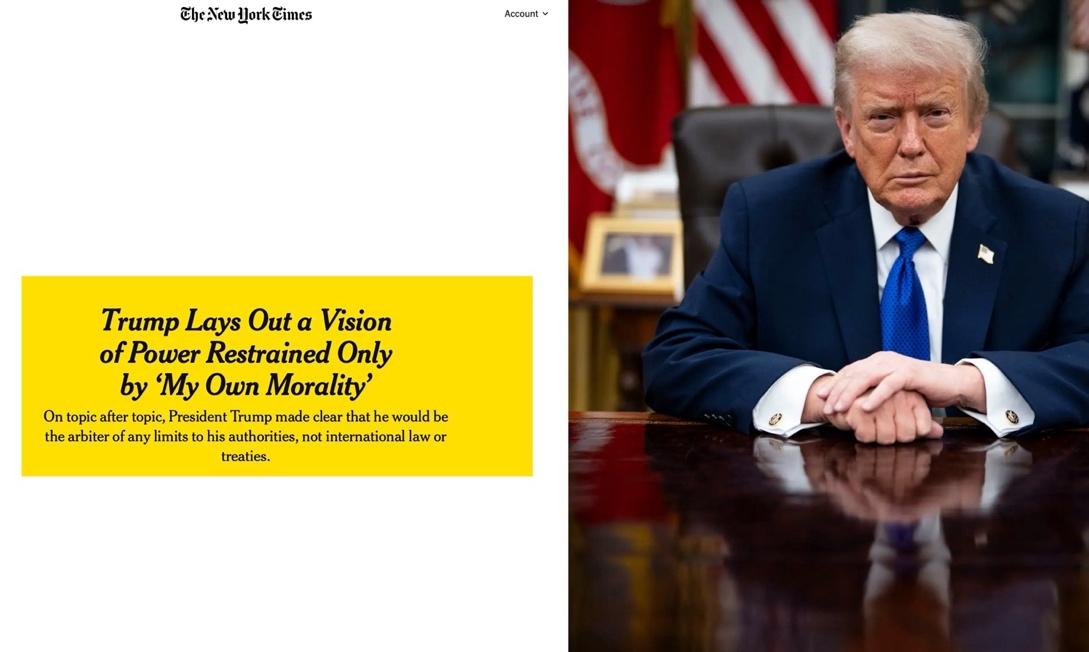
The New York Times notes:
President Trump declared on Wednesday evening that his power as commander in chief is constrained only by his ‘own morality,’ brushing aside international law and other checks on his ability to use military might to strike, invade or coerce nations around the world.
Asked in a wide-ranging interview with The New York Times if there were any limits on his global powers, Mr. Trump said: ‘Yeah, there is one thing. My own morality. My own mind. It’s the only thing that can stop me … I don’t need international law,’ he added. ‘I’m not looking to hurt people.’
When pressed further about whether his administration needed to abide by international law, Mr. Trump said, ‘I do.’ But he made clear he would be the arbiter when such constraints applied to the United States. ‘It depends what your definition of international law is,’ he said.
Mr. Trump’s assessment of his own freedom to use any instrument of military, economic or political power to cement American supremacy was the most blunt acknowledgment yet of his worldview. At its core is the concept that national strength, rather than laws, treaties and conventions, should be the deciding factor as powers collide.
[Emphasis added.]
To be clear, so much of what passed as the rules-based international order, free trade, and the free market was always skewed in favor of the most powerful. The United Nations never really stopped the strong from preying on the weak. And we routinely used military and economic power or subversion to remove and/or retain leaders we despised or favored in Cuba, throughout Latin America, Panama, Chile, Iran, Haiti, and the Congo, for example.
And so, with the war in Iran, I feel as if I have been sucked backwards through time, back to the onset of Vietnam and to April 1961 when a brazen John F. Kennedy, prodded by his advisors, decided to teach Fidel Castro and his fellow Cuban revolutionaries a lesson. Because their rag-tag guerilla army, with few resources and little training in the Sierra Maestra mountains, had the gall to oppose America’s man, Fulgencio Batista.
But, as the Encyclopedia Brittanica puts it, the reality for ordinary Cubans was:
[Batista] controll[ed] the university, the press, and the Congress, and he embezzled huge sums from the soaring economy. In 1954 and ’58 the country held presidential elections that, though purportedly ‘free,’ were manipulated to make Batista the sole candidate. His regime was finally toppled by the rebel forces led by Fidel Castro, who launched their successful attack in the fall of 1958. Faced with the collapse of his regime and with the growing discontent of his supporters, Batista fled with his family to the Dominican Republic on January 1, 1959 … and finally settled in Estoril, near Lisbon.
Like imperial powers before us, we were not about to let the people of Cuba decide their own destiny, especially when they had chosen someone we couldn’t control. So, it was time again to pick for them. Which led to Eisenhower’s, then Kennedy’s, military action at the Bay of Pigs: 2,400 CIA-trained and CIA-funded Cuban exiles, alongside some members of the Alabama National Guard, backed by eight B-26 bombers, were sent to undo the Cuban revolution. President John F. Kennedy, who was told the Cubans would welcome the invasion with open arms, lost in three days.
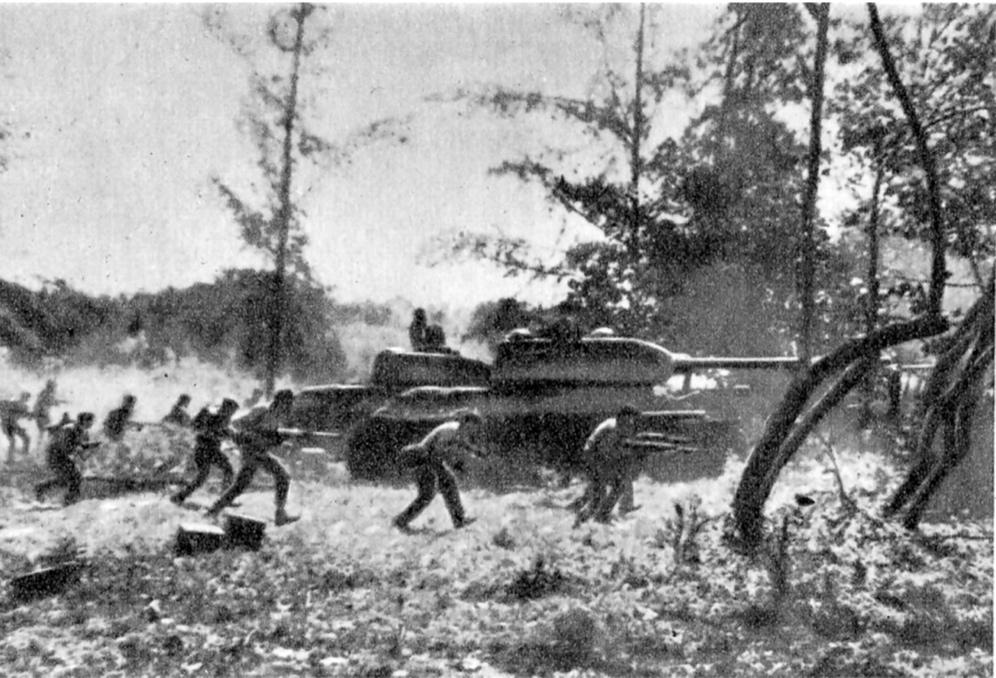
Castro became an ever-larger hero to his people and reluctantly relinquished his attempts to craft a treaty with the United States. Instead, he tragically turned to Russia. Which brought us the Cuban Missile Crisis and quite possibly the closest the world has come to nuclear annihilation.
Here is how the Encyclopedia Brittanica describes the Cuban Missile Crisis:
Having promised in May 1960 to defend Cuba with Soviet arms, the Soviet premier Nikita Khrushchev assumed that the United States would take no steps to prevent the installation of Soviet medium- and intermediate-range ballistic missiles in Cuba. Such missiles could hit much of the eastern United States within a few minutes if launched from Cuba. The United States learned in July 1962 that the Soviet Union had begun missile shipments to Cuba. By August 29 new military construction and the presence of Soviet technicians had been reported by U.S. U-2 spy planes flying over the island, and on October 14 the presence of a ballistic missile on a launching site was reported.
After carefully considering the alternatives of an immediate U.S. invasion of Cuba (or air strikes of the missile sites), a blockade of the island, or further diplomatic maneuvers, U.S. Pres. John F. Kennedy decided to place a naval ‘quarantine,’ or blockade, on Cuba to prevent further Soviet shipments of missiles. Kennedy announced the quarantine on October 22 and warned that U.S. forces would seize ‘offensive weapons and associated matériel’ that Soviet vessels might attempt to deliver to Cuba.
During the following days, Soviet ships bound for Cuba altered course away from the quarantined zone. As the two superpowers hovered close to the brink of nuclear war, messages were exchanged between Kennedy and Khrushchev amidst extreme tension on both sides. On October 28 Khrushchev capitulated, informing Kennedy that work on the missile sites would be halted and that the missiles already in Cuba would be returned to the Soviet Union. In return, Kennedy committed the United States to never invading Cuba. Kennedy also secretly promised to withdraw the nuclear-armed missiles that the United States had stationed in Turkey in previous years. In the following weeks both superpowers began fulfilling their promises, and the crisis was over by late November. Cuba’s communist leader, Fidel Castro, was infuriated by the Soviets’ retreat in the face of the U.S. ultimatum but was powerless to act.
The Cuban missile crisis marked the climax of an acutely antagonistic period in U.S.-Soviet relations. The crisis also marked the closest point that the world had ever come to global nuclear war. It is generally believed that the Soviets’ humiliation in Cuba played an important part in Khrushchev’s fall from power in October 1964 and in the Soviet Union’s determination to achieve, at the least, a nuclear parity with the United States.
And, unfortunately, we have spent subsequent decades punishing the people of Cuba and making trade nearly impossible with our never-ending boycotts. These boycotts and American attempts to assassinate Castro have both ensured Cuba’s continuing poverty and have regretfully resulted in the regime’s increased political repression. It seems as if Washington will never forgive Cuba’s decision to rid themselves of the brutal dictator Batista and actively oppose American interference in their affairs.
All of which brings us to our most recent military interventions. Flush with January’s temporarily successful invasion and removal of Venezuela’s Maduro, Donald Trump has turned with Israel to an unnecessary war with Iran and Lebanon.
You would think going to war was/is the most critical of decisions. Who are you fighting and why? What will be the consequences of that fight? In lives lost and men and women injured. You would think you would calculate the consequences—the obvious effects and attempt to anticipate the unforeseen. Of course, if you were really smart, you would exhaust each and every alternative to war.
Because Congress was not told or involved, because our allies were not involved or even informed, and because the American people were surprised, the administration has stumbled to justify going to war to crush the current Iranian regime while destroying a nuclear threat they had just bragged they had obliterated. Yes, with Operation Epic Fury, we were assured we would end Iran’s nuclear threat. Once again. A nuclear capacity buried beneath the rubble supplied by our mightiest bunker-busting bombs.
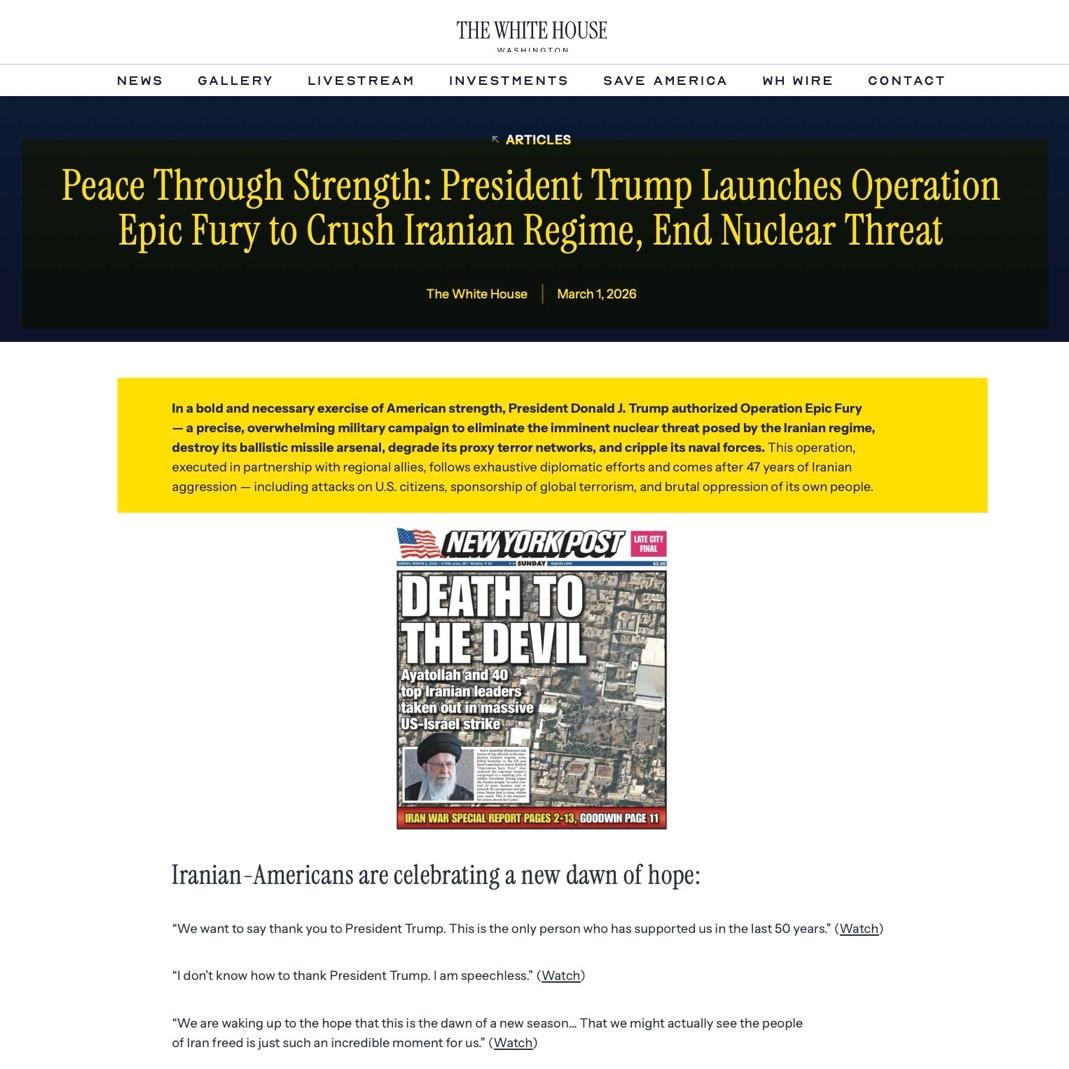
What was it President Trump told us:
In a bold and necessary exercise of American strength, President Donald J. Trump authorized Operation Epic Fury — a precise, overwhelming military campaign to eliminate the imminent nuclear threat posed by the Iranian regime, destroy its ballistic missile arsenal, degrade its proxy terror networks, and cripple its naval forces. This operation, executed in partnership with regional allies, follows exhaustive diplomatic efforts and comes after 47 years of Iranian aggression — including attacks on U.S. citizens, sponsorship of global terrorism, and brutal oppression of its own people.
In the following days, the White House and President Trump kept changing their stated reasons for taking us to war. Early on, we were told we needed to confront and eliminate the source and center of international terrorism. Considering that we had managed—protected in part by distance—to avoid any crippling act of Iranian terror here at home, that seemed a less-than-convincing reason to involve ourselves in an unpredictable war.
Problem was, Donald Trump had already been warned such an attempt would end in failure:
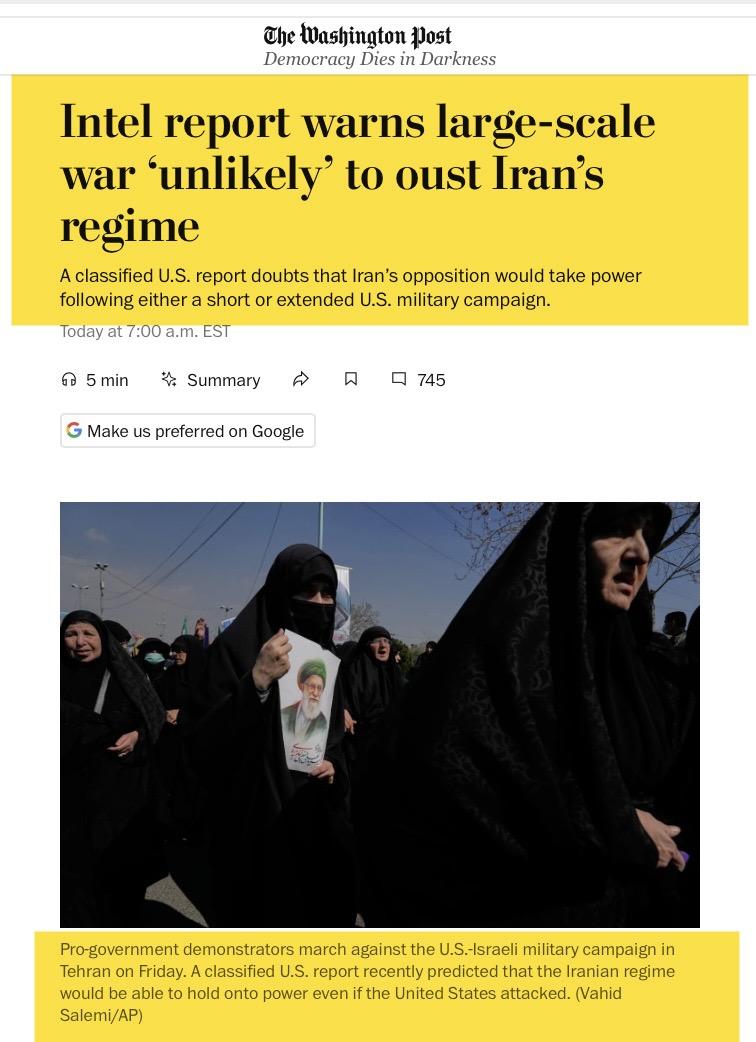
As The Washington Post reports:
A classified report by the National Intelligence Council found that even a large-scale assault on Iran launched by the United States would be unlikely to oust the Islamic republic’s entrenched military and clerical establishment, a sobering assessment as the Trump administration raises the specter of an extended military campaign that officials say has ‘only just begun.’
The findings, confirmed to The Washington Post by three people familiar with the report’s contents, raise doubts about President Donald Trump’s declared plan to ‘clean out’ Iran’s leadership structure and install a ruler of his choosing.
The White House tried once more to make the argument that, yes indeed, Iran really did pose an imminent threat to our survival. And worse, somehow, the timetable had accelerated. Suddenly, we were weeks from catastrophe.
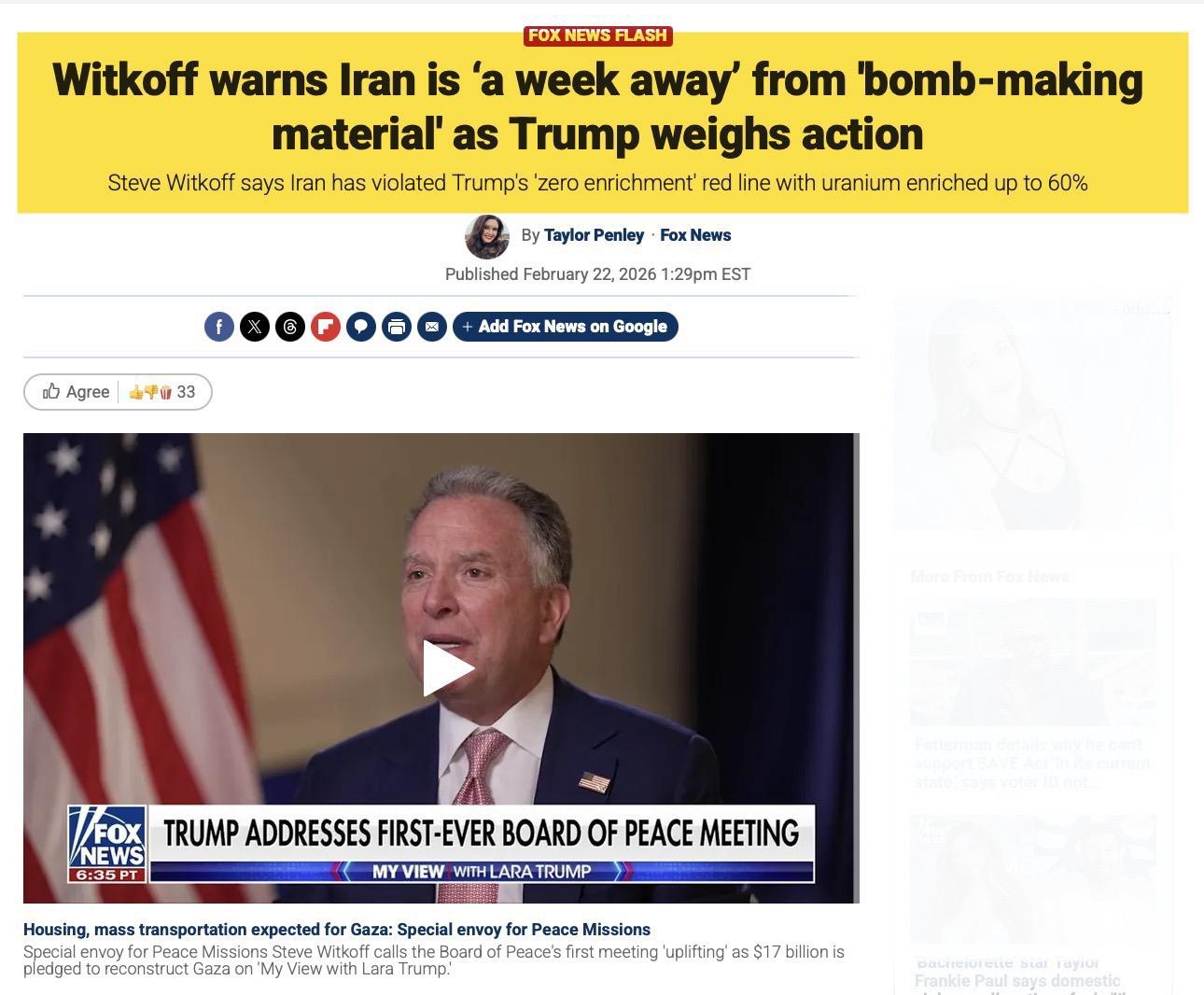
According to FOX News:
Special Envoy Steve Witkoff warned Saturday that Iran could be ‘a week away’ from having ‘industrial-grade bomb-making material’ raising urgent questions about what President Donald Trump could do next to address the looming threat. ‘It’s up to 60%,’ Witkoff said of Iran’s enrichment level. ‘They’re probably a week away from having industrial-grade bomb-making material.’
The ‘dangerous’ proposition, Witkoff said on ‘My View with Lara Trump,’ comes despite Trump’s ‘zero enrichment’ red line, which he accused Iran of violating ‘well beyond’ what a civil nuclear program requires. ‘We can’t have that,’ he said. ‘This is something that they have to stick with until they prove to us that they can behave.’
Have you ever watched someone go mad? I know there are far more sensitive ways to talk about escalating depression. But I have visited friends in those dedicated wings of the hospital. And sadly I have watched someone slip into debilitating paranoia, slowly consumed by rage, before taking her life. So, from where I’m sitting, the notion of going mad seems accurate.
Which brings me to “Howl” 2.0. Because I am talking about how slowly, inevitably, some of us, trying to deal with the fact that there are madmen lying us into an absolutely unnecessary war, are being driven bonkers. Is it asking too much of a rational mind to hold two entirely contradictory realities at the same time? To sit back and allow an obvious and apparent lie to justify the deaths of innocent civilians in several different lands, the destruction of safe drinking water, the destruction of the economies of many nations? And, yes, while the majority of the disruption is happening elsewhere, buildings leveled, infrastructure crippled, historic sites destroyed, we have already lost the lives of too many Americans. As the administration hardly mentions. them, more than 200 have been wounded.
I am talking about the mental gymnastics that will permit us to accept the Witkoff story.
Which requires us to believe that somehow the Iranians have miraculously recovered from the utter destruction Donald Trump rained upon their nuclear facilities last June. We must wipe from our memory the many times he bragged about the demise of their nuclear program.
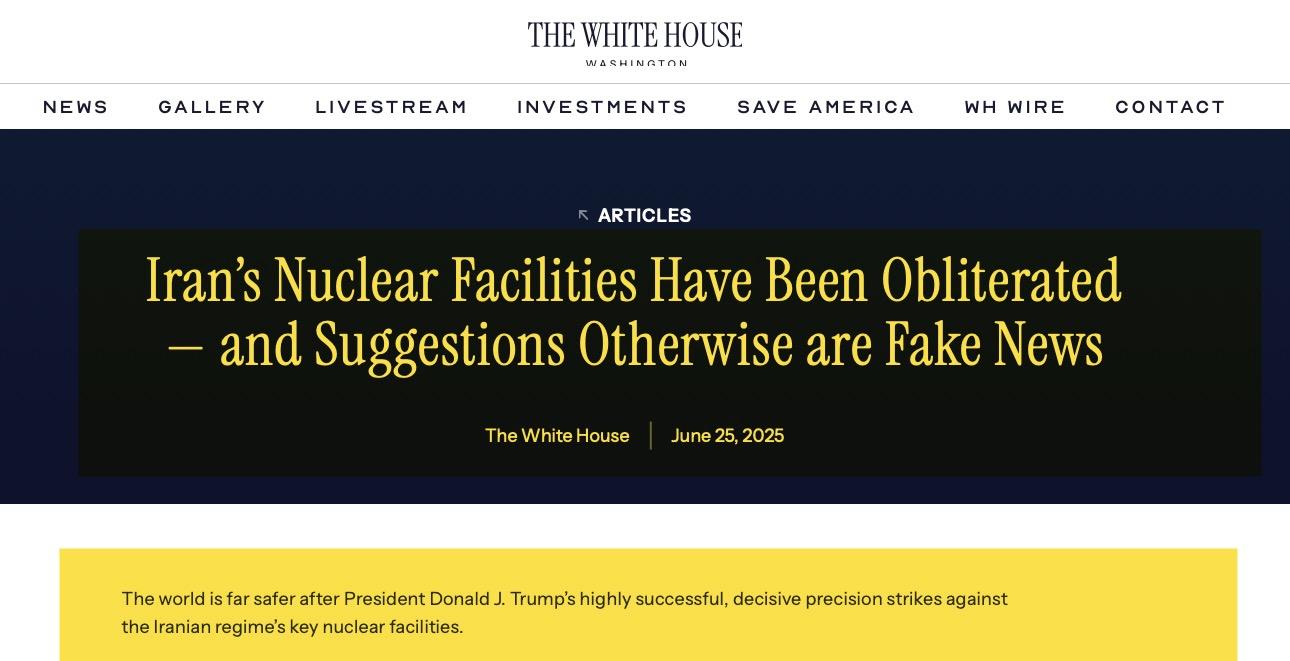
According to his White House posting, President Trump insisted:
Monumental Damage was done to all Nuclear sites in Iran, as shown by satellite images. Obliteration is an accurate term! The white structure shown is deeply imbedded into the rock, with even its roof well below ground level, and completely shielded from flame. The biggest damage took place far below ground level. Bullseye!!!
Meanwhile, the White House has upped the ante on Witkoff. The capacity to attack had transformed itself into the likelihood of an attack. On March 4, President Trump declared:
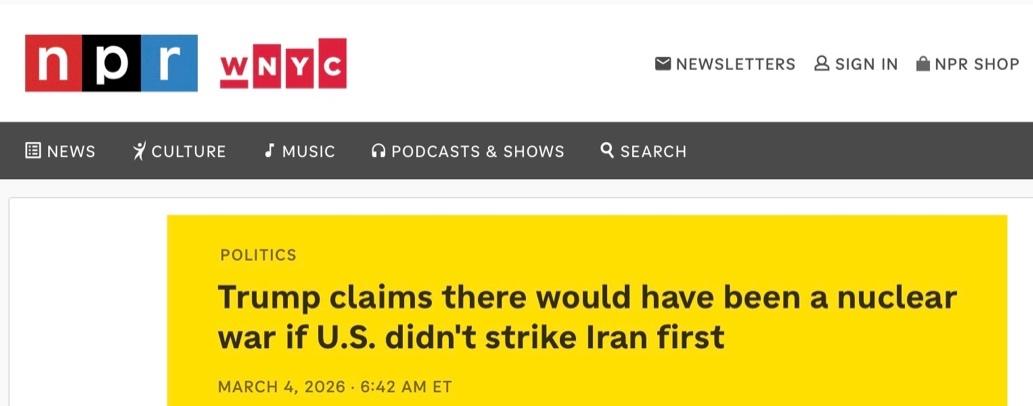
According to NPR:
President Trump offered a new reason Tuesday for the U.S. strikes on Iran, saying it was his opinion that the country was going to strike first. President Donald Trump: ‘But if we didn’t do what we’re doing right now, you would have had a nuclear war, and they would have taken out many countries.’
NPR White House correspondent Deepa Shivaram added his perspective:
You know, there has been a lot of mixed messaging here. And just to put this into context for a second, Trump said on Monday that the U.S. attacked Iran because Iran was developing nuclear capabilities and missile capabilities that would soon be able to hit the U.S., though previous government analysis says those capabilities were not imminent. But that seemed to counter what his secretary of state, Marco Rubio, said – that the U.S. believed Israel was going to strike Iran, and Iranian counterattacks would have put the U.S. at risk, so the U.S. struck Iran first … [Then] Trump was asked yesterday if Israel forced the U.S.’ hand. And the president said he might have forced Israel in attacking Iran after negotiations fizzled.
TRUMP: You see, we were having negotiations with these lunatics, and it was my opinion that they were going to attack first. They were going to attack. If we didn’t do it, they were going to attack first. I felt strongly about that.
Shivaram then made the point: “And I want to emphasize that Trump didn’t cite any U.S. intelligence that Iran was going to strike. He said it was his opinion and that he felt Iran was going to strike the U.S. or Israel.”
Yet more contradictions. Iran was now miraculously able to strike us first. Or maybe it was more likely that Israel was going to strike Iran first and so we had to hurry to involve ourselves. Because surely Iran would respond to an Israeli attack by attacking us. Unfortunately, if that was the case, it would appear that Israel had forced our hand. Which would mean that Netanyahu and Israel were in charge of this war and that Donald Trump was merely responding—a political reality Donald Trump couldn’t live with.
So, yes, they have gotten their war. As for a status report, here is what President Trump had to say in the Oval Office on March 16, 2026:
And I think we’ve probably proven that with Venezuela and now with — with — because we have done a number on Iran. But have I — if I didn’t do that, if I didn’t decimate, I call it the nuclear dust, they would have had a nuclear weapon within one month after that bombing took place and they would have used it on first Israel and then the Middle East.
And you know that because all of those missiles that were launched against their neighbors were set long ago, long before they knew they would be using them this quickly. Had we not done this, you would have had a nuclear war that would have evolved into World War III. And more important, this is a war that there would have been nothing left. So we’ve done a great thing. The people that say it’s okay for a very sick ideology, a very sick country in terms of its leadership, very good people, great people, but the people that say that — I think they’re actually — they’re either evil or they’re stupid. So if you believe that Iran should not have a nuclear weapon, they should not have it, then you have to absolutely love what I’ve done, because in two weeks we have decimated them.
They have no navy. They have no air force. They have no anti-aircraft weapons. They have no leadership. The leadership is gone. But then they set up a new leadership to go and name a new leader and that leadership is gone. And now they think maybe the son is gone. They’re all gone. My biggest problem is I have no idea who we’re talking to because nobody ever heard of any of these people.
They’re all dead. But we did a job for the world, not a job for us, for the whole world. We took the worst country in 50 years and maybe longer from the ideological standpoint, a country that wanted to blow up the world, a country that is sick, sick, and it has a religious fervor. And when you add religion — you know, people don’t realize more people died in religious wars than every other war put together.
And that’s what you would have had here and it was a terrible thing. I’m very proud of what we did. And I think JD understands better than most, if you give Iran a nuclear weapon, at least a very substantial part of the world would be blown up and it will be used almost immediately.
You can’t really hear me, but I am howling. How about you? If you have been watching, despite their total annihilation, their complete obliteration, the Iranians, much like the Vietnamese, have managed to meet the overwhelming massive American military might with their own sustained resistance. Here is a pertinent question and answer from that same Oval Office appearance:
Question: You were talking about Iran a couple times today and what they did after Epic Fury began. You said they hit Qatar, Saudi Arabia, UAE, Bahrain, Kuwait. Nobody expected that; we were shocked. Are you surprised that nobody briefed you ahead of time that that might be their retaliation?
Donald Trump: Nobody, nobody, no, no, no. No, the greatest experts, nobody thought they were going to hit. They were, I wouldn’t say friendly countries, they were like neutral. They were — they lived with them for years … I heard they were sending missiles to UAE. I said that’s strange. You know UAE is like the banker for — for Iran. They — they’re like the banker, Qatar, their neighbors, they got along okay. Uh, Saudi Arabia. All of a sudden Kuwait. Kuwait is getting hit. Bahrain is getting — all these countries are getting hit. There was no expert that would say that was going to happen. It’s not a question of like, gee, should you have known?
And if we did no big deal, I mean, we have to do what we have to do, but we hit them so hard like nobody’s ever been hit. We hit them very hard and we’ve extinguished most of their missiles. We’ve extinguished most of their drones. We’ve extinguished most of the places where the missiles and the drones are built.
We’ve fully extinguished two layers of leadership and probably a third, if you believe some story. So, uh, we only have one thing to have a little choke point and they’ve used it very well for years, but it doesn’t work …
And so here we are so many years later, and I am forced to remember all the lessons of Vietnam and Cuba obviously not learned. Considering recent American history, who would be surprised that Iran would fight back any way it could? The Vietnamese survived our never-ending bombing campaign, watched their bridges destroyed, their crops eradicated, and yet their peasant-based army used guerilla tactics to fight us to a standstill.
Back to the Oval Office:
Question: Can I ask you another question about the war? Uh, if Iran, as you say, totally obliterated, got the missiles, got the first two rounds of leadership, uh, air force gone, navy gone, can we wrap this war up this week?
Donald Trump: Yeah, sure. We could.
Question: Will we?
Donald Trump: I don’t think so, but it’ll be soon, won’t be long. And we’re going to have a much safer world when it’s wrapped up, it’ll be wrapped up soon. We’re going to have a much safer world. I had an obligation to do this. I didn’t want to — I called it an excursion. I didn’t want to make this journey. We had the highest stock market in history. We had low gas prices, everything was good and I know exactly — I know what, you know, you’re going to do it and people are going to raise the price of oil. But — but I know that, but that’s a very small thing compared to allowing them to have — you want to see a stock market go down? Start letting them hit you with nukes, OK? Uh, I think — I said it this morning, I think it’s a very small price to pay and frankly, I thought it was going to go down much more, if you want to know the truth.
Yes, it will be soon. It won’t be long. Which is why Secretary of War Pete Hegseth just asked for an additional $200 billion dollars because it costs money to fight the bad guys.
You think maybe it is time to HOWL?