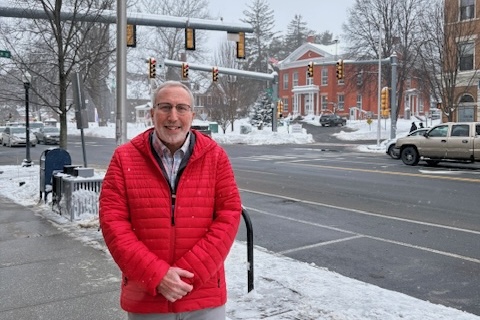
Steve Bannon (not that Steve Bannon, though even world figures have made the error) is one of the most familiar faces and voices of southern Berkshire County, having served on the Berkshire Hills Regional School Committee since 1999 and on the Great Barrington Selectboard since 2010. I caught him for a sit-down as he had just come off a shift at Fairview Hospital, where both he and I were born, and where he has worked as a pharmacist for 17 years.
Our conversation has been edited for clarity and concision.
SHEELA CLARY
How far back does your family go?
STEVE BANNON
My parents moved here from Pittsfield in the 1950s. My dad was from Brooklyn, and my mom was from Troy. He was a World War II veteran, stationed in England. He actually got a Purple Heart but didn’t talk about it—we found out towards the end of his life. What happened was he was going into a building, and it blew up, and he put his arm up and got wounded. He said he didn’t deserve a Purple Heart because he felt like he hadn’t saved anyone else.
After the war, he went to pharmacy school. My uncle was Melvin, who owned Melvin’s Drugstore.
CLARY
Melvin’s was our drugstore growing up.
BANNON
That’s my uncle. Melvin Katsh. In the ’50s he was like a department store. He had a soda fountain. My dad worked for him and then opened his own store, Bill’s Pharmacy, in 1968.
CLARY
Your dad was a pharmacist, and your uncle was a pharmacist?
BANNON
And my brother’s a pharmacist. I went to Bryant School, then Searles. I graduated Monument in 1976, then I went to the Hampden College of Pharmacy in Holyoke. (It became Mass College of Pharmacy my last two years.) I lived in Holyoke for five years.
CLARY
Did you always expect to move back here?
BANNON
I think I did. We were attached to the area. I could work at Bill’s. It started out where GB Eats is now. It was Bill’s, then it became Frank Tortoriello’s Deli after Bill’s moved into the [current] CVS building, in 1972.
CLARY
You’re not retired?
BANNON
Nope. Everyone thinks I am, but I’m not. We sold the store in 2009 to CVS, and I retired for nine months. That didn’t work out well.
CLARY
You got bored?
BANNON
I got bored. The yard looked nice, but that was about it. Dee Aberdale, Joe Aberdale’s mother, called me and said, ‘We’re opening a pharmacy here [at Fairview Hospital]. Can you come up for a few weeks and set it up?’ And I said I’d love to. I never left.
CLARY
How did you get involved in public governance?
BANNON
I started coaching the Golden Knights basketball in the mid-’80s. I coached softball, too, and I umpired Little League. Not very well, but I did it.
CLARY
Had you been an athlete at Monument?
BANNON
No, but they needed people. In 1997 I was still coaching, and there was an opening on the school committee. I was appointed unanimously.
CLARY
How many members were on it then?
BANNON
There were 10 just like there are now, but at that point, there were six schools [Bryant, Searles, Housatonic, Stockbridge, West Stockbridge, and Monument], whereas now we have three. It was a great community when I got on, with a lot of veteran people. Debbie Kane was on it, Elizabeth Baer, Mike Kirschner, the former police chief of West Stockbridge. I can’t forget Martha Muir. By 1999, Martha had done her time. We had elections in November, and the next thing I knew, I was chair. I haven’t left.
CLARY
So, the school committee came first, and then how did the town work come to be?
BANNON
In 2010, there was an opening on the Selectboard.
CLARY
Do you have any end date in mind?
BANNON
As long as I enjoy it, I will keep doing it. I have two more years, and I may run once more. I’ve made a lot of good friends, met a lot of good people.
CLARY
On the Selectboard side of things, what would be the highlights of your tenure?
BANNON
I’m taking no credit, but I think how of successful Great Barrington has continued to be. We have a lot of problems. We have housing problems, low-income, affordable housing, workforce-housing problems. I always look at things that need to be improved, but we’re working on them. But still, you look at Main Street and the people who have moved here. Great Barrington’s still a vibrant town, and I think that’s terrific. I always think of the things that need to be improved, and we’re working on them.
CLARY
I know from having spoken to business owners that downtown rents are increasingly unaffordable. What can the town do?
BANNON
That’s a problem we’re gonna have to deal with. One of the things we talked about last night was a residential tax exemption and the split tax rate. With the split tax rate, the merchants would end up paying more, and they’re having trouble now.
The residential exemption is interesting. People think of it as part-time people paying more. Well, that’s not true, because, through a complicated formula, there’d be a breakeven point to determine whether you would pay more or less. That point’s probably around, let’s say, $800,000. A lot of people who’ve lived here their whole lives, their houses are worth more than that, and they would end up paying more, not less. I am undecided about the RTE but do have my concerns.
If there was some sort of magic formula, everyone would be doing it [affordable housing]. But we have to spend less. We may have to change that mindset in the community, that we can’t have everything for everyone. I don’t know what that looks like yet.
CLARY
How’s the new Town Manager [Liz Hartsgrove] doing?
BANNON
She has only been here a few months, and she’s really acclimated herself. What I said to her is tradition is great, but if there’s a better way of doing it, we’ll do it a different way. She’s already made the statement that she doesn’t believe in random borrowing.
CLARY
How would you frame the top three issues facing Great Barrington and the most creative approaches to tackling them?
BANNON
Employment, housing, and infrastructure. Bridges, roads. We have 90 miles worth of roads in Great Barrington. Roads last, let’s say, 10 years. So if you’re not doing 20 percent of the roads every year, you’re falling behind. But we weren’t, because it was too expensive. So we have figure out ways to ensure our infrastructure is strong. We have to decide how far we can go and where there’s grants. Chris Rembold is very creative about writing grants. So is Joe Aberdale.
[Regarding the state of the town’s bridges,] I’m not proud of what happened, but what our plan was, and it clearly didn’t work well, is that the state eventually would redo all the bridges. Unfortunately, their timeline did not keep up with the failure of the bridges, especially Brookside. By next fall, we’ll have a temporary bridge at Brookside.
The governor just said in the State of the [Commonwealth address] that she was doing an accelerated bridge program. Leigh Davis mentioned there are 17 bridges she has in mind.
CLARY
When will she list what they are?
BANNON
We don’t know. It has to go through the Senate and the House. We’re waiting to see. But the state has been very cooperative. I’m hoping one of our bridges falls in that category.
CLARY
Which bridge would it be besides Brookside?
BANNON
Well, there’s Cottage Street, there’s Division Street, and we already know the bridge by Domaney’s is being replaced in 2030, on the state’s schedule.
CLARY
How is the school tax increase going to interface with the other increases?
BANNON
That’s a really good question.
What I will say about the school project is 78 percent of the people thought it was a good idea. They had their eyes wide open, knowing it would affect their taxes.
A new high school changes the way people look at the three towns. Saying it a different way, voting down a new high school changes the way that people look at the three towns. But I think you’ll see people will stay here or move here with kids. We do need younger families, and having a high school that was built in ’68 doesn’t scream, ‘Move my kids here.’ We just have to work hard to make sure that we don’t lose residents, and I think we can do that.
CLARY
What would you say to someone who used to live in town, used to work in town, and now feels so angry about the unaffordability of town that they go miles out of their way to avoid Main Street, because they feel as though the only thing that’s accessible to them is maybe Carr Hardware.
BANNON
The days of mom-and-pop stores, anywhere, not just for Great Barrington, are sadly, going away. I wish I had a magic ball and a way to bring them back. I love going to stores where I can actually say hi to the owner. The [Great Barrington Bagel Company] is a great example. I can say hi to Bob, and he’ll ask why I haven’t been in in the last month. That’s how I grew up.
Great Barrington is lacking some things that we may never get back. It’s hard to buy basic items of clothing here. People say to me, ‘I can’t buy underwear in town’—you know, since Kmart closed.
CLARY
What about the affordability issue?
BANNON
You’re right, it’s unfortunate that things are expensive. Why are they expensive? Taxes are high, rent’s high, and it’s spiraling, and we do have to figure out a way to slow that down.
CLARY
How has public service changed in your tenure?
BANNON
It’s mostly negative. It’s a really tough time to be a public servant, especially one with my name. Because people associate me with a certain Republican…
CLARY
Steve Bannon.
BANNON
I get mail. Funny story. I got a Christmas card with a family of four on it. I think it said, ‘Miss you.’ It was signed by a woman who was a Prime Minister of Great Britain.
CLARY
You mean Liz Truss?
BANNON
Yes. Wrong Steve Bannon. I used to get like 15 emails a week for him. I’ve gotten a couple books sent to my house that people wanted him to read. That bothers my family, because they know where I live. But I stopped getting the emails, which is good.
CLARY
How much time do you give on a weekly basis?
BANNON
Probably seven or eight meetings a week. I don’t meet on Fridays. I’ll have Saturday, two breakfasts, and then Sunday, maybe a breakfast and a lunch. I do this work because I love it.
CLARY
What lessons did you learn from the ‘Gender Queer’ issue?
BANNON
The school district, by having public meetings—which were the most painful one I’ve ever had in 28 years, and painful for Peter [Dillon], and for the school committee—I would like to think that we were open and transparent and honest as much as we could be. Even the people who disagreed with us respected us for sitting there and listening to the people who were affected. I like to think we’ve learned some lessons, and we all grew a little bit from that.
CLARY
What about specific lessons in terms of what went wrong?
BANNON
What I think is whenever there’s a controversy, wherever possible, talking about it, having either private discussions or public discussions, is important. Just to hide under your desk, or act like it didn’t happen, is not the answer. Kevin Kinne, who did the report for the school district, did a very open and transparent report. There was nothing hidden. It was: ‘Here’s what you did wrong.’ It sounds obvious, but in this day and age, politicians being transparent and honest is not always the normal way.
CLARY
What do you think went right with the new high school vote this time?
BANNON
It started with the architects and project managers. You’ve seen Donna DiNisco and her firm [DiNisco Design], and they were exciting. I said these people will excite the town. The town asked us, ‘Why did you pick Dinisco?’
I said, ‘Are you kidding me?’ When Donna got done [with her initial presentation and pitch], I was ready to get a shovel and start the project. She was enthusiastic. She came out, and they had Monument colors on the presentation. Simple things. She said, ‘I love Monument. It’s 70 beautiful acres. I want this project.’
So that’s number one. Then, the younger people, parents with kids in elementary and middle school, got behind the project. That was hugely important. The Yes Committee formed, and it was a great committee. Skanska [project development and construction firm], they knew what they were doing. They were all in.
I would have been happy with a 51 percent-49 percent win. But 78 percent? Everything came together.
The only thing I’ve been trying to push Peter [Dillon], and I don’t think it’s possible, is to also have plumbing. If I knew the vote was going to be 78 percent, and it was going to be another $10 million to put it in plumbing, I would have loved to see both [electrical and plumbing].
CLARY
How confident are you that a new high school is going to attract people to the area?
BANNON
I make no promises, but… talk to me in 2030 when it opens. People who’ve been in private schools, people who maybe have homeschooled, people who have decided to move here? I think it will happen.