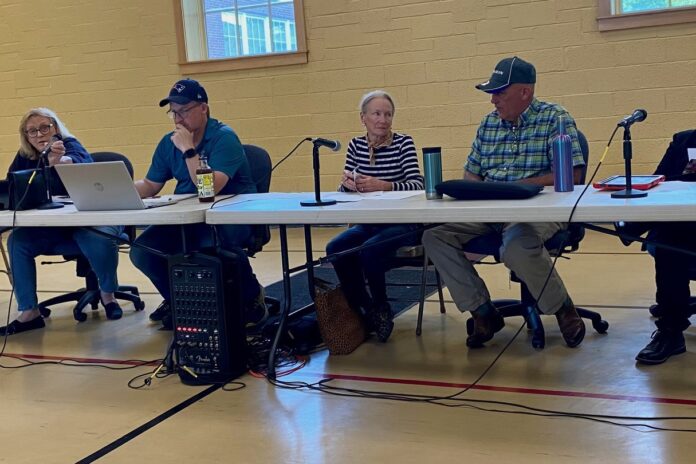
West Stockbridge — On the evening of May 20, Philip Shedd drove about an hour and a half from his home in Northampton, Mass. to West Stockbridge for the town’s Planning Board discussion of a proposal filed by The Foundry.
“What The Foundry is doing here is really unique compared to a lot of the other venues here in western [Massachusetts],” he said of the facility, adding that his experience includes working at various entertainment institutions from Boston to New York City. “It’s the productions, and it’s the environment. It doesn’t just bring people into a space to view dance or music; it brings people in to create a whole environment.”
For Shedd, the drive was worth the show of support for the venue and its owner, Amy Brentano, who requested a ruling that would allow all of the project’s sound-monitoring requirements be dropped. The December 5, 2022 special permit allowing The Foundry to operate required the venue account for its performance sound levels emanating from the facility, ensuring those levels remain below 60 decibels for higher frequency sounds and 65 decibels for lower frequency sounds, among other specifics. And, in the time between the granting of that special permit to date, according to Brentano, there has been a lot of those events—150 to be exact.
The town has been divided on this issue, with some residents bolstering the owner of a restaurant and home abutting the venue who has long alleged noise issues emanating from a few productions at the 2 Harris Street site that interfere with her quality of life and business. Over the past year, Truc Nguyen, together with her mother Trai Thi Duong, and on behalf of her restaurant Truc Orient Express, has filed appeals of decisions by the town’s zoning enforcement officer, Brian Duval, alleging Duval erred in his handling of actions brought by Nguyen that The Foundry violated the noise limits specified in its special permit. In all but one of those cases, The Foundry was determined to have not violated its special permit.
A case filed by Nguyen and Duong, naming The Foundry, Planning Board Chair Dana Bixby, and officers of the West Stockbridge Zoning Board of Appeals, is pending in Massachusetts Land Court.
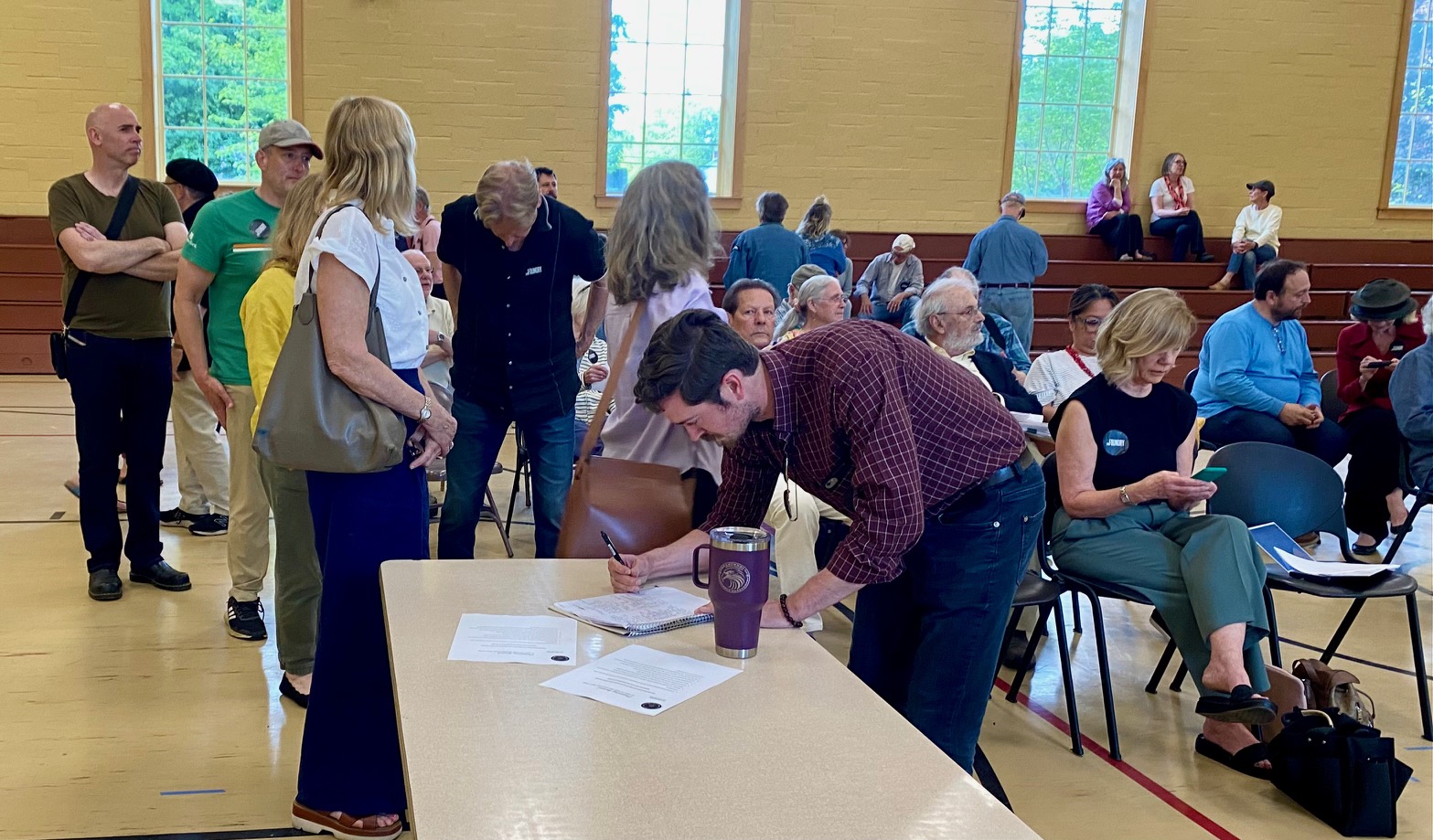
Along with Shedd, The Foundry’s large group of supporters donned stickers bearing the name of the venue. With the Town Hall gymnasium seats filled, a few hecklers made their presence known, but Bixby kept order. At the end of close to two hours of testimony, the group unanimously voted to continue the hearing on June 3, giving time to review the stack of reports, statements, and data from hired experts, along with an opportunity for Duval to present his side of things.
The Foundry’s case
The special permit, granted by a unanimous vote, allowed The Foundry to operate a multidisciplinary performing arts venue in the town’s commercial district that includes live music, dance, comedy, and community events as it “generates economic activity for the Village center,” Brentano said quoting the permit. Additionally, the permit provides that The Foundry will not “be detrimental to adjacent uses or to the established character of the neighborhood.”
Calling the sound-decibel-monitoring protocol at the property line “burdensome,” Brentano said every second of every performance held at the venue is required by the permit to be monitored. She said she not only purchased the professional sound-monitoring equipment in February but must also annually recalibrate the equipment. According to Brentano, Duval has found the venue to be in compliance with the required sound conditions in 12 performances with the exception of February 11, a 13th performance. With that performance, she said Duval reviewed the sound-decibel logs but not the corresponding audio recording, and the recording’s noncompliance is attributable to ambient noise that creates “spikes” of sound above the maximum decibel levels set by the special permit. Those “spikes,” or permit violations, have long been alleged by Brentano in previous hearings to be created by ambient noise—wind or traffic from the nearby Massachusetts Turnpike.
“It’s reasonable to assume that the Planning Board did not intend to infer that The Foundry is responsible for the ambient noise levels created by other sources than our own venue performances,” Brentano said, adding that the zoning officer should have been required to listen to the audio files to determine the source of the violative sounds.
Nguyen has been the lone abutter complainant in the 13 allegations of violation, Brentano said, “causing the zoning enforcement officer to spend hours listening to the seconds in the logs where the sound spikes over the allowed decibel levels in order to determine the source of the sound.” With events lasting typically two hours, she said each event creates 180 pages of log files Duval must review to detect those spikes.
“No other business in West Stockbridge, in our opinion, has been asked to jump through so many hoops for so long,” Brentano said. “And we have jumped through all of the hoops required of us. The toll this has taken on our business is real in terms of time and money and of great consequence. We ask that the town of West Stockbridge defend and protect our right to do business in the commercial district and put an end to requiring us to endlessly prove our compliance when no proof of detriment is required of the one, lone abutter alleging violations. Please treat us fairly, hold us to equitable and reasonable conditions, recognize us as an asset to the town and as a blossoming business in the commercial district with all the proper permitting and proven compliance so that we can continue to provide the community with the ability to come together through quality and accessible live performance.”
Although sound limitations are provided by town bylaws in the residentially zoned areas, no similar limitations are applied to the commercial district where The Foundry is situated, according to Brentano’s attorney, Bill Martin. “If the finding is that [the] sound, as we now know it to be, is not a detriment to the neighborhood, there is no need for the condition, and that’s why we’ve asked that the condition be eliminated in its entirety and not simply modified,” he said.
Local residents and business owners Sandra and Joel Hotchkiss approached the dais in favor of The Foundry, as did numerous others including Simon Davenport, a resident and The Foundry performer, pointing out that Brentano hosts the summer farmers’ market in the venue’s parking lot and collaborates with local restaurants to bring in patronage from the project. A petition in support of the venue’s position was turned into officials as part of the record, as were other emails in favor of Brentano’s amendment, Bixby said.
“Amy Brentano has curated an amazing number of events over these past four years and has overcome many obstacles along the way by cooperating and persevering, and now The Foundry is entering its fifth year in West Stockbridge,” Joel Hotchkiss said. “Hundreds of guests from West Stockbridge, the surrounding Berkshire towns, and beyond have attended performances at The Foundry, and many have signed the petition supporting The Foundry knowing that losing The Foundry would be a significant cultural fail for this town.”
Opposition
Attorney and resident Mitch Greenwald spoke in opposition to the amendment but not before objecting to Planning Board alternate member Sarah Thorne and new member Jared Gelormino, who is the technical director for entertainment venue TurnPark ArtSpace. Bixby responded that, in her experience and with the advice of town counsel, since Gelormino stated he has no financial interest in The Foundry, he is eligible to serve on the Planning Board’s decision.
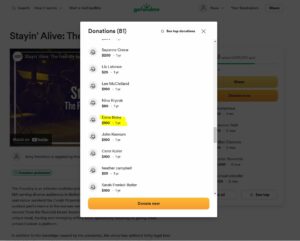
Previously, resident David Anderegg provided to The Berkshire Edge a letter showing a $100 contribution made by Bixby to the “Stayin’ Alive: The Foundry Fund” that pays for the venue’s legal fees, including Nguyen’s Land Court appeal, with both The Foundry and Nguyen factors in the amendment hearing. During the Planning Board hearing, Anderegg reiterated his concerns about Bixby. “It’s nothing about financial gain, but the appearance of unfairness is glaring,” he said. “You [Bixby] have used the words ‘fair and impartial’ several times this evening. Impartial? I’m asking you, can you possibly claim impartiality when you have given money to The Foundry’s legal defense fund?”
Although Bixby denied she has a monetary benefit from The Foundry, she said she supports the venue and has seen a few performances; however, without a financial interest, she had no reason to recuse herself. Clerk Ryan Beattie, an abutter owner, recused himself, with Thorne seated in his place as alternate. Member Christopher Tonini, an officer of abutter Wisdom Lodge A.F. and A.M. (Massachusetts Freemasons), remained on the dais as the facility was sold May 8, Bixby said.
“The problem is not The Foundry’s program—it’s great,” Greenwald said. “The problem is the fallout from it, the noise and sound.”
He said a residence is a permitted use in a commercial zone with very few other uses allowed as a matter of right, without getting a special permit. Although Nguyen is the lone complainant, Greenwald said Nguyen is geographically the closest abutter to the venue and that The Foundry’s sound, when above permit levels, is detrimental to the use of her adjacent property. According to Greenwald, the protocol of measuring the sound emanating from the venue “was fatally flawed.”
“Would any condition satisfy us?” he said. “Sure, we’ve said this many times: Soundproof the building. Do what you like; just don’t force others to endure it.”
Nguyen said she isn’t against The Foundry. “We have problems with certain programming that are detrimental and harmful to us,” she said, noting amplified sounds from base and drums. “It’s not a popularity contest. It’s not anti this, anti that. We’ve made it clear. We’ve always said that, and somehow the narrative is ‘we hate The Foundry, and we want them gone.’”
For Nguyen, the character of the neighborhood was established by her family when they moved in 45 years ago, with The Foundry site being a parking lot at the time. “Why does that get discounted,” she asked.
Nguyen said the noise levels set when the special permit was granted were determined without regard to how those levels impact the interior of her home and business. “If it’s wind, traffic, highway, airplanes, why does the data not spike like it does for the performances that harm us,” Nguyen said. “We’ve done the analysis … Everyone’s home is their sanctuary. Why is my home any different?”
In opposition to the proposed measure, resident Jon Piasecki noted the Williamsville Inn’s lack of amplification. “I think this all could be resolved by not having amplification,” he said.
Resident David Capeliss urged the Planning Board to deny the amendment before them, arguing that by allowing the petition, the contentious issue wouldn’t be resolved and instead prolonged and heightened. “If there had been no [sound] violations, it is because of the conditions, not despite them,” he said. “A solution to the complaints of undue noise, however imperfect, has been put in place. Jettisoning the solution would only reintroduce the problem.”
The meeting was held in person and the board did not offer virtual access.