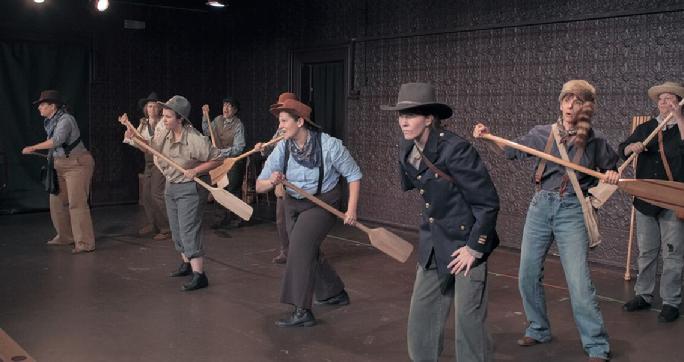
Men on Boats
By Jaclyn Backhaus
Directed by Patrick White
“We won’t know it’s the right choice until we make it.”

Famous for the 1869 Powell Geographic Expedition, a three-month river trip down the Green and Colorado rivers, including the first official U.S. government-sponsored passage through the Grand Canyon, John Wesley Powell served as second director of the U.S. Geological Survey (1881–94) and proposed, for development of the arid West, policies that were prescient for his accurate evaluation of conditions. He became the first director of the Bureau of Ethnology at the Smithsonian Institution during his service as director of the U.S. Geological Survey, where he supported linguistic and sociological research and publications. He had only one arm, having lost his left arm at the Battle of Shiloh in 1861, but he was still an intrepid cartographer.
Gathering nine men, four boats and food for 10 months, he set out from Green River, Wyoming, on May 24. Passing through dangerous rapids, the group passed down the Green River to its confluence with the Colorado River (then also known as the Grand River upriver from the junction), near present-day Moab, Utah, and completed the journey on Aug. 30, 1869. Jaclyn Backhaus’ play “Men on Boats,” now onstage at the Sand Lake Center for the Arts, celebrates that exploratory voyage in an all-female cast produced by the Acting Class with Patrick White, their first-ever presentation.
One section of this play takes the members of the expedition down a series of dangerous waterfalls, a beautiful physical exploration of stagecraft that shifts the positions of the “men” who truly bring us the effect of rapids and water movement and the impact of returning to churning, flatbed river water. In the 88-minute one-act play, this is just one of the sensational effects that director Patrick White achieves thanks to a very talented company of actors.
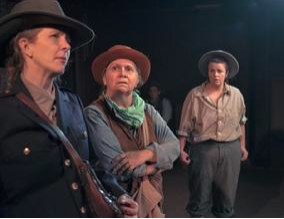
Chad Reid’s sound effects and filmic musical accompaniment tended to be a bit loud on opening night, sometimes drowning out the actors’ voices, but certainly providing an element of watery effusion. In particular Cori Irwin’s voice was often drowned by the expedition’s most essential aspect. She gave a definite dignity to the character of Powell, providing a constantly inspiring sensibility to his vision and command of the voyage.
As his younger brother Walter H. Powell, Susan Katz delivered nicely in Shady’s consistent support of Powell’s decisions and drive in the mission. Jeanette Horowitz as Andrew Hall, the team’s youngest member, delivered all the sweetness of the expectations of youth and, near the end of the play, exulted with glee at their success.
Among the best moments of the evening was the scene with the two Native Americans who advised the travelers on their future and provided help in revivifying their food supplies. Mary N. Williams, in particular, delivered a serious sense of joy in her performance as the sage. Myrna Bernstein’s opposite and serious Tsauwiat was a nice touch, and her later appearance as the government agent who greets the expedition on their arrival at their destination was just as good, if not better.
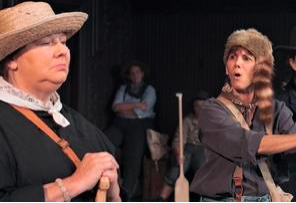
Key to the drama in this play was William Dunn, who assisted Powell in all things until he decided to abandon the team, taking with him the Howland Brothers, O.G. and Seneca. Dunn was delivered to this audience by Debra Bercier, who was the most convincing actor in the production. Her performance is dark and strong and wonderfully representative of the 19th-century Western man. I cannot imagine this role played better than Bercier gives us.
Iris Singer as the sane, sound voice of Sumner did a fine job. The Howlands, Sara Paupini as O.G. and Victoria Vine as Seneca, were excellent, as well. Susan Dantz as the Englishman who abandons the team after one too many near disasters gave a fine performance in the role, her accent clean and deliberate and her emotional responses clear as day.
The costumes, uncredited in the program, helped to define the characters, and even the one feminine piece of apparel didn’t distract from the character’s male identity. Barry Streifert’s lighting design helped to give a true sense of the isolation and mystery this company survived on those rivers so very long ago. In a show about discovering what isn’t known, the company, under the superb direction of Patrick White, opens our minds in many, many ways. There is no way I would undertake this voyage with any company of men other than the ones on stage in Sand Lake, New York.
–––––––––––––––––
Men On Boats plays at the Sand Lake Center for the Arts, 2880 NY Route 43 in Averill Park, New York, through Sunday, Sept. 23. For information and tickets, see the Berkshire Edge calendar, call (518) 674-2007 or go online to www.slca-ctp.org.