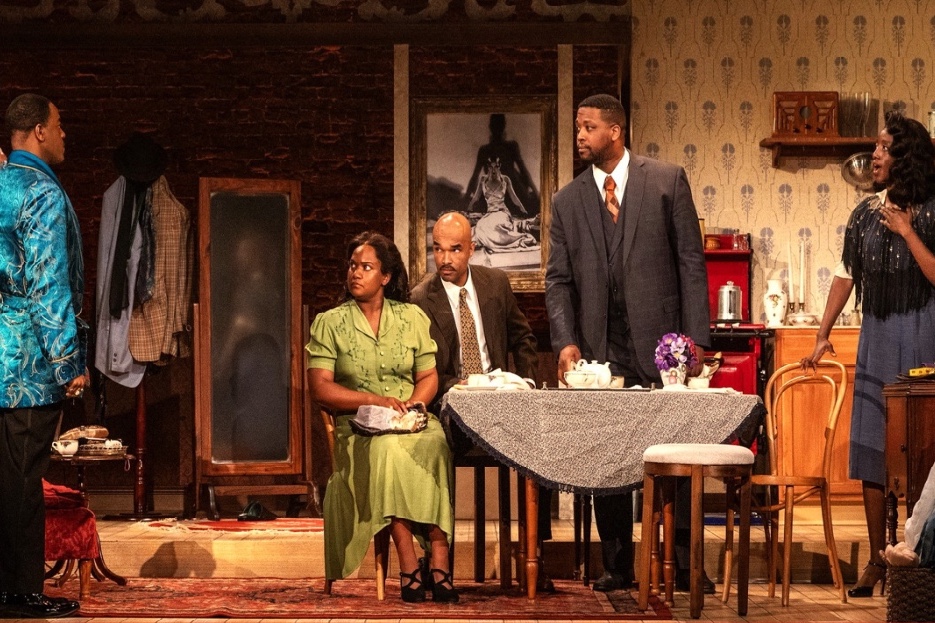
Barrington Stage Company in Pittsfield
Written by Pearl Cleage, directed by Candis C. Jones
“Just remember, Sweetie, Alabama isn’t just a state. It’s a state of mind.”
Barrington Stage Company’s production of Pearl Cleage’s play “Blues for an Alabama Sky” delivers a punch that pierces the decades, from its setting in Harlem in 1930, through its writing in 1995, to our world today. It is a moralism play about birth control, abortion, fair treatment of Black people (“Negroes” in the script), the impact of stardom, and the devastation of love.
Angel Allen, a singer in a club in Harlem, loses her job when she berates her white Mafia lover from the stage, and her best friend, nightclub costume designer Guy Jacobs, loses his job at the club for supporting her. Backing Angel is what Guy has always done. It is part of who he is.
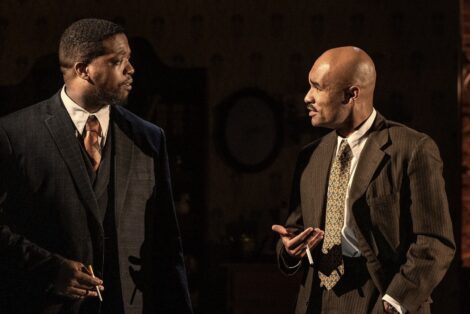
Getting her home to his apartment he receives unexpected aid from a total stranger, a newcomer to Harlem from Tuskegee, Alaba. He, Leland Cunningham, becomes the center of Angel’s world and the upset to the normalcy in which she survives. His country morality is out of place in the world Angel and Guy inhabit, and even her longtime association with gangsters does not prepare her for what inevitably takes place.
Tuskegee was the home of George Washington Carver, who revolutionized farming in this country. It was not a city of simplicity. Similarly, Savannah, Ga,, the place that gave birth to both Angel and Guy, was not a simple place. Located on the Atlantic coast, it was an urban center of trade, very cosmopolitan, and influenced by the world through constant visitation. People from the rural South and people from the urban South tended to sound different from one another in the first place, and growing up in Savannah and Tuskegee would have given different voicing to young residents, but the actors in this production, as to their origins, are indistinguishable from one another, a matter which the director could have corrected.
But the morality here is what is most important. Angel has not lived the finest life. We know that from the early moments of the play. Guy is homosexual and not afraid to exhibit that in his daily life. These are people who live in the forefront of their lives and their places in the world. Their friend, Sam Thomas, is a doctor who celebrates the birth of every baby he delivers but who is not afraid of performing the illegal abortions that women he knows need to have. He falls in love with a social worker, Guy’s neighbor, Delia Patterson, who is a 25-year-old virgin involved with Margaret Sanger, helping her to establish a birth-control center in Harlem (Sanger’s third in New York City).
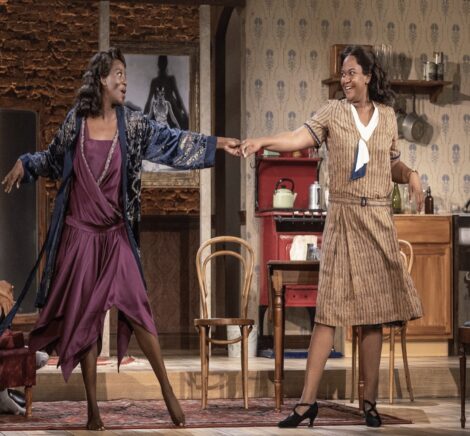
These are the characters and the situations that form the text of this play. It is exciting to watch their relationships grow and play out in the course of the two and a half hours it takes to navigate the six weeks of the story. To make things even better, the actors are quite remarkable in their roles. Jasminn Johnson is a lovely Delia. She brings delicacy into the play and does it right. She is no moralist, but is truly a good person. It is hard not to fall in love with her, and Dr. Sam does. He is played by Ryan George, an actor who has survived “The Play That Goes Wrong” and “Law and Order, S.V.U.” George exhibits honest charm in this stage role, and it is easy to believe in Sam’s conviction and his sense of right and wrong, which is only marred by friendship and loyalty.
DeLeon Dallas plays Leland and manages to avoid going over the top with emotional changes, which could easily have happened. His outrage is realistic, and his loving is exhausting. It is a memorable performance in its remarkable restraint. Angel, his love, is played by the beautiful Tsilala Brock, who sings well, moves well, and plays drunkenness with realism, and she has an immediate effect on the audience. Throughout the play, her Angel seems to struggle with what is right for her, and Brock makes the effort so worthwhile that the ending of the show is a letdown when all of Angel’s intentions go up in smoke. A hearty Brava for the realism in Brock’s work.
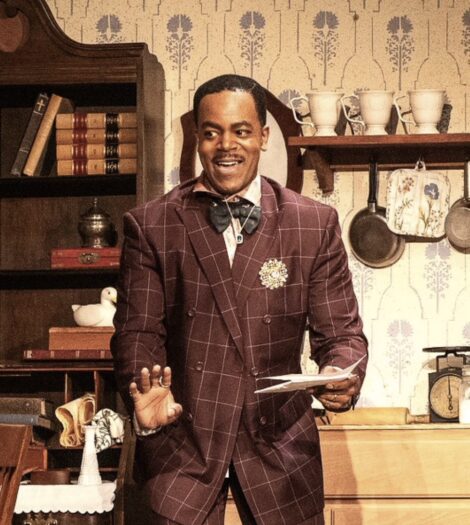
The hardest role of all belongs to Brandon Alvión as Guy. He keeps the “showiness” of Guy’s gayness to a minimum but makes sure that we never forget who or what Guy is. He plays his affection for both women with a genuineness that is smart, sweet, and suave. Guy’s devotion to Josephine Baker (whose all-important portrait is a design disaster! With so many available portraits of Baker available surely something better could have been chosen) is made clear, as is his ardor for Langston Hughes, Bruce Norton, and other great Black artists of the dying Harlem Renaissance (killed by The Depression). Guy is the lynchpin of the play, and he is firmly supported by the work of actor Brandon Alvión.
Candis C. Jones has done a decent job with the play (with reservation, some of which are stated above). It moves well on a very complex set designed by Sydney Lynne that doesn’t quite meet expectations (its two apartments are not compatible) from reading the script. Costume Designer Danielle Preston has created very appropriate clothing for these characters—though somewhat out of period style. Adam Honoré has lit the show with a bit too much staginess for my taste, and not enough illuminatioin. Fabian Obispo has designed a sound wall of sound to bring the show together, scene to scene, again not focused on the period. Earon Chew Nealey has devised excellent wigs, hair, and make-up design.
The final moment of the play is a letdown as Jones replaces the figure of a man, another stranger, with a dim nothingness that tells us nothing about Angel; there is no impact to the ending of Angel’s story. She becomes less important than the woman who used to live across the street from me on West 81st Street in Manhattan. I could hear her voice in the last line of the play, and see her leaning out her window as Angel does. Still, she never spoke out to no one; she waited for her moment. That is theater.
For his second main-stage play of his first season, Artistic Director Alan Paul has produced a play that refers to the Kit Kat Klub and has an abortion and a rejected lover and staggering costume effects, just like his own production of “Cabaret,” which opened the season on the Boyd-Quinson stage. The question remains: Will the next play also have coincidental similarities? Only time will tell. In the meantime, however, there is this excellent play to see. I think it should be seen in spite of its weaknesses. It brings relevance to today’s problems, today’s world, even if it is set more than 90 years ago. This is a play for our times.
“Blues for an Alabama Sky” plays at Barrington Stage Company’s Boyd-Quinson Theatre at 30 Union Street in Pittsfield through August 5. For information and tickets, go to Barrington Stage Company’s website or call 413-236-8888.