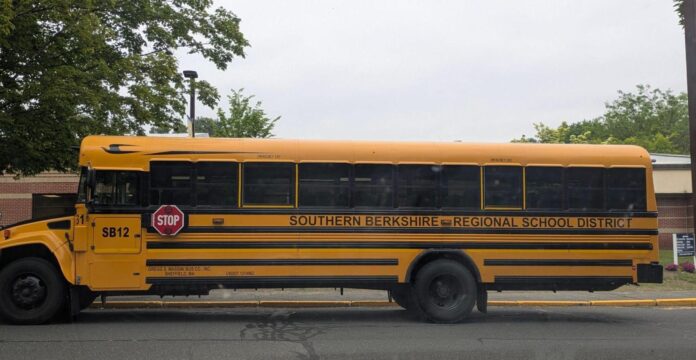
Sheffield — Residents and officials from multiple member towns spoke out during a public hearing on Southern Berkshire Regional School District’s proposed fiscal year 2027 (FY27) budget on Thursday, March 12, at the Mt. Everett Regional School library.
Superintendent of Schools Brian Ricca has put two proposed budget options before the School Committee.
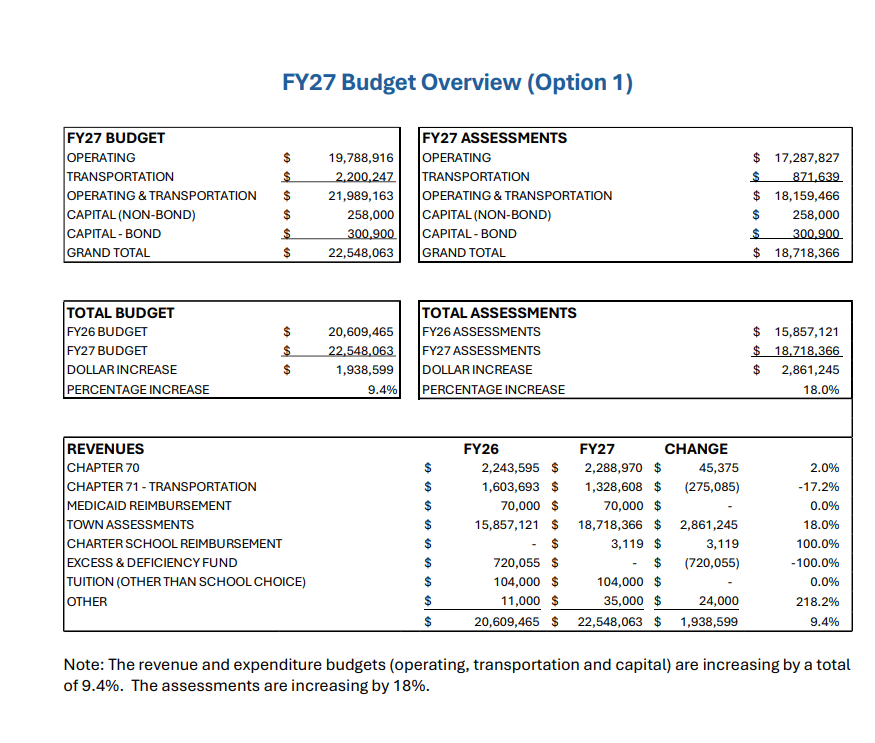
The first option is a fiscal 2027 budget of $22,548,063, a $1,938,599 (9.4 percent) increase over FY26. In this option, the revenue and expenditure budgets—which include operating, transportation, and capital budgets—are increasing by a total of 9.4 percent. If passed, assessments to district member towns would increase by 18 percent.
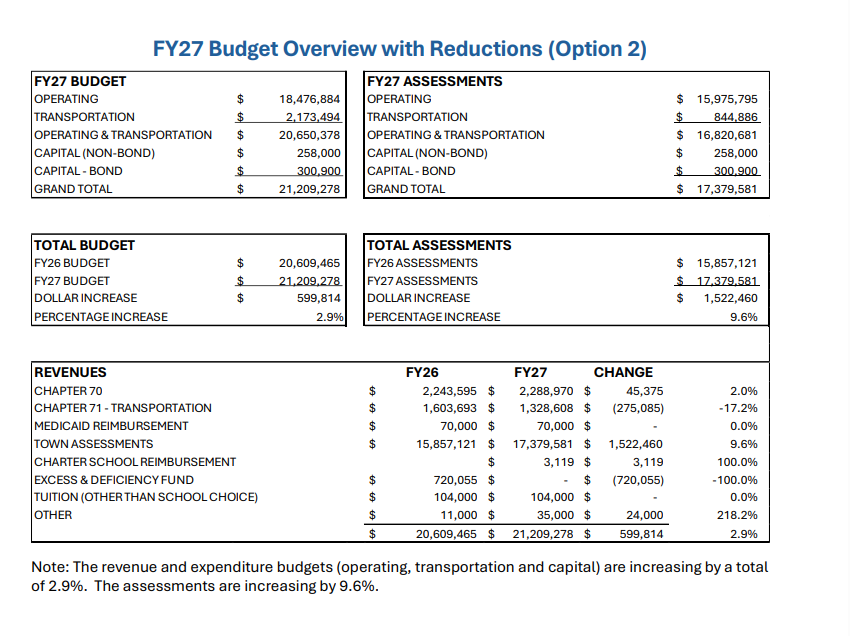
Ricca’s second option is a total budget of $21,209,278, an increase of $599,814 (2.9 percent) over this fiscal year. This proposal would see revenue and expenditure budgets increase by 2.9 percent, while town assessments would increase by 9.6 percent.
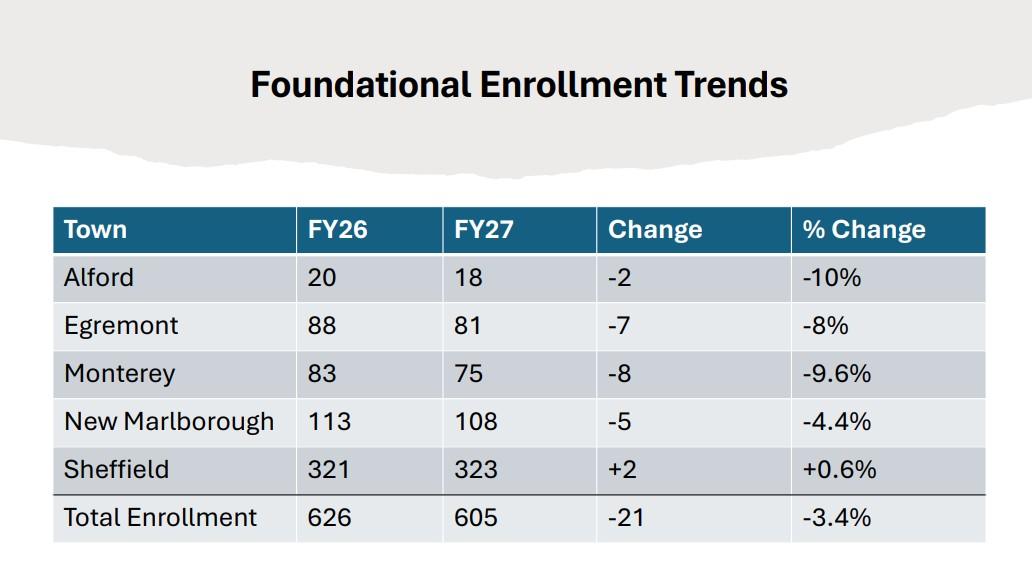
The budget documents note that total student enrollment is predicted to decrease from 626 students to 605 students for the next school year.
Ricca notes that despite the decrease in enrollment, Chapter 70 state aid is expected to increase from $2,243,595 for this fiscal year to $2,888,970 for FY27, representing a $45,375 (two percent) increase.
While Ricca predicts that transportation costs will increase by 2.5 percent in fiscal 2027, the Chapter 71 transportation reimbursement is expected to decrease by $275,085, or 17.2 percent.
Ricca also notes that employee health insurance rates will increase by 8.75 percent. The school district pays 80 percent of the employee’s plan, with a predicted fiscal 2027 cost of $340,000.
At the March 12 hearing, Alford Select Board member Bruce Schreiber asked Ricca, “Why should anyone consider the more expensive option versus the less expensive option?”
“I am going to be recommending to the school committee that they choose option one, with the expectation that the leadership team brings it down to a much more reasonable assessment point,” Ricca said. “The reason why we showed two options was to demonstrate that, with option two, which includes substantial reductions in force, the assessment amount is still unpalatable for the five towns.”
“Well, I think option two is more palatable than option one,” Schreiber told Ricca.
“But option two includes more than 10 reductions in force, and gutting some of our essential programs,” Ricca said. “With the amount of money and the gap that we needed to close [for option two], we took more than $400,000 from non-instructional places. But you could not [save] $1.5 million without seriously looking at humans. When you have that kind of budget gap, there’s no other way to close that gap without looking at [laying off] human beings while we honor the current salary structure.”
Ricca called the second option “an exercise to show that, with substantial reductions in force, it’s still an unpalatable budget, both in terms of assessment and in terms of programming here in the budget.”
Schreiber asked Ricca if he had considered consolidating the upper grades in the district’s elementary schools or closing schools.
Ricca said that, in accordance with the school district’s collective bargaining agreement with staff, he has not considered closing any schools. “We are directed to reduce non-professional teachers first, so teachers that have not earned professional status, three consecutive years in the district per our collective bargaining agreement, are the ones that we are directed to reduce,” he explained. “We are going to look at all the options that we have. I would not recommend to this committee that a teacher be assigned to a multi-grade class of three levels. I don’t think that’s appropriate, but we are looking at all options internally.”
When asked if Ricca could cut other budget items besides personnel, he said he could, but “it’s not going to really affect the overall [budget] gap.” “With the type, depth, and breadth of the gap we’re looking at, we’re going to have to get very creative,” he said.
During the hearing, criticisms arose about how the budget was presented, with a lack of line items in the budget documents.
Former Monterey Select Board member Rick Mielke, who was also previously a School Committee member for six years, criticized Ricca for the lack of details and budget line items in his budget presentations. “I was a math major who graduated from Westfield, and I can add and subtract,” Mielke said. “There’s nothing there [in the budget documents], no substance whatsoever. I saw [on budget option two] where you’re cutting staff, but you didn’t cut any benefits. If you’re going to cut 10 teachers, there should have been benefits taken out. I hate to be mean, but it’s a poorly put-together thing. You need to do line items because we can add and we can subtract. Honestly, you’re not smarter than we are. You just have a higher degree. You’re the one who put it together, and you’re the superintendent. I would like to have line items put together so I could tell you I agree with this proposal. I don’t agree with this proposal because you gave me nothing to agree with.”
Committee Chair Julie Hannum agreed with Mielke on the lack of line item documentation. “I was one of the School Committee members who abstained on the budget last year, looking for line items in the budget,” she said. “We have not had that, but I would like that process to return many, many years ago, where we can sit several months ahead of time and do that. Unfortunately, that is not the process that happened this year.”
The School Committee is expected to discuss and possibly vote on Ricca’s proposed budget at its meeting on Tuesday, March 17, at 6 p.m. The meeting will be held at Mt. Everett Regional School’s library and online via Zoom.
Update: At a contentious meeting, the School Committee voted to delay any vote on the proposed fiscal 2027 budget to a meeting on Thursday, March 26. An article in the March 17 meeting will be published later this week in The Berkshire Edge