Sometimes the act of writing is pure catharsis. At those times — not every day, not even every week — when I feel as though the only thing that will keep me from bursting is to sit down and write what’s ailing me, I sit down and write what’s ailing me. I deflate the balloon of disease inside me, until I can do other things again, like breathe in and out in a regular rhythm, feed the dog, pay the bills, sing along to a song on the radio. I’ve gotten better lately at turning these emergency writing products into something a reader might actually be able to relate to. The most recent personal essay I published here, came about this way one morning when I just couldn’t stand another minute alone in my skin with thoughts and worries, woes and inner screams.
Sorry if you’re here looking for more in that vein. (Stay tuned, though, because I’m due to be helplessly overcome with parental angst again next Wednesday or Thursday.) This writing now is not born of urgency. This morning my breathing is normal, my mind is uncluttered, and I’m feeling only the need to unburden myself of a little gratitude. Today I just want to say thank you, to the New York Times and its daily Spelling Bee game. What a gift it’s been to me and my family, not all of whom, it should be said, are verbally gifted. You don’t have to be a great reader or writer to enjoy the Spelling Bee.
Spelling Bee is a game — available by subscription for $40 per year, for which you receive the crossword and other games, too — that gives you a solid reason to at least sit up in bed each morning, if not get out of it. It serves up seven different letters on your device afresh each day. The letters appear in seven boxes arranged like a honeycomb, with one letter in the center. Today, October 12, for instance, the letters are: IHDEPTC, with “C” as the central letter, which each created word must include. Your job is simple: come up with all the words you possibly can. Easy. Also difficult. Also, most days, frustratingly impossible to perfect. I’ve found that not all 26 letters get equal play, or even their turn at bat. I’ve never seen an ‘s,’ or a ‘q,’ for instance. But more often than you’d think, based on Scrabble, you get a ‘j,’ a ‘z’ or an ‘x’.
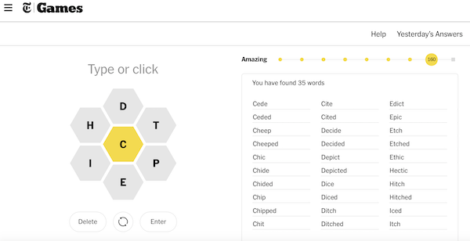
You start out on Spelling Bee as a ‘Beginner,’ but with just a word or two under your belt, your self-esteem is invited to ascend up to ‘Good Start’ and then ‘Moving Up’ and then, without too much trouble, ‘Good.’ But ‘Solid’ is sometimes quite a distance from ‘Good,’ and ‘Nice’ almost always a good ways from ‘Solid.’ (We are rewarded for each new word entered with a range of motivational compliments. I’m a sucker for “Awesome!”)
On busier days, my family needs to be satisfied with ‘Great’-ness level, though, on the days when “-ed” and “-ing” and “-tion” words are possible, we’re fairly guaranteed to be ‘Amazing.’ It feels better than great to be amazing, but not as great as it does to reach the pinnacle of Spelling Bee amazingness, ‘Genius.’ Today we got to Amazing before leaving to catch the school bus. (Today is an “-ed” day.)
Back in the early days of shutdown, when there was really nowhere to go except the grocery store, I could keep more or less up with my smart neighbor Joe, who’s always a genius, no matter what. One blessed day in that era I was even dubbed Queen Bee, which means that I had found every single possible word combination. When that happened, I did a little Rocky-at-the-top-of-the-library-steps-dance and then ran over to Joe’s house to gloat, I mean … share the good news. (He was also a Queen Bee that day, so we agreed to share the crown.)

The most common word in Spelling Bee? “Loll,” followed by “noon,” “toot,” and “naan.” But the list of possible words is not as expansive as the dictionary’s, which is sometimes, no, actually, often, annoying. The game is selectively curated. Words that have racist or sexist overtones are not permitted, which makes sense. Other exclusions, however, continue to baffle me, and I’ve had occasion to share my indignation with the Spelling Bee Powers That Be, a wizard named Sam Ezersky, who I imagine sitting behind a control panel of buttons for every single word in the English language, turning some on, some off, then turning the off ones back on, and the on ones off, and laughing maniacally throughout.
What on earth is wrong with “intinction,” for example, the everyday Catholic practice of dipping communion bread in wine, practiced by hundreds of millions of people around the world? More importantly than the insult to Catholics everywhere is the fact that I have on several occasions been robbed of nine perfectly good points because of this unjust ban on a perfectly good word. (I’m not the only one who’s taken umbrage at what Spelling Bee thinks is allowable. There are Reddit and Quora threads about the issue. A typical Quora entry comes from William Phelan, PhD English Literature at UCLA, who complained on August 21, “Today Sam Ezersky rejected the pangram ‘unclouded,’ which has nearly six million Google entries….Why, Sam, Why?”)
I realize I haven’t even told you yet about the pangram. Pangrams are the word or words that include all seven letters, and there is always at least one. Recent pangrams that I or my older daughter figured out include “awkward,” “eggplant,” “friction,” and “filching/flinching.” Recent pangrams that I wasted far too much time in my day failing to solve include “trattoria,” “fettucine,” and “calorific.” The fact that I missed those first two is just embarrassing; I’m an Italian teacher. But I refuse to feel embarrassed for failing to summon up “calorific.” What a stupid word.
 On October 4th, we also technically got credit for the pangram “immediacy,” but we shouldn’t have. My sneaky 11-year-old asked Siri for the answer while I was in the bathroom, then reported, “Mommy, I got it!” (Perhaps, I wondered, it was time to divest a bit of emotion from finding the daily pangram. Don’t want to drive my son to a life of word crime, do I?)
But, all told, I have really come here to say: God bless Spelling Bee. Tracing my family life over the past 19 months, I see what a wide variety of our needs it’s filled. In the spring of 2020, more times than I could count, getting from Great to Genius accompanied my glass of Prosecco as a sweet narcotic distraction from all the forms of impending catastrophe enumerated elsewhere in the Times. Ever since then, too, it’s been an informal homeschool aid, providing a fun, quick, painless way to develop spelling skills and vocabulary in my kids, to say nothing of the naturally-occurring opportunities it afforded them to research useful facts like the basics of Roman architecture (“ionic” columns), late Baroque architecture (“rococo”) and human anatomy (I’ve never had so many chances to spell “labia”). Also, Spelling Bee recently let my son show off some actual knowledge, apart from his Siri-assisted cheating abilities. He typed in a whole series of words — tonic, ironic, ionic, iconic, conic— one after the other, and revealed that these were governed by the spelling rules he’d just reviewed with his tutor. It’s not often my son gets to shine in tests of verbal ability, but Spelling Bee lets him.
Most poignantly, the game is an enduring common interest for me and my older teen daughter, one of the only ones we still enjoy, apart from rock music of the 1980s. When we sit beside one another at the breakfast table, crunching on English muffins, my laptop between us, our hands are nearly touching, and the nearly touching can go on for many long, quiet minutes as we become lost in recalling for one another all the verbs that include the consecutive letters “-tch.”
I ask you, what else in life can do all this?