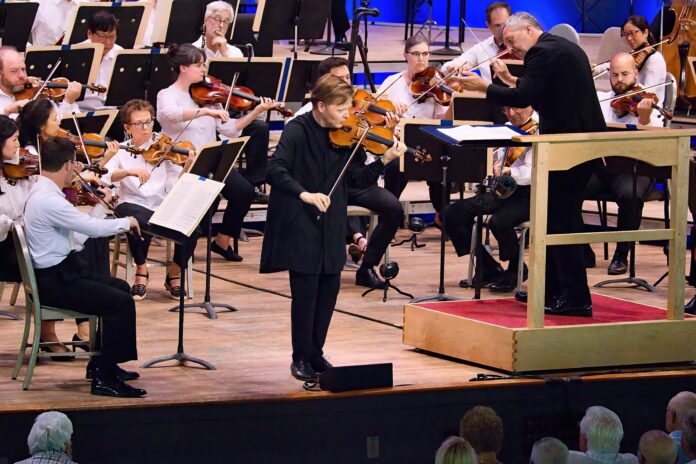
Thomas Adès conducting the Boston Symphony Orchestra at Tanglewood, Sunday, July 13
Program
Gabriella Smith, “Tumblebird Contrails” (2014)
Jean Sibelius, Violin Concerto in d, op. 47, with Pekka Kuusisto, violin
Sibelius, Fifth Symphony in E-flat, op. 82
The program was a well-thought-out combination of works designed by a conductor who had ties to all the referenced points of the compass. He had made a spectacular debut at Tanglewood with the major item on the program, one that helped propel a growing international career 40 years ago. About that performance, Will Crutchfield wrote in The New York Times:
[The] big, affirmative symphony … is a work that can sound a bit overblown if it is not borne along on a certain broad, inexorable momentum. [The conductor] caught that, and animated the local event in a way that was vivid and detailed yet not interruptive of the larger flow. The surge forward at the end of the first movement was exciting, and the great climaxes of the finale welled up and burst like a wave seen in slow motion.That performance was an epiphany in itself—a daring interpretation superbly executed with thrilling results.
This had been my first experience of a live performance of the Sibelius Fifth Symphony. The conductor was the then-27-year-old Esa-Pekka Salonen, and his return this summer to Tanglewood for this work and entire program was eagerly anticipated. Sadly, the maestro (now a youthful 67) had to withdraw; stepping heroically into the breach was a familiar presence at Tanglewood who knows his Sibelius: English composer, conductor, and pianist Thomas Adès. Interpretively, the musical results were quite different from what had been anticipated. The word “heroically” was not chosen casually; Adès is a very physically demonstrative conductor whose large, energetic gestures elicit a big, bold sound from the orchestra, especially the brass and percussion. His passionate commitment to this score and to the concerto was obvious. The second part of the heroic first movement of the symphony (originally a separate movement before being fused with the first in a revision), is ingeniously structured as a gradual and continuous accelerando ending with that “exciting” surge mentioned in the Times review, at which point Adès was positively dancing on the podium. His arrival velocity outstripped that of any other version I have heard.
This is a very demanding symphony for all the players, both musically and physically. It is one of the few pieces that the Tanglewood Music Center Orchestra struggled with in their reading under Stefan Asbury several years ago (2016). The energy, precision, and tonal luster achieved by the Boston players on Sunday were up to their usual world-class standards. What I missed in the performance was a careful balancing of the textures, especially in the second and third movements. Sibelius was a master of orchestration, as great in his own way as his near-contemporary Debussy. And like Debussy, his scores have to be treated with great delicacy to achieve a transparency which allows us to hear all the wonderful inner details. The sound Adès elicited from the orchestra seemed bottom-heavy, with low strings, brass, and percussion tending to erect a harmonic smoke screen that obscured delicate wind activity in the middle and upper registers.
The last movement of the symphony uses a layered texture that must sound both rich and transparent. There are two clearly defined themes: One, for four horns in a rich middle register, evokes a swinging bell or the flapping of great wings, oscillating widely spaced chords in a repeating four-bar pattern and, two, a contrasting lyrical melody played by the high winds above the first, with narrow intervals and a hymn-like intensity, not unlike the great nationalist themes found in “Finlandia” or the end of the Second Symphony. Underpinning it is an important bassline in the low strings that mirrors the bell-ringing motive at times and needs to be heard clearly.
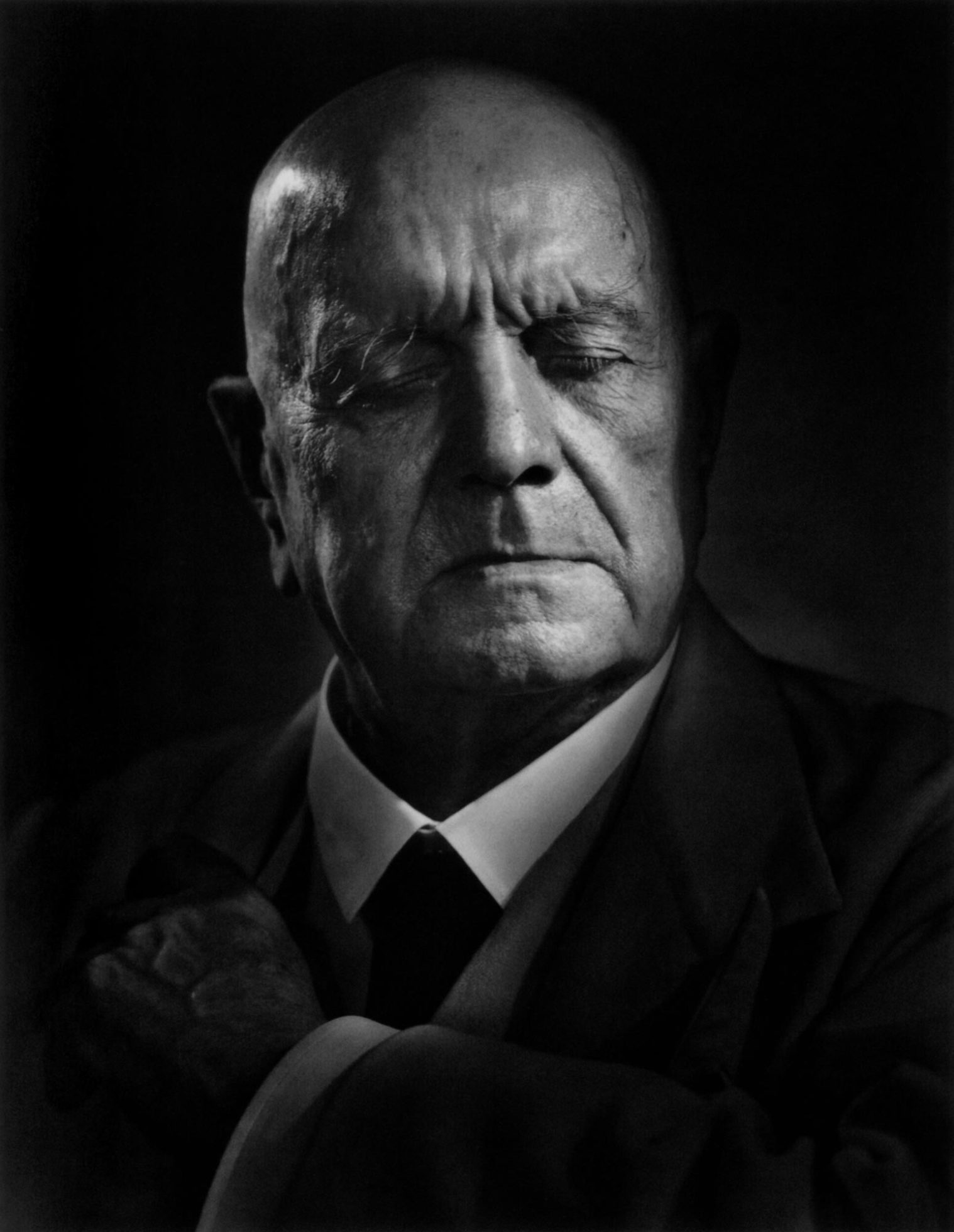
Sibelius wrote that this movement was inspired by watching a flight of 16 swans circling over his country home in rural Finland one April morning, the beauty of which triggered a spiritual revelation of the unity of nature. The mood generated is one of intense exaltation and great forward-flowing energy which is eventually halted by grinding dissonances welling up from the brass. The tension is released in one of the most original endings in the symphonic literature: Seven mighty chords separated by resounding silences, declaring a forcefully affirmative reconciliation.
In order for this finale to achieve optimum effect, all the layers of the texture need to be clearly audible. In Adès’ reading, the lower strings and horns produced a rich “soup” of harmonics that overpowered the more delicately scored song of the high winds, which is not only the capstone of the texture but the driving energy of the movement. The result sounded more episodic and less fluent than it could have (and as one remembers from that old Salonen performance: see the previously cited review).
The other Sibelius on the program was the Violin Concerto, which Adès had previously done at Tanglewood (in 2018, in a program that also included the Fifth Symphony) with Christian Tetzlaff, violin. On Sunday, the soloist was a very different artist, Pekka Kuusisto. Whereas Tetzlaff offered what I called a “high-testosterone” interpretation to match the robust (and richly scored) orchestral part, Kuusisto was mercurial and spontaneous, producing a more delicate silvery tone on his Stradivarius. Kuusisto is a charismatic performer whose interpretation seemed to spring out of the moment. His cadenzas (solos in a freer rhythm) sounded improvisatory: He could be seen listening intensely to himself, building the energy from a momentary inspiration, often whipping the violin into a frenzy that led dramatically into the re-entry of the orchestra. His rhythms had an extra “snap” to them and were rarely metronomic; there was an element of looseness redolent of the folk melos of many of Sibelius’s themes. For the most part, Adès did a good job keeping the orchestra synchronized with the soloist and brought out some colorful details of orchestration with exceptional clarity. The only fault was that the robust orchestration at its loudest was allowed to dwarf or almost drown out the soloist.
Kuusisto offered as an encore the demonic “Devil’s Polska,” which had a distinctly exotic (Eastern European?) flavor. It was a virtuoso nod to the rich realm of Scandinavian folk fiddling. He preceded this by sharing an anecdote about a motion offered in 1918 in the brand-new Finnish parliament to institute a monarchical form of government. Kuusisto recounted that the motion was rejected and commented, “It was not a good idea; I don’t recommend it.” The audience’s reaction indicated a hearty appoval.
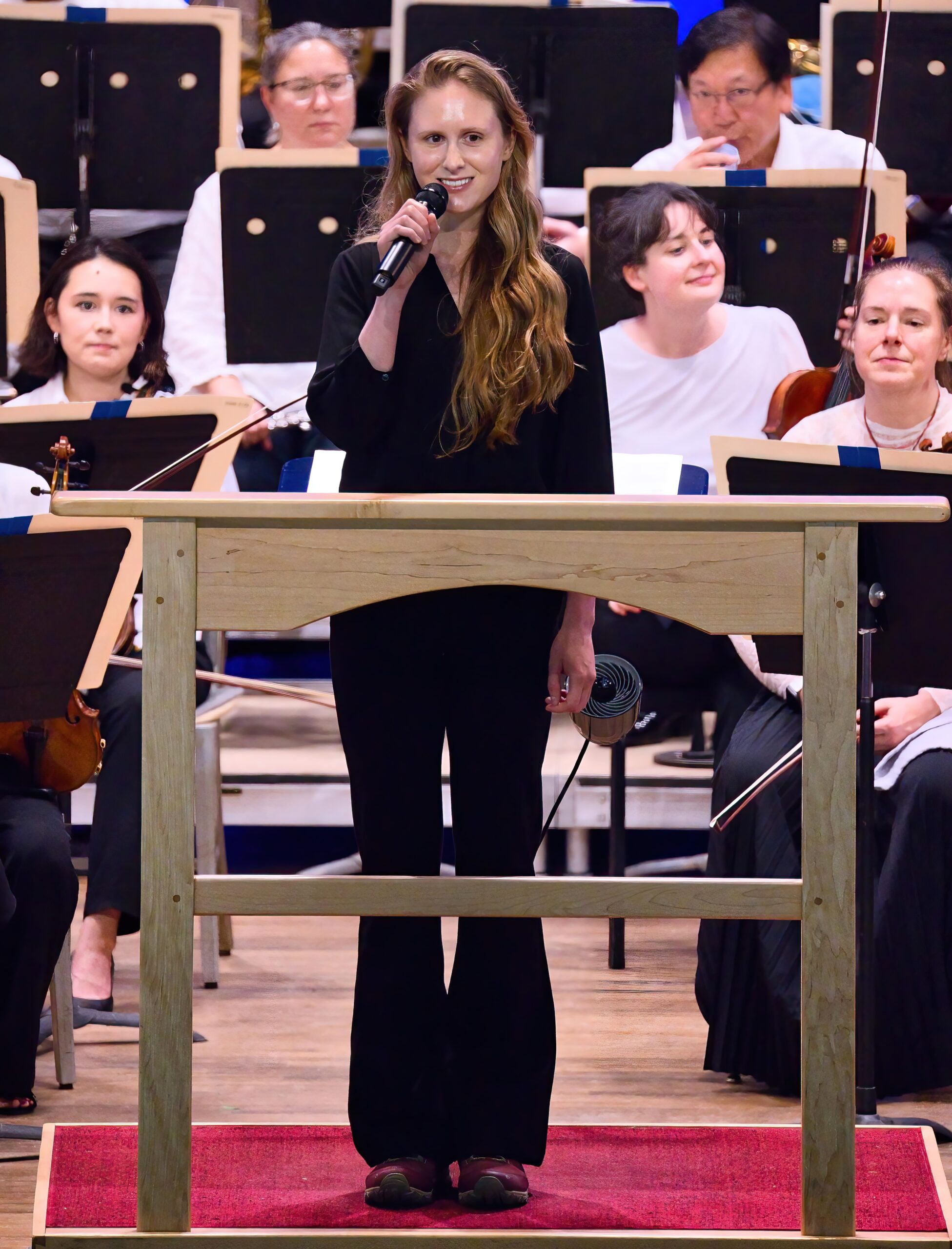
The opening work on the program, “Tumbling Contrails,” was substantial: a 14-minute orchestral expansion of another epiphanic moment, this one experienced by California composer Gabriella Smith while sitting on the beach at Point Reyes California toward the end of a three-day hike. The 34-year-old composer introduced this 11-year-old work from the podium, describing a soundscape that she sought to capture in the orchestral textures and their development. Like the first movement of the symphony, the work developed in a long continuous arc, starting with a bed of rhythmic percussion (wave, sea foam on sand, etc.) which remained active throughout, moving into sustained textures and suggestions of the cries of seabirds, culminating in a kind of lower brass hymn reminiscent (but not imitative) of the conclusion of that great classic of oceanic nature music, “La Mer.” Smith’s colorful work belongs to a contemporary genre with historical roots that could be termed “eco-composition.” The great exponent of this approach is John Luther Adams, whose longer work “Becoming Ocean” won the Pulitzer Prize and a Grammy (2014 and 2015, respectively), and it seems firmly rooted in West Coast musical culture.
While the spirit of Salonen hovered over this program, the musicians present precipitated it into tangible acoustic form in a manner and environment conducive to epiphanies for the audience, whose response indicated that the enterprise had met with success.