
West Stockbridge — On July 5, 1852, author, abolitionist, and freedman Frederick Douglass gave his speech “What to the Slave is the Fourth of July?” at a meeting of the Rochester Ladies’ Anti-Slavery Society held at Corinthian Hall in Rochester, N.Y. At the time, the union was 76 years old, and Congress wouldn’t pass the 13th Amendment to the U.S. Constitution abolishing slavery for another 12 years.
Douglass’ speech reads, in part:
What, to the American slave, is your 4th of July? I answer: a day that reveals to him, more than all other days in the year, the gross injustice and cruelty to which he is the constant victim. To him, your celebration is a sham; your boasted liberty, an unholy license; your national greatness, swelling vanity; your sounds of rejoicing are empty and heartless; your de nunciations of tyrants, brass fronted impudence; your shouts of liberty and equality, hollow mockery; your prayers and hymns, your sermons and thanksgivings, with all your religious parade, and solemnity, are, to him, mere bombast, fraud, deception, impiety, and hypocrisy—a thin veil to cover up crimes which would disgrace a nation of savages. There is not a nation on the earth guilty of practices, more shocking and bloody, than are the people of these United States, at this very hour. Go where you may, search where you will, roam through all the monarchies and despotisms of the old world, travel through South America, search out every abuse, and when you have found the last, lay your facts by the side of the every day practices of this nation, and you will say with me, that, for revolting barbarity and shameless hypocrisy, America reigns without a rival …
The full speech is available here.
Almost 173 years later, on Friday, July 4, over 100 people attended and took part in a community reading of Douglass’ speech at the TurnPark Art Space in West Stockbridge.
The reading was held in conjunction with Mass Humanities, the Du Bois Freedom Center, and the West Stockbridge Historical Society. The event, “Reading Frederick Douglass Together,” has been presented by Mass Humanities at 50 different locations throughout the state.
“If you read the speech, there is so much of it that was said then that rings true now, particularly in this current political climate of the country,” West Stockbridge Historical Society President Bob Salerno told The Berkshire Edge. “The speech has this whole perspective of how this country formed in the sense of independence, freedom, and democracy. In his last few paragraphs, Douglass writes about how America is not in isolation but is part of the world. Douglass wrote that democracy is not a set-and-done thing. He wrote that democracy is something we have to continue to work on and fight for. It’s an important underpinning of our country.”
“It’s important to remember how recent this speech was and how recent slavery was,” emphasized West Stockbridge resident, composer, and event co-organizer Eric Shimelonis. “Slavery didn’t exactly stop on a dime. It’s important to understand Douglass’ words and understand that we are still doing work to form a more perfect union.”
Mount Holyoke Department of History Assistant Professor D. Caleb Smith hosted the event. An affiliate of the Critical Race and Political Economy Department at Mount Holyoke College, his work has appeared in the American Journal of Legal History, Black Educology Mixtape Journal, Labor History, and Left History. “Reading his speech brings more realization to what this day means, especially what it means to the racial minority,” Smith said. “To me, this speech is important because it calls for awareness in terms of abolition, and it also critiques how Americans think of and remember the Fourth of July. One of the most significant things that we, as contemporary historians, can do is challenge public memory regarding celebrations, including monuments, and how we perceive them in a contemporary context. I think that the reading of Frederick Douglass’ work comes at a vital time in America because democracy is in shambles. We have valuable lessons to be learned from this speech.”

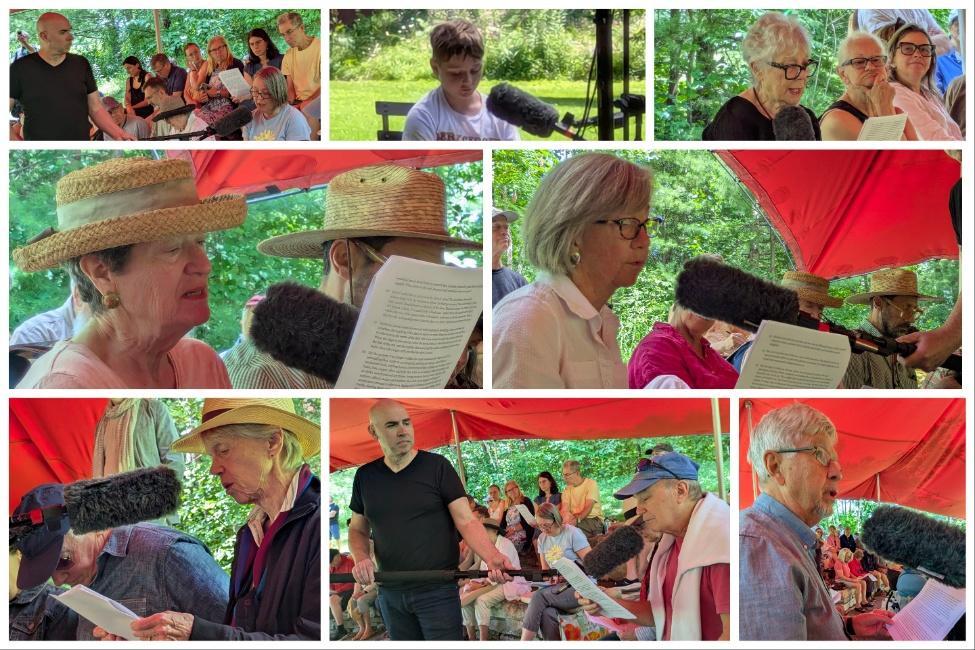
Smith said that while Douglass was critical of slavery and the state of America in his speech in 1852, he found ways to offer hope. “His speech honored the abolitionist movement,” Smith said. “We are constantly interpreting the Declaration of Independence, the U.S. Constitution, and the ideals of the founding fathers versus the actuality of what rights are supposed to mean today. Douglass gave a lot of harsh criticism, but he also gave hope. I think that’s the one thing that we could benefit from now is optimism, especially considering the dark period of history that we are in now.”
For more information go to these websites:
Du Bois Freedom Center
The West Stockbridge Historical Society
TurnPark Art Space
Mass Humanities