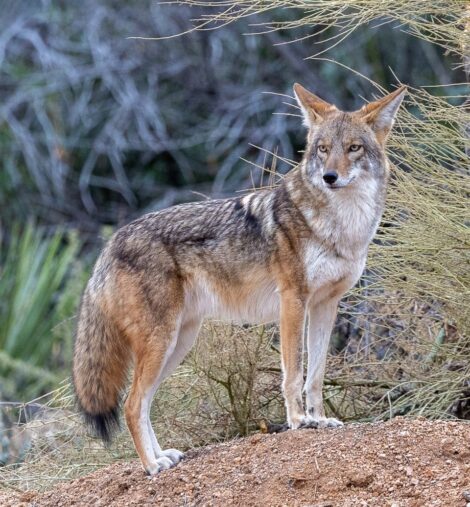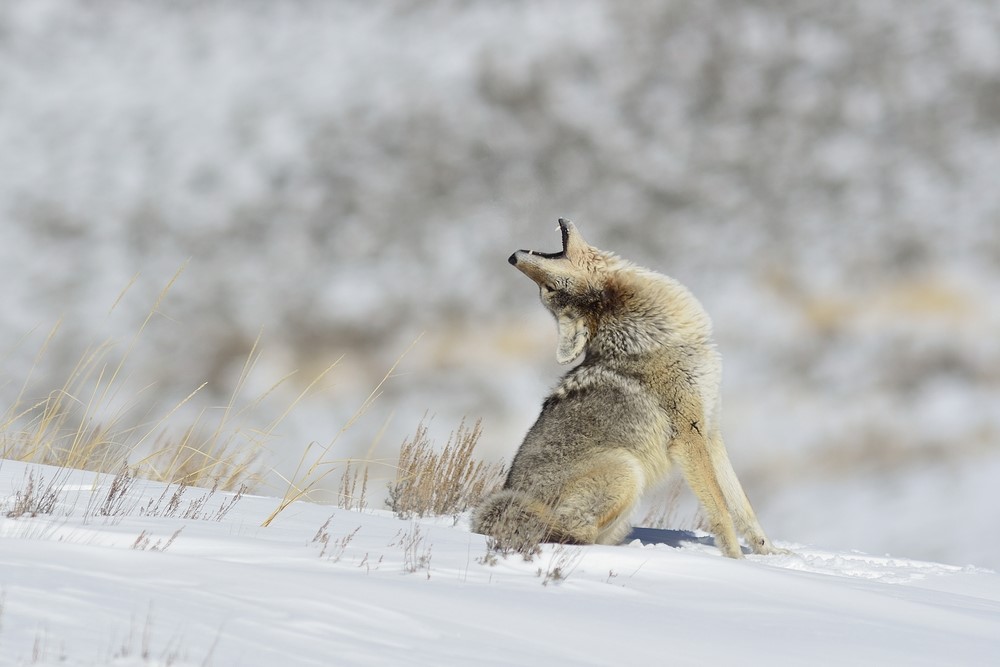
“Not only did western Indians select the coyote, among all the animals available to them, as a deity responsible for the creation of the world, he also functioned as an avatar—a stand-in for humans in the world—whose real function was to instruct humans about the foibles of human nature.” — Dan Flores, “Coyote America”
To be stirred by the nighttime singing of a chorus of coyotes communicating with each other is the only way most of us discover that coyotes inhabit our landscape. Though seeming nearby, vocalizations could be from a great distance. Known as Song Dog by many native peoples, the root of the name Coyote is found in Aztec mythology of thousands of years ago.
Generally active from dusk until dawn, sensationalist media reports aside, coyotes discreetly avoid contact with humans. MassAudubon’s Dale Abrams exclaims, “They are incredibly secretive.” Nature Conservancy’s Rene Wendell recounts a serendipitous opportunity, “I was driving past Berkshire School in Sheffield when I spotted three coyote pups playing in a roadside field. Mom arrived and they settled down to nurse. I got to watch them nursing!” Rene continues, “It makes my heart swell to see this impressive animal. I always feel safe.”
This idyllic picture is reminiscent of the 1804 writings from the Lewis and Clark expedition west of the Missouri River, where the explorers first met the “small prairie woolf” and described it as “beautiful in the extreme,” the “great quantity of game, . . feeding in every direction.”
Coyotes hunt mainly rodents, rabbits, and—occasionally—deer, functioning as disease and overpopulation control. In the Berkshires, while enjoying the beauty of living on the edge of wild lands, we have a responsibility to avoid attracting wildlife, including coyotes, to our dwellings. Don’t feed wildlife. Keep untended pets and their food and water indoors. Secure garbage containers, preferably indoors. If we create “pests” of coyotes, there will be a crusade to kill them, out of fear.
When I hear of cities and towns acclimating to co-existing with coyotes, I think of Project Coyote’s “Coyote Friendly Communities” initiative.
In light of the conclusions of a recently released research study, “Conserving Wildlife Can Help Mitigate Climate Change,” humans bent on eradicating wildlife have met their match. From the Yale School of the Environment:
“Solving the climate crisis and biodiversity crisis are not separate issues. Animals remove billions of tons of carbon dioxide each year. Restoring species will help limit global warming, new science reveals … Wildlife species, throughout their interaction with the environment, are the missing link between biodiversity and climate,” Oswald J. Schmitz of Yale says. “This interaction means rewilding can be among the best nature-based climate solutions available to humankind.”