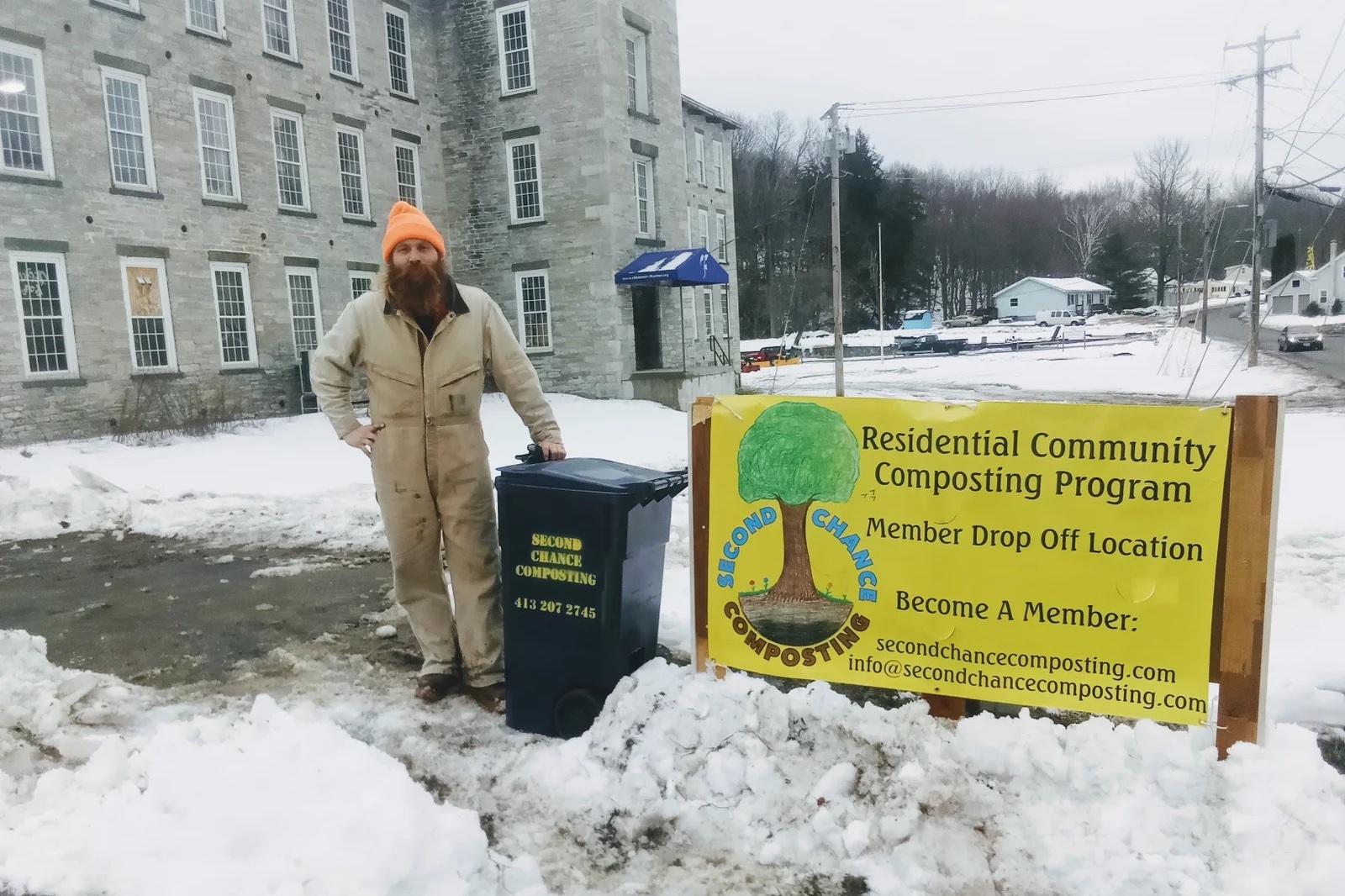
Adams — John Pitroff is a big believer in second chances—especially when it comes to putting surplus food scraps and organic matter to good use. The North Adams native had what he calls an “ah-ha” moment while gardening, one that arose at the intersection of lived experience in both the food service and logging industries. Despite watching piles of food waste and wood chips go unused, he was purchasing hundreds of dollars of organic compost to augment his soil. And then it hit him: “I just knew there was a lot of what people consider waste material out there that wasn’t really waste, so I decided to start picking it up,” he says of how Second Chance Composting—the only community-based compost operation in North County—was ultimately born.
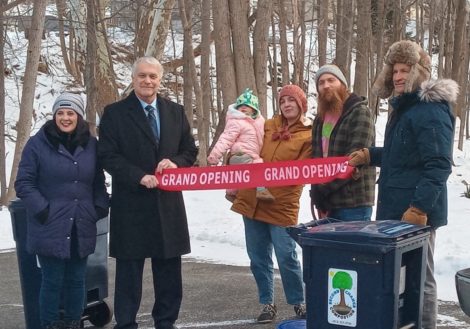
“It just made sense,” says Pitroff who, following a ribbon cutting ceremony in Adams earlier this month, recently debuted his company’s Residential Community Composting Program. For just $2.30 each week, individual homeowners can drop off their food scraps (inclusive of meat, bones, eggs, and dairy, which a backyard pile can’t always handle) at one in a trio of community sites: in Adams at Old Stone Mill Center Zero Waste Maker Space (2A Grove Street); in North Adams at All Saints Berkshires Episcopal Church (59 Summer Street); and in Williamstown at Wild Soul River (at 248 Cole Avenue). From there, Pitroff and his crew do the hard work of closing the loop.
“If you eat an apple and throw it in a [garbage] bag, it creates pollution; when you eat an apple and you throw it on the compost pile, you’re [ultimately] creating a nutrient-rich soil amendment in which to grow a bunch more apple trees,” Pitroff explains of an endlessly productive cycle in synch with the way nature was intended to operate before human intervention. Hence his company’s monniker: “Second chances are a way of life, and composting is great because it’s the end and it’s the beginning … and that’s the beautiful thing.” Pitroff’s goal is to be selling organic compost for home use—either by the bag or in bulk, by the cubic foot—by this time next year.
“We’ve been composting at home for years,” Pitroff told The Edge; last spring, he began working with the North Adams Farmers Market, offering his service free to the community. Now, more partners are needed. In addition to residential drop off, Second Chance Composting will pick up and haul food scraps on a commercial scale; at present, they have their sights set on restaurants, supermarkets, and schools.
“We’re trying to build relationships with other like-minded individuals,” says Pitroff, who also offers pickup, hauling, and drop-off locations for commercial scale organic matter including manure and bedding, sawdust, hay, and some types of yard debris.
“Landscapers can bring leaves, [and] tree companies can bring wood chips,” says Pitroff of the large-scale piles that break down to the tune of 60 to 70 percent. And, in the big scheme of things, food waste makes up just a fraction of what’s needed for proper composting.
“You actually need carbon—from wood chips and brown leaves—more than anything,” he explains, which not only helps to mitigate smells associated with decomposing matter but also “heats everything up and feeds the microbes” that do the hard work of composting. When compared with backyard compost heaps (that often lack carbon-rich matter), Pitroff’s piles are enormous and consistently reach 160℉, which means they break down quickly before entering the curing phase.
The piles are turned, based on temperature, over a certain number of days; this summer, Pitroff is investing in a tractor to do the bulk of the “absolutely backbreaking hard work” that comes with turning the piles by hand. Still, aeration is key.
“It’s almost like a fire,” he says of the microbes which, in the absence of oxygen, will die. When the temperature of each pile (monitored with a giant probe at the center of each pile) begins to fall, turning re-ignites the process which causes the temperature to spike.
At the end of the day, Pitroff is in the business of educating. In fact, when their youngest child was born almost two years ago, he and his wife vowed that, by the time River turned 15, she’d live in a world where all teenagers would see the process of composting (done almost entirely by microbes and, in the end, fungi) as second nature.
Pitroff is more than confident. “To me, it’s magical … [and] I think we can make it happen.”