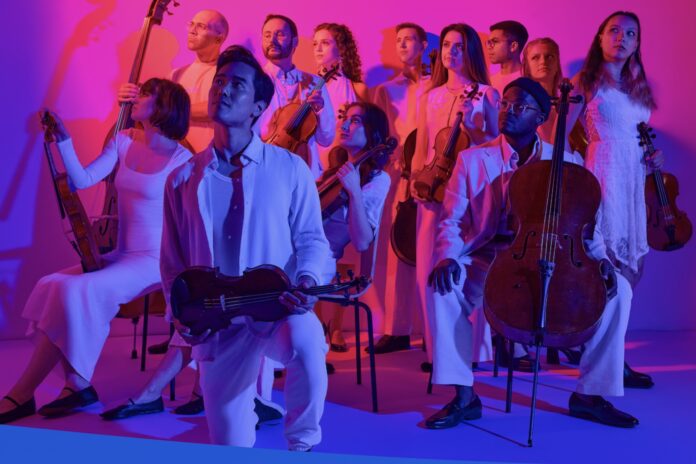
Lenox — Palaver Strings, a Grammy-nominated, musician-led chamber ensemble based in Portland, Maine, will appear at Tanglewood’s Linde Center for Music and Learning on Sunday, September 28, to perform “Port City,” a cross-genre concert program exploring tango music throughout the genre’s history. Sunday’s performance will feature bandoneonist Heyni Solera as soloist and composer.
Palaver Strings is known for its innovative programming, collaborative leadership, and commitment to education and social justice. Founded in 2014, the group presents a full concert season and teaches hundreds of students through its Palaver Music Center in Portland, Maine. The ensemble shares artistic and administrative responsibilities among its 13 co-artistic directors, and its performances often feature cross-genre collaborations, new commissions, and underrepresented voices. Palaver has appeared at such venues as Carnegie Hall and the Kennedy Center and frequently partners with institutions like Ithaca College and the Longy School of Music.
Teagan Faran, a native of Buffalo, N.Y., is a violinist, violist, educator, and composer committed to social change through music. A co-artistic director of Palaver Strings, she has pursued tango music since age 12 and has performed across North and South America and Europe with ensembles including Alarm Will Sound and the Cabrillo Festival Orchestra. Faran studied at the University of Michigan and the Manhattan School of Music and was a Fulbright scholar in Argentina. She is an assistant professor of violin at Ithaca College and a member of the electroacoustic duo Persephone & the Phoenix. Her most recent album, “Middle Child,” was released on Navona Records in January. I spoke with Teagan last week to learn more about “Port City” and the thinking behind it. Our conversation has been edited for clarity and length.
What drew Palaver to tango as the focus of this program, and why is it called ‘Port City’?
The idea of a port city—as a place of exchange and refuge—is part of what inspired the title. It’s something we reflect on often, being based in Portland, Maine, which is the U.S. state geographically closest to the African continent. Maine has a large refugee population, and we strive to be a welcoming and hospitable community. Buenos Aires, Argentina, is also a historic port city, shaped by waves of immigration and cultural exchange—the very forces that gave rise to tango music. For us, that connection felt natural. One thing we aim to do is carry that spirit of a port city wherever we go. Even if we’re performing somewhere landlocked, the concert stage can still become a place of connection—a kind of port—where people are welcomed and ideas can be exchanged.
I myself have been playing tango since I was about 12, and so it’s a music that’s very near and dear to me, and it’s really special I think, because it was in large part created by a number of violinists and other string players. So, it’s a musical language that feels really good on the instrument.
Can you tell us about working with Heyni Solera and what makes her artistry unique?
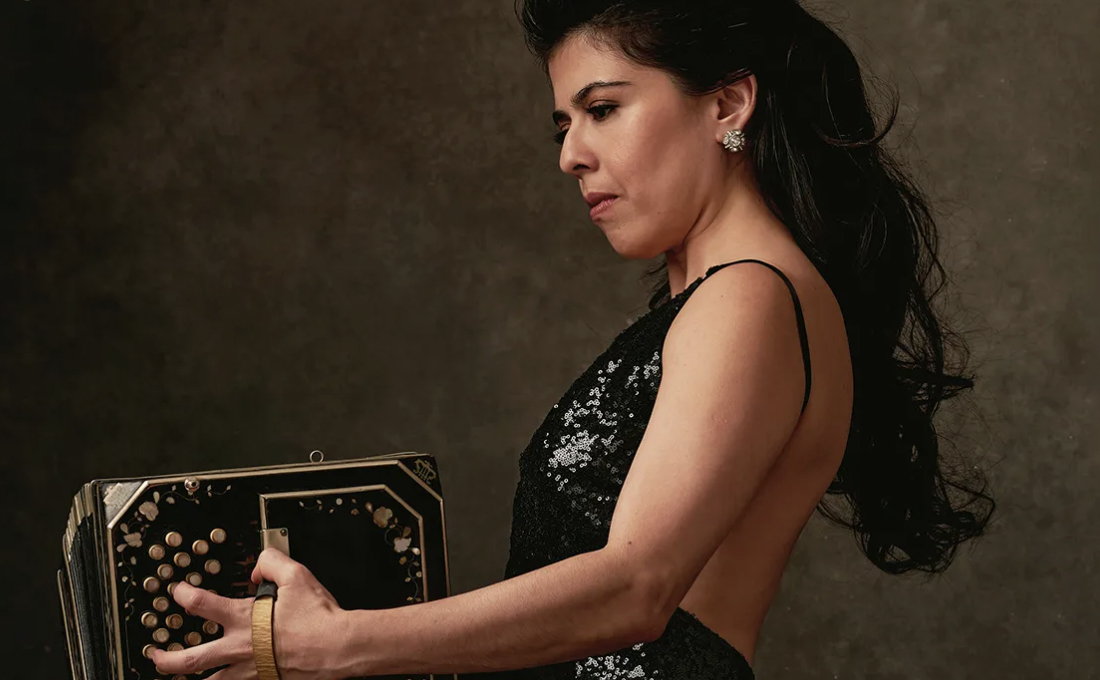
Yes. Heyni and I met in Buenos Aires in 2019, and we’ve been more or less musically inseparable since then. She is a powerhouse. She’s one of the few female bandoneon players in the world. It’s an instrument that, much like the genre of tango, has been largely gendered. It’s a very physical instrument, and just the idea of having to open your legs on stage is something that is often talked about with unfortunate undertones. And so, Heyni is a real champion of the instrument—of making the pedagogy of it more accessible for smaller hands, for instance, and finding ways to make playing the instrument possible for people with smaller frames. But she’s also one of the new age of composer performers, and so we’re playing two of her pieces on the program, which she is specifically writing for her style of bandoneon playing, which is really great.
She is also, by day, a nurse anesthetist, and so… we got off a planning call one time with her saying, ‘Well, I have to go to a C-section now.’ And nothing else I had to do that day seemed all that pressing. So, she is somebody who is incredibly driven. She knows how to manage her time very well. I bring this up because one of the pieces that we’re playing of hers is from a suite that she’s currently writing, reflecting on her time working in the hospital during 2020. And so her being able to take these experiences that are both very individual to her in the hospital, but also largely universal, and translate it into music to be shared through another medium, is something that I really appreciate about her artistry.
What can audiences expect from ‘Port City,’ musically and emotionally?
Musically, we’re going to start with a chronology of tango, going back to when it was a little bit more in the background in the dance halls, and moving forward as musicians started to enter the limelight, along with their egos. And so, we’ll begin with some pretty standard danceable tangos that you might hear if you go to a milonga. And then we’re going to start bringing out some more modern pieces like Golijov’s ‘Last Round,’ which depicts a boxing match through two warring string quartets, and Julián Peralta’s ‘Sofia y los Sueños,’ which tells the story of an Argentine play through a bandoneon concerto.
Emotionally, we’re going to be celebrating the way people find identity through tango, both how it started off as a means to connect even when there wasn’t a shared spoken language and how it is now grounds for identity reclamation. We’ll be featuring two dancers performing with us as well. They are very active in the queer tango community in New York City, and so they bring a lot of expertise about how we can engage with a genre that is so gendered in its legacy, while using it as a means for social change.
‘Port City’ features many original compositions and arrangements. Can you describe one piece that you’re especially excited to perform?
Yes. I think I would highlight ‘Sofia y los Sueños‘ by Julián Peralta. It’s set in six movements, and it’ll feature the entire strings plus Heyni on bandoneon. And Peralta based this on a play by an Argentine playwright, Roberto Artel, and it tells the story of a servant woman who has been assaulted, and it’s a very sad play, and she goes to take her own life. And as she’s making this decision, she enters a dream state and meets these six figures who give her a moment to reflect on her life—both what could have been and what has happened. And the way Peralta uses the strings and the bandoneon to create these textures is very cinematic. I haven’t been able to find a copy of the play yet, so I haven’t read the playwright’s words. But just reading the synopsis of the play and hearing the music, I have a full picture of what a staged performance would be. What, to me, is very inherent to tango is this idea of communication without words. And I think the ‘Sofia y los Sueños’ highlights that really well.
Is there a moment in ‘Port City’ that feels especially meaningful or powerful to you on stage?
I can say certainly the ‘Sofia y los Sueños,’ for the reasons that we mentioned, but I’m also really excited that I’ve been able to do a lot of arranging for this program. A number of the pieces I’ve either arranged myself or worked with the composers to arrange them for our specific instrumentation. So the ‘Port City’ program brings forward four brand-new, original arrangements of these tango standards for string orchestra: the three that the dancers are doing with us—’Milonguero Viejo,’ ‘Palomita Blanca,’ and ‘La Yumba’—and then Piazzolla’s ‘Libertango.’
It’s been really exciting to take the original recordings of those pieces and figure out how to craft the entire tango band with the piano, the bandoneons and everybody, and put it into the world of string orchestra alone. And I’m excited that we’re able to translate that Porteño accent into our main string ensemble, but also that the program is making this music more accessible for people in the states.
That’s something that has been really important to me since I moved back from Argentina: finding ways for more people to engage authentically with the musical genre. That this program has produced new arrangements is a huge benefit to all the tango players in the States.
What do you hope audiences will take away from ‘Port City’?
I hope audiences are able to find a love of tango—perhaps starting with their familiarity with Piazzolla, but then moving beyond into the many decades of tango that exist. I hope it sparks a curiosity to attend a dance class or a listening session and encourages new forms of communication. Most of all, I hope it gives us all space to reflect on what it means to be a port city—how we might create small ports within our own communities that prioritize openness, welcome, and care in all that we do.
Palaver often ties its programming to themes of migration, identity, and social justice. How does ‘Port City’ connect to those larger conversations?
Well, I think the globalization of tango is deeply connected to migration. As a genre of music and dance, it began through movements like the slave trade and forced immigration to Argentina—people living in difficult circumstances seeking connection. Later, globalization helped popularize it. When Argentine diplomats traveled to France, people in Paris wanted to hear tango, and it became an export. So in many ways, the idea of national identity was projected outward before it was fully defined at home. It’s also important to recognize the privilege and joy of being able to travel internationally to learn about different musical traditions.
In terms of identity, one thing I like to point out is that tango is one of the few Latin American musics that does not inherently have drums in it. If you go see a tango band, you’ll not often see a percussionist on stage, but you’ll still hear percussion because all the instruments on stage are using these extended techniques to create new sounds. So there’s this idea of having an expanded identity, that as a violinist I’m not just playing melody. I’m also responsible for groove and drums in that way. I think that’s a really beautiful metaphor for personal identity, that you’re not just one role in your community. You can go and fill the role that is needed.
* * *
Hear Palaver Strings with Heyni Solaroon September 28, 7 p.m., at Tanglewood’s Linde Center for Music and Learning. Tickets are available here.