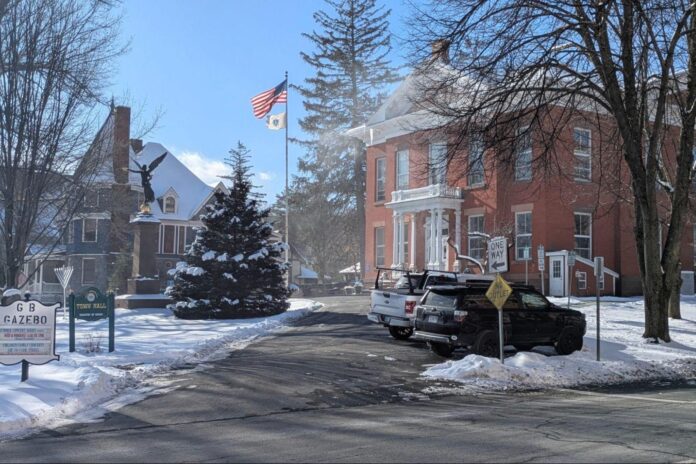
Great Barrington — On Friday, February 13, Town Manager Liz Hartsgrove published her proposed budget for fiscal 2027 on the town’s website, her first since the town hired her back in October.
Hartgrove is proposing a municipal budget of $17,348,228 for fiscal 2027, an increase of $655,484 from this year’s municipal budget. Back in May, voters approved a fiscal 2026 municipal budget of $16,692,744.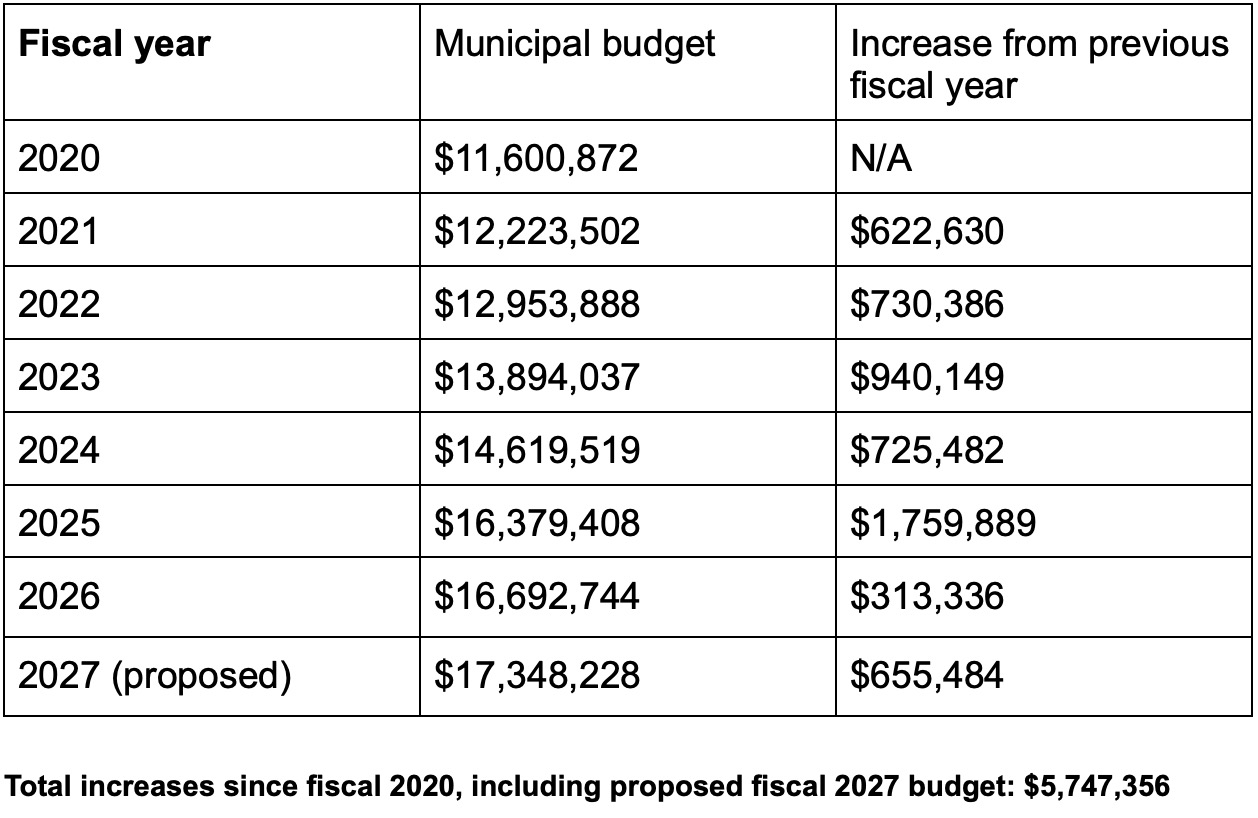 “The fiscal 2026 review and fiscal 2027 forecast identified significant cost pressures entering fiscal 2027,” Hartsgrove writes in her budget presentation. “Health insurance is projected to increase by more than eight percent. Regional school assessments are projected to rise by more than seven percent. General liability and property insurance costs continue to trend upward. Public safety and emergency service demands remain strong, and deferred infrastructure reinvestment continues to accumulate long‐term financial risk. At the same time, the town’s excess levy capacity remains limited, leaving little room for unexpected events.”
In her budget, Hartsgrove writes that she would eliminate the use of the town’s free cash line item for recurring municipal operations. “Free cash, while certified at over $11 million in fiscal 2026, must be viewed in its proper context,” she explains. “Historically, the town has relied on approximately $3.9 million annually in free cash to offset recurring operating expenses. While that approach can moderate tax growth in the short term, it masks structural gaps and diminishes long‐term fiscal flexibility. Additionally, more than $5 million in free cash had previously been set aside for cannabis litigation. With that matter now resolved, those funds are being removed from free cash availability. This development provides clarity but reduces discretionary reserve capacity entering fiscal 2027 and reinforces the importance of treating free cash as a one‐time resource rather than an operating subsidy.”
Hartsgrove writes that she is recommending a Proposition 2½ override in order for the budget to be passed.
Proposition 2½ is a state statute that limits tax levy increases.
“The fiscal 2027 forecast illustrates a structural imbalance between projected expenditures and allowable revenue growth under Proposition 2½,” Hartsgrove writes. “Even after conservative revenue assumptions and disciplined expenditure controls, the projected gap between levy capacity and required expenditures approaches $5 million.”
Hartsgrove claims her proposed budget “narrows that gap through structural adjustments, reserve discipline, and pay‐as‐you‐go capital funding.” “However, to fully sustain the level of municipal services reflected in this recommendation, the town would require consideration of a Proposition 2½ override in the range of approximately $4.8 to $5.0 million,” she writes. “An override of this magnitude is not simply a financial mechanism; it represents a community policy decision. It requires broad public understanding of the town’s fiscal condition, a shared recognition of service priorities, and a sustained commitment to structural change. Overrides are not tools to correct short‐term fluctuations. They are long‐term revenue resets that permanently increase the levy base.”
Hartsgrove pushes for the town to institute “demonstrated fiscal discipline and transparent reform” in order for the proposed budget and an override to be passed by residents at the annual Town Meeting. “First, the town must clearly articulate what services, investments, and workforce stability the override would protect,” she explains. “Second, the town must demonstrate that all reasonable internal cost controls, capital sequencing adjustments, and efficiency measures will be implemented. Third, there must be visible alignment between financial policy, strategic priorities, and budget execution. An override must be understood as a structural correction, not a continuation of past reliance on one‐time resources. Building public trust requires clear data, consistent messaging, and evidence of responsible stewardship.”
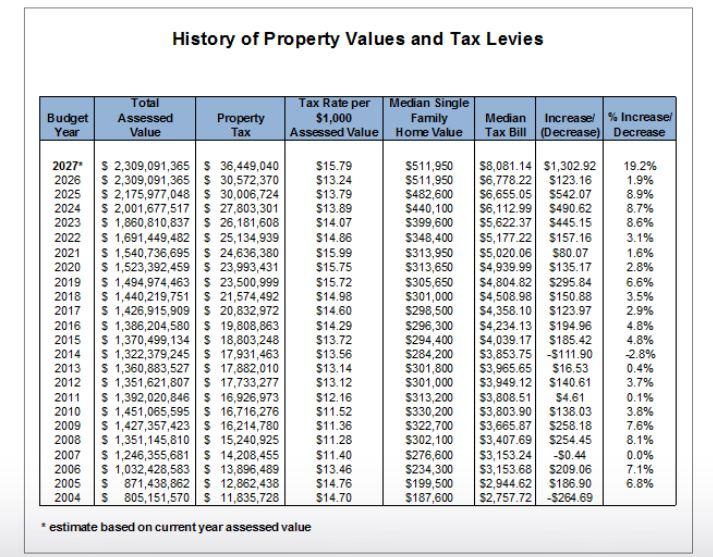
According to a chart included in Hartsgrove’s budget proposal, if the budget passes at the annual Town Meeting as proposed, the estimated tax rate would be $15.79 per $1,000, a 19.2 percent increase from this fiscal year.
Over the next few weeks, the Selectboard will hold budget workshops to review the operating and capital budgets of municipal departments, along with warrant articles and Community Preservation Act proposals to go before voters at the annual Town Meeting.
Budget workshops to review the town’s proposed operating budget will take place on Tuesday, February 24, and Wednesday, February 25. Workshops on the proposed capital budget are scheduled for Tuesday, March 3, and Wednesday, March 4. A workshop to review the warrant articles and CPA proposals for the 2026 Town Meeting is scheduled for Monday, March 23.
A public hearing on the proposed fiscal 2027 budget is scheduled for Tuesday, April 14, and the annual Town Meeting is scheduled for Saturday, May 2.
Related reporting:
“BHRSD Superintendent Dillon: ‘Fiscal 2027 is a difficult and impactful budget situation’“
“Great Barrington town manager presents several fiscal 2027 budget scenarios“