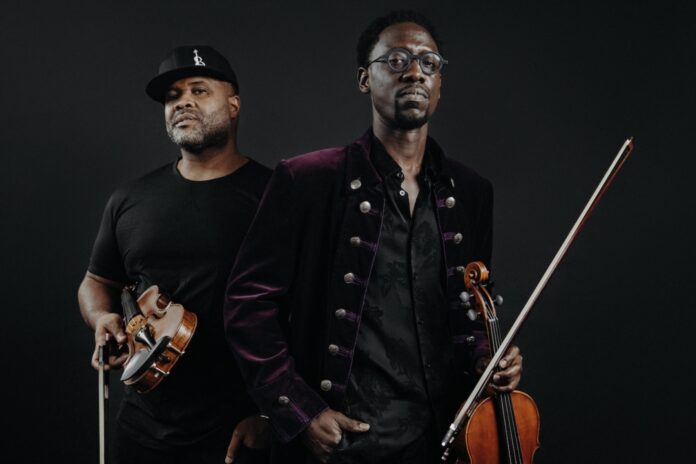
Great Barrington — The genre-defying Black Violin brings its “Full Circle” tour to the Mahaiwe Performing Arts Center on Friday, February 27, at 8 p.m.
For more than two decades, the Grammy-nominated duo has occupied a musical lane of its own, merging classical strings with hip-hop beats while challenging assumptions about genre, audience, and artistry. Violinist Kev Marcus and violist/vocalist Wil Baptiste trace their origins to a Fort Lauderdale high school orchestra class in 1996, where both were classically trained by day and immersed in rap music at night.
After attending different colleges, the two reunited, moved in together, and began experimenting with hip-hop covers on violin and viola, building a local following that led to repeated wins on “Showtime at the Apollo.” Industry attention followed, including a performance with Alicia Keys at the Billboard Awards and tours with artists ranging from Mike Shinoda to the Wu-Tang Clan.
Black Violin’s latest album, “Full Circle,” marks a turning point in the duo’s creative process. For the first time, they brought their entire touring band into the studio, emphasizing collaboration and improvisation. Longtime producer Phil Beaudreau returned to help shape the project, which blends boom-bap rhythms, orchestral textures, and melodies that balance tension with accessibility.
Marcus has described the album as a renewed artistic push after questioning his motivation following years of nonstop touring and multiple Grammy nominations. A return to the Grammys in 2023, where Black Violin earned a nod for a collaboration with the Blind Boys of Alabama, helped reignite his drive to explore the boundaries of the group’s sound.
While Black Violin has performed at venues such as the Kennedy Center and appeared on national television, its reach extends beyond the stage. Through free performances, school partnerships, and the Black Violin Foundation, launched in 2019, the group works with students nationwide to expand access to music education.
Both musicians emphasize that Black Violin is less about individual recognition than the collective energy they’ve built. As Marcus has said, audiences aren’t coming to see them so much as the idea itself—something they believe will outlast them.
I spoke with Wil Baptiste last week by telephone. Our conversation has been edited for clarity and length.
THE BERKSHIRE EDGE
Wil, you called ‘Beautiful Day’ a moment when you felt calm and fully in your element. How important is joy as a creative compass for you?
WIL BAPTISTE
It’s essential. It’s a necessary piece. For that song, I was thinking about my kids when I was writing it and fleshing out the top line. My kids were on my mind. And that’s joy to me.
THE EDGE
What surprised you most about the music that emerged in the studio when everyone had an equal creative voice?
BAPTISTE
What surprised me was that we didn’t do it sooner. The whole band was in the studio really creating for two weeks—just throwing things at the wall—and magic happened! ‘Smoke’ was a voice memo that Kev came up with, and the band is there, and the actual music part of it came together really quickly. And we said, man, we should have done this a long time ago.
THE EDGE
On ‘Smoke,’ what did it feel like to finally let the viola take that kind of spotlight?
BAPTISTE
It felt natural. It was like, man, what took us so long? You know, it’s funny. That’s one of Kev’s favorite songs. He’s not even playing on there. I’m playing the viola. But we’re both violists.
I’m a singer at heart, so the way I play is just kind of the way I would sing. So the way that track came about… I literally just hummed along and sang the lines, with no words, and I played my viola on top of that. And again, it was one of those things, like, man! I should have done this a long time ago!
THE EDGE
The Black Violin foundation extends your mission far beyond performance. What impact do you hope kids feel years from now because of that work?
BAPTISTE
Well, I hope kids years from now feel that this was the beginning of freedom. Because it was the beginning for me when I was really able to become who I am today. That’s what I hope kids get from this. That’s the dream, because in our careers, we had a lot of influential individuals who were really important to us, who really helped us get to the next level. That’s what we want for these kids, but they don’t always have the right opportunities.
The worst thing is to see a kid who has a dream, has that fire in their eye, but they just can’t do anything about it, because they have no control over finances or whatever. So that’s one of the things we wanted to mitigate.
We hope that 10 or 20 years from now, there’ll be someone who tells us, ‘Hey! You know, you gave me the scholarship to this camp or this instrument, and I’m an attorney now,’ or whatever. ‘Because of that, I was able to pursue a dream.’ It doesn’t necessarily mean you’re going to be a musician in the future. But when you’re a young adult, and your dream just gets snuffed out, it kind of derails you for everything else.
THE EDGE
After multiple Grammy nominations, how do you keep external recognition from defining your sense of success?
That’s a very good question! And it’s really simple for me. For me, what’s real, what’s actually tangible in my life, is family, the people who are closest to me. It’s my kids.
We had a show in Morgantown, West Virginia, and there were kids in the front mimicking me playing. And man! Their eyes! That’s priceless! To be able to engage the minds of these future leaders of the world… that is my real joy, my real purpose. That’s what matters most. Everything else is icing on the cake.
It was great to get two Grammy nominations, and it would be great to do it again and win one. But that doesn’t define me at all.
THE EDGE
If your ‘Full Circle’ album were a live show distilled into one song, which track would best represent it?
BAPTISTE
Let’s see… The answer would definitely be different for me than it would be for Kev. It’s such a good question! It would relate to Black violence. I would say, ‘The Illest,’ the very first song, because that’s who we are. It’s that hard-hitting beat with the beautiful strings on top playing the melody. The second part is really aggressive, and that’s also who we are. We mess your mind up, like, what am I listening to?
THE EDGE
You often describe Black Violin as more a movement than a brand. When did you first feel that shift?
BAPTISTE
I really started to feel that shift about six or seven years ago. We were still doing what we’d always done—performing for kids, playing festivals like Bonnaroo—but the way people were responding changed. People would come up to me and say, ‘I was in prison for 10 years, and your music helped me survive that,’ or kids who are grown now would tell me how much our concerts meant to them. That’s when I realized this was bigger than me. Bigger than Kevin or Will. This thing has a life of its own.
Looking back, the signs were probably there 10 or 12 years ago, but it took time to really understand what we were building. Once I did, my mindset changed. It stopped being about how tired I was or how hard it felt. It became about responsibility. People need this. At that point, it was out of my hands—it wasn’t just about me anymore.
***
The Mahaiwe Performing Arts Center is located at 14 Castle Street, Great Barrington. Tickets to see Black Violin on February 27 are available at the Mahaiwe box office.