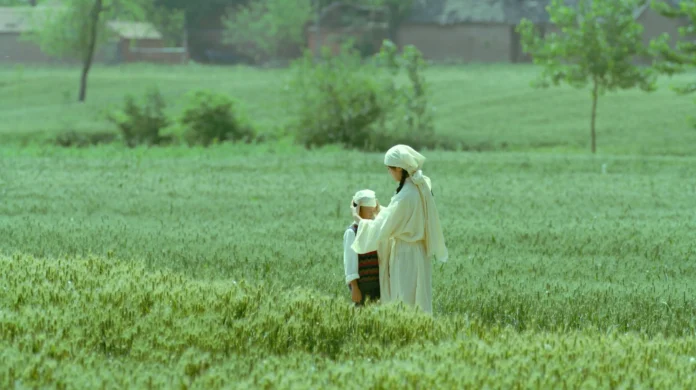
“Living the Land” (opening at the Film Forum on April 3) is a Chinese film directed by Huo Meng that looks like a documentary but is pure fiction. It is set in a crowded rural Chinese village in 1991, on the cusp of industrialization and the breakdown of traditional culture. But growing wheat at that time is still done arduously by oxen and plow, and life is economically perilous.
The film, which is a bit too leisurely, is less focused on individual character than on community and extended family—forces that, alongside a distant and repressive government, define their lives.
The one character we connect with is the smart and sensitive 10-year-old Chuang (Wang Sheng) who quietly observes all that goes on. He lives with relatives while his parents work in factories in South China with his two siblings. It is far from an easy life, but there are small pleasures and moments of joy, and most of the characters don’t spend too much time engaging in lamentation about their lot but carry on with their daily lives. The film lingers on the quotidian details of work—capturing its rhythms—with breaks for funerals and a wedding, which turn into elaborate communal rituals.
The characters’ interactions are often rough and usually loud, but some of the women express real feeling. We see Chuang’s mother weeping uncontrollably as she must leave him for what could be years after visiting for just a day.
There are other characters we get some sense of, including Chuang’s mentally disabled cousin Jihua (Zhou Haotian), who is treated with some warmth but is bullied and beaten much of the time.
And there is the chain-smoking, weathered great-grandmother Li (Zhang Yanrong) who puts everybody down but loves Chuang. She is in the tradition of the old male codgers like Walter Brennan who populated American Westerns and supposedly offered some sort of life wisdom.
Chuang’s young unmarried aunt Xiuying (Zhang Chuwen), who acts like a surrogate mother and tends to spoil him, is forced into a marriage with a man she abhors. Her wedding is a boisterous, drunken, fireworks-filled affair that leaves her looking devastated.
She has no way out given the cultural constraints for women in rural China.
Huo Meng uses long takes and tracking shots to evoke this circumscribed, dense world. Nothing is underlined—the action just flows, capturing the introduction of tractors and a television set without commentary. Holes are even dug in the wheatfields as workers begin prospecting for oil. All the while many villagers leave for more money and opportunities in the city.
The conclusion does not leave us with an image of green fertile fields that open the film but with a slightly desaturated image of the landscape and with a sense of ambiguity about the future.