March 19–April 2, 2022
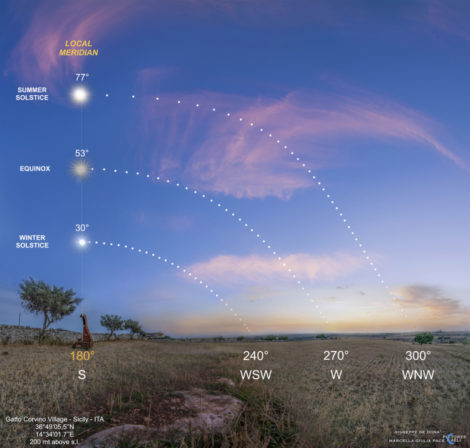
MOUNT WASHINGTON — Tomorrow, March 20, the rising Sun marks due east on the horizon and the setting Sun marks due west, while tracing an arc in the sky that brings about equal day and night. The Vernal Equinox (aequus = equal and nox = night) is the astronomical first day of spring in the northern hemisphere. As seen in the illustration below, our star’s equinox trajectory is halfway between the winter and summer solstices, the shortest and longest days of the year, respectively.
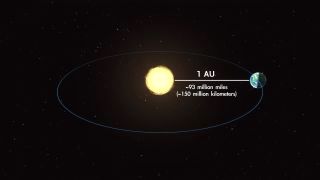
While we align with the movement of the Sun in relation to Earth, astronomers are observing our parent star through the eyes of a spacecraft that is approaching closer to the Sun than ever in human history. The Solar Orbiter, a project of the European Space Agency (ESA) and our National Aeronautics and Space Agency, crossed the Earth-Sun line — the halfway point between our planet and the Sun — on March 8. The brilliant flying machine arrives at perihelion, the name for closest approach to the Sun, next Saturday, March 26. Solar Orbiter will be less than one-third of the distance from the Sun to Earth and is designed to survive for relatively extended periods of time this close to the upper layer of the Sun’s atmosphere, the corona, which is millions of degrees Celsius.
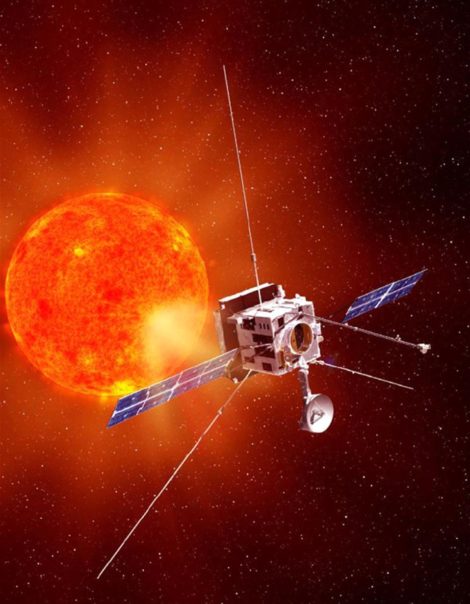
As described by the ESA, the March 26 perihelion passage is one of the major events in the mission. All 10 instruments will be operating simultaneously to gather as much data as possible. Solar Orbiter will spend until April 6 inside the orbit of Mercury. Around perihelion, Solar Orbiter will bring high-resolution telescopes closer than ever before to the Sun.” Follow the mission’s progress and news in real time.
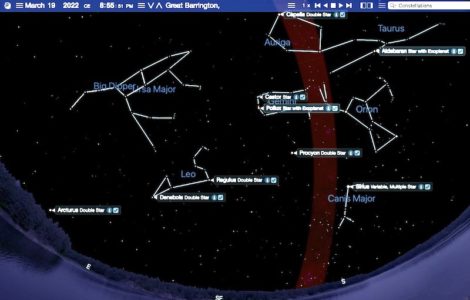
Stargazers all, we come back to observe the change of season movement of the Sun by day and the equally alluring changing positions of the stars in the nighttime sky. Spring stars and constellations rise in the east and travel the celestial dome all night while winter celebrities command the west, setting around midnight. Most dramatic, winter’s Sirius the Dog Star, the brightest star in Earth’s skies, appears in the south at nightfall, then wildly twinkles, flashing rainbows as it nears the southwestern skyline from about 10 p.m. until midnight. Opposite, above the eastern horizon, second brightest star in northern skies, golden Arcturus the Spring Star, rises with a brilliant flourish in the east at around 8 p.m. The nearly Full Sap Moon, one day old, climbs above the horizon to the right of Arcturus tonight, March 19, at about 9 p.m. Beautiful Leo the Lion climbs in the east as mighty Orion the Hunter descends in the west.