At the turn of the year, our star, the Sun, beckons all to admire as its incandescent orb traces its shallowest arc of the year these Winter Solstice days. From sunrise above the southeast horizon to sunset in the southwest, the Sun, at its farthest southern point over Earth, is lowest in Northern Hemisphere skies while highest in the Southern Hemisphere, where it is Summer Solstice. Our Winter Solstice occurred the night of the 21st, a scant day and a half before this posting.
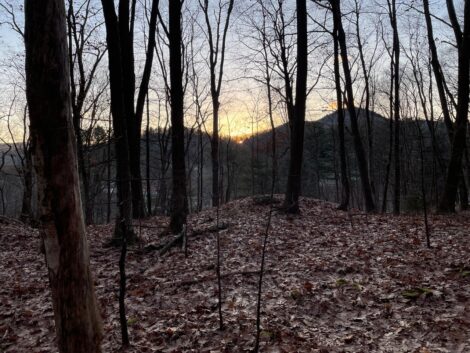
Derived from the Latin “sol” (“sun”) and “sistere” (“to stand still”), the Sun seems to stand still at its rising and setting locations for several days on either side of the exact moment of solstice. That is, the seasonal movement of the Sun’s daily path, as seen from Earth, pauses at its southern limit before reversing direction. To participate in the wonder of it, I choose a feature—a tree, pole, building—that marks the location of sunrise and sunset at my location at this moment. From these markers, I observe sunrise and sunset moving north. Our next marker is spring equinox when sunrise and sunset have moved north from their southeast and southwest positions to arrive due east and due west, respectively.
In Great Barrington, John Berthet has an ideal marker for winter solstice sunrise: a notch created between two forested hills.
On a popular chart of sunrise to sunset features, day length is simply put at nine hours and six minutes from December 17 through 27. At solstice time, a fuller story is told by looking at the change from day to day in seconds, not minutes. It will take three weeks from the solstice to gain 10 minutes of daylight.
Today, December 23, sunrise is at 7:19 a.m., sunset 4:24 p.m. The Sun will not rise earlier but continues to rise later—7:22 a.m. from December 30 through January 10, 2024. Sunset, however, is also later! From sunset at 4:21 p.m. on December 6 to 4:40 p.m. on January 10, 2024, a gain of 20 minutes, all in the afternoon. Day length will have increased to nine hours and 18 minutes.
After January 10, sunrise is several seconds earlier every morning until, on January 31, the sun rises at 7:09 a.m., 13 minutes earlier than its latest of the season. Day length will have increased to nearly 10 hours. That is 50 minutes greater than the darkest days of the year.
As twilight deepens tonight, December 23, look up to the east-southeast for a great gibbous moon with bright planet Jupiter to its right. On December 26, the Full Long Night Moon rises in the east-northeast at 3:52 p.m. The winter solstice moon traces the Sun’s summer solstice path in Earth’s sky, rising farthest north for the year and reaching near zenith at midnight. Enjoy moonset until about 7 a.m. in the west-northwest on December 27 and until the end of December.
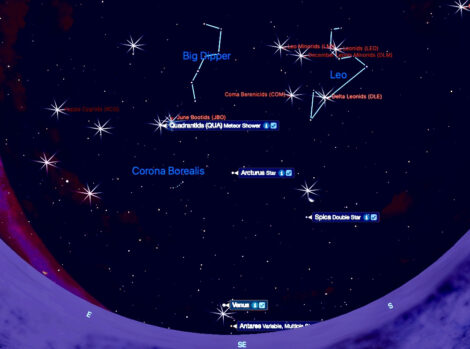
Begin the New Year with the Quadrantids Meteor Shower, active from December 28 through January 12, with peak numbers of shooting stars before dawn on January 4. Begin to look northeast at 4 a.m. The schema, below, is set in Great Barrington and the northeast region at 5:55 a.m. Should small type be blurred in the image, note that brilliant planet Venus can be seen rising above the southeast horizon. The Quadrantid radiant is near the tip of the handle of the Big Dipper. Shooting stars are seen all over the sky.