Thursday, March 19, 2026

News and Ideas Worth Sharing

HomeLearningEYES TO THE...

EYES TO THE SKY: Orion the Hunter and a tale of two suns

The seventh brightest star in northern skies and one of the furthest stars visible with the naked eye, Betelgeuse meets our eyes inspiring wonder—and motivation—of gigantic proportions in the months ahead.

Orion the Hunter, a quintessential winter constellation, travels the sky all night as autumn turns toward winter. Recognized as the essence of a human figure reclining on the east-southeast horizon at nightfall, he appears a titan asleep. His shoulder is marked by a red giant star, Betelgeuse, 0.4 magnitude. Three stars standing vertically on the skyline represent Orion’s belt. To the right of the belt, a brighter blue giant star, Rigel, 0.2m, indicates the Hunter’s right knee. In hilly locations, see Orion rise close to 8 p.m. tonight, November 25, and an hour earlier by December.

On November 25 and 26, in the sky above Orion, a waxing gibbous moon appears with Evening Star Jupiter to its right. On November 27, the Full Frost or Snow Moon rises in the east-northeast at 4:22 p.m., opposite sunset at 4:24 p.m. in the southwest.

The image at the top of this page shows Orion standing upright to the horizon as he appears hours after rising and when setting at dawn in the west-southwest.

Analyzing data from NASA’s Hubble Space Telescope and several other observatories, astronomers have concluded that the bright red supergiant star Betelgeuse quite literally blew its top in 2019, losing a substantial part of its visible surface and producing a gigantic Surface Mass Ejection (SME). This is something never before seen in a normal star’s behavior. Our Sun routinely blows off parts of its tenuous outer atmosphere, the corona, in an event known as a Coronal Mass Ejection (CME). But the Betelgeuse SME blasted off 400 billion times as much mass as a typical CME! Illustration: NASA, ESA, Elizabeth Wheatley (STScI).

Betelgeuse, Alpha Orionis, is one of the largest diameter stars known: 667 times larger than our Sun, according to StarryNight7. Described another way, Betelgeuse is bigger than the radius of the Earth’s orbit around the Sun. The seventh brightest star in northern skies and one of the furthest stars visible with the naked eye, Betelgeuse meets our eyes inspiring wonder—and motivation—of gigantic proportions in the months ahead.

Our star, the Sun, revealed its own “Epic Filament Eruption” in an image captured by NASA. Learn about it and view a film here.
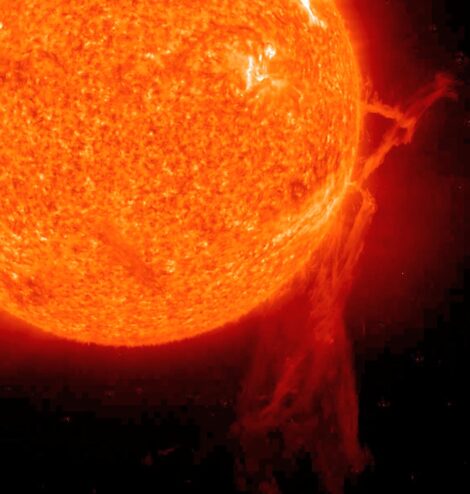
Epic Filament Eruption from the Sun. Photo courtesy of NASA Goddard Space Flight Center via Flickr.

The Sun continues to drift south, rising at its furthest southeast location on the horizon and setting southwest, tracing its smallest arc above the horizon as we approach winter solstice, December 21. Now, all the more, to be contemplated, mused about, and appreciated as the center of our world.


spot_img

The Edge Is Free To Read.

But Not To Produce.

Continue reading

EYES TO THE SKY: Planet Venus, the Evening Star, closest, brightest mid-February

At peak magnitude, seek out the goddess of love planet in a clear blue sky in the west-southwest during daylight hours, being extremely careful to keep eyes diverted from the sun.

NATURE’S TURN: Turning the corner to spring — a Valentine for Earth

“A thing is right when it tends to preserve the integrity, stability and beauty of the biotic community.” — Aldo Leopold

NATURE’S TURN: Dynamic winter designs in snow, treetops

The first porcupine in a string of winter squatters and the first to enter right beside the doorstep to my home, this entitled individual even tread onto and then sidled sideways off the edge of the lowest steppingstone to my front door to reach the crawlspace.

The Edge Is Free To Read.

But Not To Produce.