February 19–March 4, 2022
MOUNT WASHINGTON — Wake up in morning darkness and, clothes at the ready, pick up the speed of a firefighter as you rush out to a spot on the southeastern skyline ablaze with planet Venus rising. The gleaming planet, an orb of white fire in the darkness, appears in early dawn. Like the Sun and moon, Venus, the third brightest object in Earth’s sky, inspires viewing when rising or setting. Having dazzled us as the Evening Star all fall, Venus re-appeared in January, the beginning of the planet’s morning apparition that continues into late August.
The goddess planet, similar in size to Earth and the second planet from the Sun, is our closest planetary neighbor. But its brilliance is not to be attributed to its proximity. As described by scientists at EarthSky.org, “Venus is bright … because it’s blanketed by highly reflective clouds. The clouds in the atmosphere of Venus contain droplets of sulfuric acid, as well as acidic crystals suspended in a mixture of gases. Light bounces easily off the smooth surfaces of these spheres and crystals. Sunlight bouncing from these clouds is a big part of the reason that Venus is so bright.”
The magnificent 2016 Akatsuki image, above, captured what is described in NASA literature as a world perpetually shrouded in thick clouds that “whip around the planet at about 200 miles per hour (100 meters per second).” The planet “has a thick, toxic atmosphere filled with carbon dioxide … (and the) yellowish clouds of sulfuric acid trap heat, causing a runaway greenhouse effect. Venus is the hottest planet in our solar system, even though Mercury is closer to the Sun. Surface temperatures on Venus are about 900 degrees Fahrenheit.
In more recent observations of the planet, NASA’s Parker Solar Probe has taken its first visible light images of the surface of Venus from space. “Smothered in thick clouds, Venus’ surface is usually shrouded from sight. But in two recent flybys of the planet, Parker used its Wide-Field Imager, or WISPR, to image the entire nightside in wavelengths of the visible spectrum — the type of light that the human eye can see — and extending into the near-infrared.”
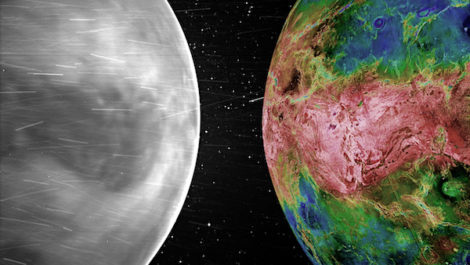
The WISPER images reveal a faint glow from the surface that shows distinctive features like continental regions, plains, and plateaus. A luminescent halo of oxygen in the atmosphere can also be seen surrounding the planet.
To observe Venus before dawn and until half an hour before sunrise, look to the southeast. Sunrise is at 6:45 a.m. on February 19; 6:34 a.m. next Saturday. Seek out a location with a view to the southeast by 5:45 a.m. to observe Venus, Mars, and Saturn in the coming days.
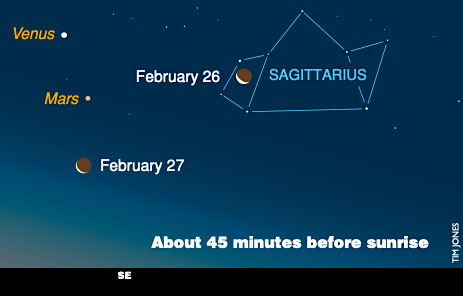
The moon and Venus may be visible until about 6:15 a.m. Venus -4.61 magnitude on February 20, decreasing to -4.51m on March 5. Mars -1.30 m, Mercury 0.00 m. If you plan to adventure out before dawn to see Venus rise, know that she’s up earlier every day: February 20 at 4:20 a.m.; March 5 at 4:05 a.m. In hilly terrain and other obstructed views, expect Venus later by half an hour or more.
Immerse yourself in Venus exploration: go directly to NASA for more, including films.