January 20 – February 2, 2020
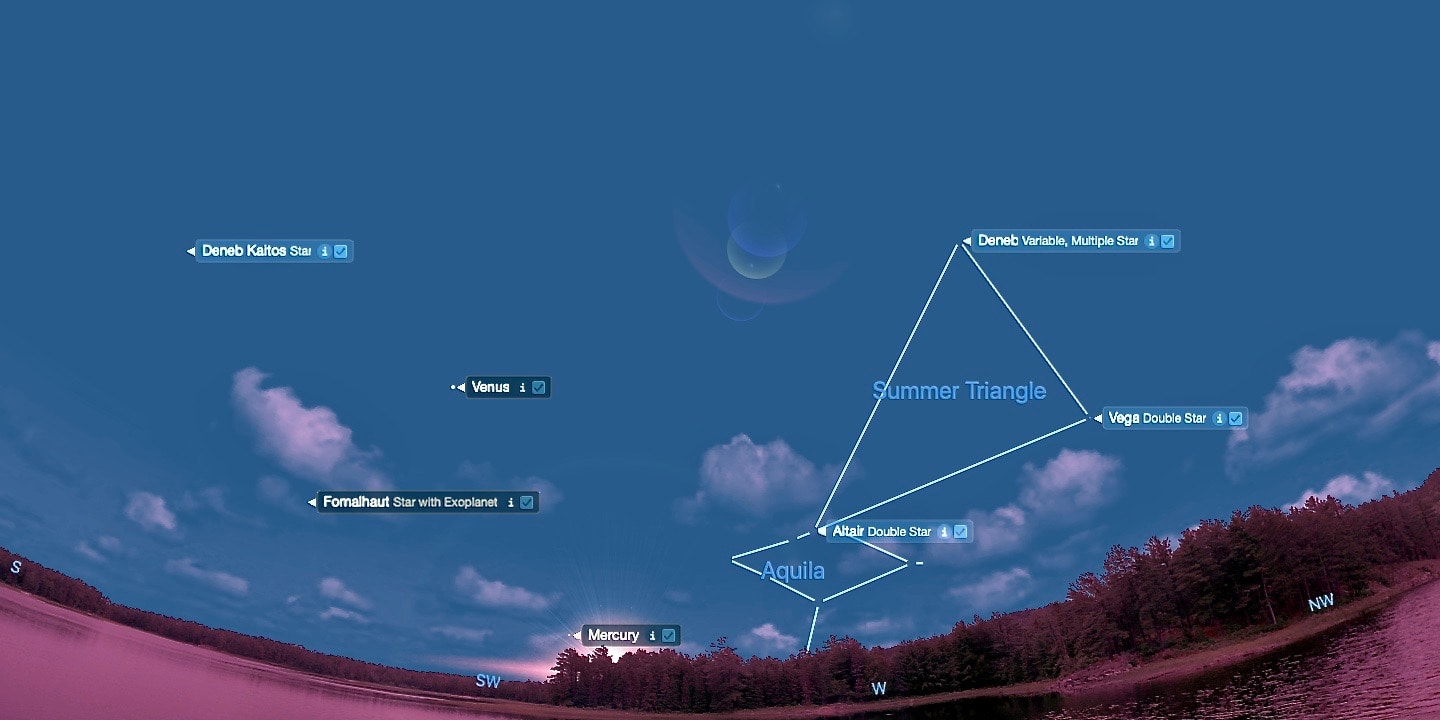
Mount Washington — The Summer Triangle’s long season in the evening sky ends this week, although one of its remarkable stars, Deneb, lingers for another month. The Summer Triangle is a star pattern known as an asterism: Three outstanding stars shape it, one from each of three constellations. It is a commanding sight from its emergence in the evening sky in May through summertime and autumn. Now, stretched out on the skyline from west to northwest as darkness gathers, the great triangle is particularly impressive, but fleeting.
Altair, the brightest star in the constellation Aquila the Eagle, is the first point of the Summer Triangle to set. This evening, the 20th, Altair sets due west at 6:22 p.m., an hour and a half after sunset, which is at 4:52 p.m. this afternoon. By next Monday, the 27th, Altair disappears almost half an hour earlier, at 5:55 p.m., when sundown is at 5:01 p.m.. To observe the 0.75 magnitude star while it still appears as part of the Summer Triangle, look early this week from an unobstructed view to the west.
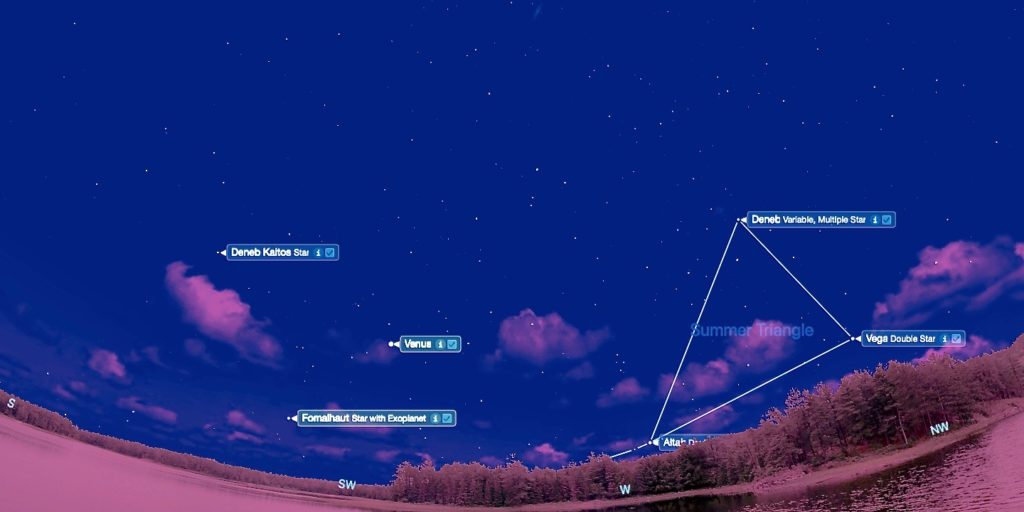
The second star of the Summer Triangle to set, Vega, marks its right angle. Vega, at 0.00 magnitude, is the alpha star in the constellation Lyra the Lire and third brightest star visible from the northern hemisphere. Vega sets at 7:45 p.m. tonight, 7:17 p.m. on the 27th and 6:54 p.m. Feb. 2 when sunset is at 5:09 p.m.
It is our view of Deneb and Cygnus the Swan, the constellation it highlights, that is the most surprising and gratifying and lasts the longest each evening. We are accustomed to seeing the Summer Triangle and its associated constellations at a distance, e.g., overhead. When observed close above a forested hill or cityscape, standing on our skyline, the whole figure of Cygnus the Swan appears bigger and wonderfully near. At 1.25 magnitude, Deneb, Arabic for “tail,” is not as brilliant as Vega, but Deneb holds the place of star furthest from Earth visible with the naked eye.
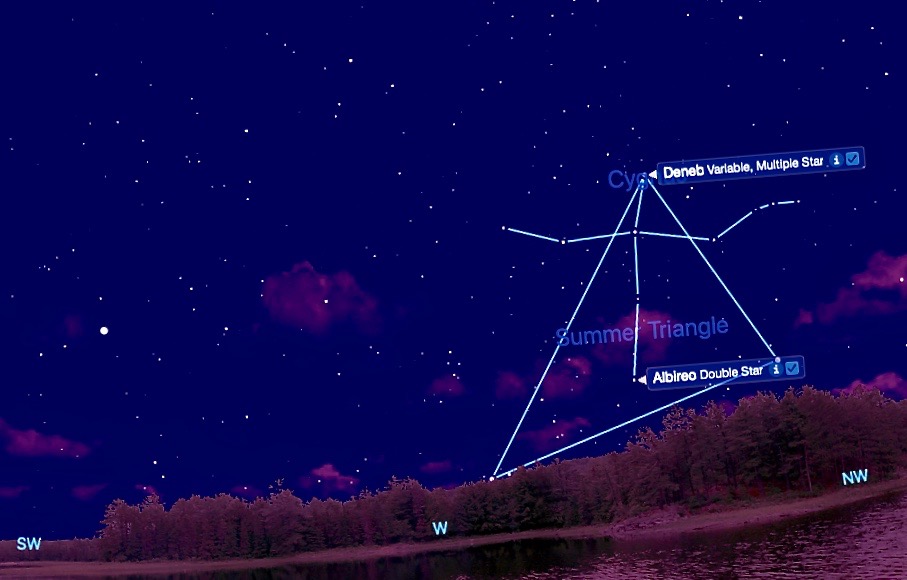
It is disorienting at first to learn that the bright star Deneb is the Swan’s tail. We have to reach inside the Summer Triangle to locate Cygnus’ head and beak star, Albireo, a dimmer star at 3.03 magnitude. But as soon as we glimpse the broad, outstretched wings and the long neck that leads to Albireo, the whole picture of a swan in flight comes into focus. Deneb sets at 11:14 p.m. tonight, 10:46 p.m. on the 27th and 10:23 p.m. Feb. 2.