Winsted, Conn. — Approximately 30 miles away from Great Barrington, Winsted is a small town with 6,504 residents, as of the 2020 Census.
For many years, the town was home to several factories that developed and manufactured products, including the William L. Gilbert Clock factory, Capitol Products which manufactured toasters and hot plates, and Lambert Kay which produced pet products. In August 1955, a massive flood destroyed downtown Main Street, and over the years the factories have shut down, leaving empty and vacant buildings, along with a depressed economy.
Back in 2001, Sharon, Conn. based artist Ellen Griesedieck launched the American Mural Project (AMP) as a tribute to American workers. Griesedieck chose Winsted as the location for AMP because of its history of manufacturing. She even chose a former factory building at 100 Whiting St., which used to be where the Winsted Hosiery Factory operated for many years.
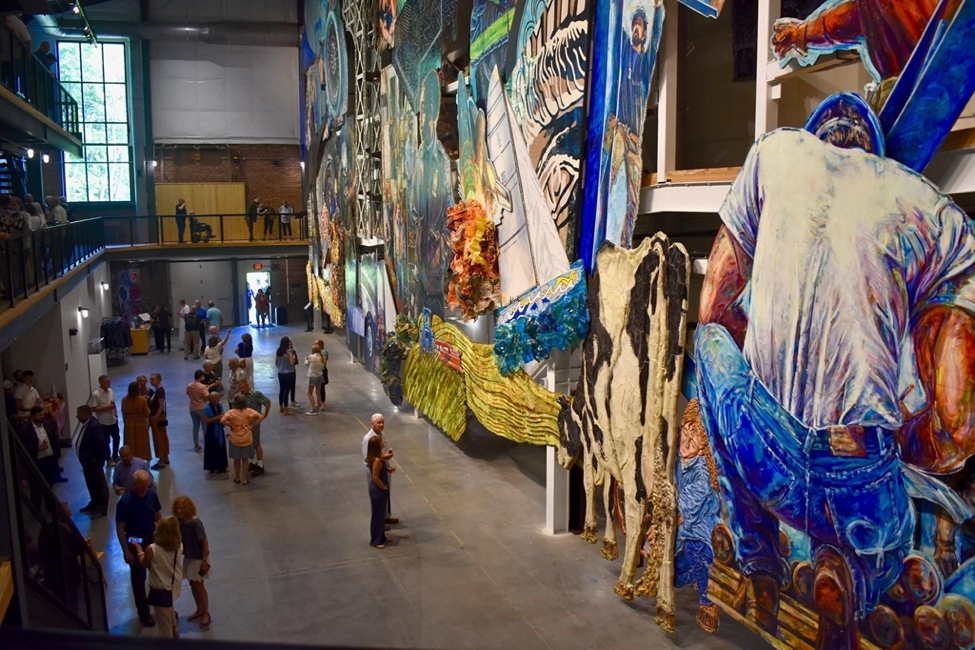
Over the next 21 years, Griesedieck worked with others to create what the organization describes as the largest indoor collaborative artwork in the world: a three-dimensional mural 120 feet long and five stories high. She said that the mural is a tribute to American workers who have defined the country over the last century.
This summer, after four presidential administrations, three Connecticut governor administrations, and one pandemic, the mural was finally completed.
“It’s nothing short of a miracle that it was completed,” Griesedieck said in an interview with The Berkshire Edge. “I will say it is a miracle because so many people jumped into hell to help me. This is something you can’t do by yourself. You have to be crazy, and I’m ready to take that as part of my makeup, but you have to have help and people who believe in you and continue to support you for over 22 years. I received so much support from people including little children, installation workers, teachers, and all the people that worked with us. The list is endless, but that’s why we’re here.”
Workers and laborers are depicted in the mural itself, including from the fields of medicine, emergency work, farming, and construction work. “They’re the lifeblood of this country,” Griesedieck said. “There are so many things that these workers have done on our behalf that nobody acknowledges. That’s the part that frustrates me the most. People complain a lot, but nobody ever sees what other people are doing for them. It’s all work. Yet, we don’t acknowledge their contributions at all.”
Griesedieck said that while people acknowledged the work of frontline workers during the COVID pandemic, it’s not enough acknowledgement. “Why does it take COVID or Sept. 11 for these people to be acknowledged and appreciated?” she said. “Why can’t you just have an average day where you walk into the grocery store and be thankful for the guy who got the blueberries out in the store? It’s an ongoing conflict where there is no acknowledgment for workers. You should be happy for them every single day and be thankful for all the good things that people do.”
According to AMP’s website, more than 15,000 students from 17 states have contributed to the mural through the organization’s education and arts initiatives. The organization plans on continuing its initiatives in the remaining 33 states over the next few years. “I hope the whole state of Massachusetts will come down to visit AMP,” Griesedieck said. “I would love to greet them at the door.”
The work of AMP will be celebrated at a fundraiser on Saturday, September 17 at 6 p.m. at the Art of Work Gala. The event will include performances by Theresa Thomason, Sandra Boynton, Michael Ford, The Miss Milo Band, and Chorus Angelicus.
AMP is open Fridays and Saturdays from 10 a.m. to 5 p.m., and Sundays from 12 p.m to 5 p.m. For more information about the American Mural Project, go to their website. For more information about the Art of Work Gala, including tickets, go to this link.