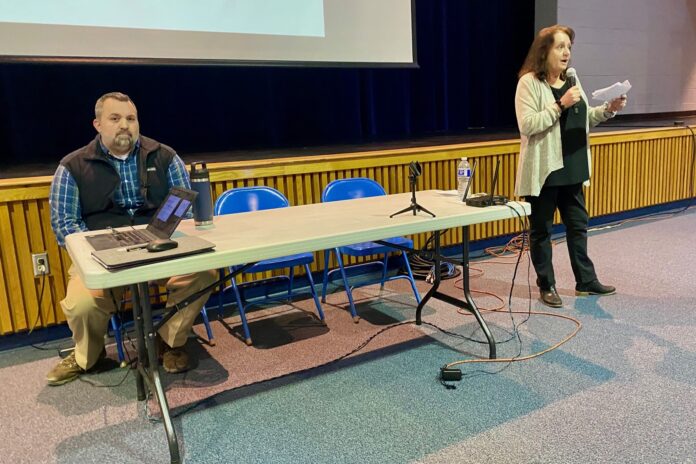
Lee — Longtime Lenox resident Steve Turner had concerns about the Upland Disposal Facility, or toxic-waste landfill, set for neighboring community Lee. “It’s on top of a gravel bed, on top of an aquifer, [and] a liner that does not guarantee [the toxins’ security],” he said.
Turner, along with other Berkshire County audience members at the April 18 UDF information session hosted by the Environmental Protection Agency and presented by General Electric Company, hoped for answers. Although those representatives responded to questions posed by local residents about the draft UDF final design plan, many left still pondering what the project will ultimately look like from their vantage points and how the health and safety of citizens and the environment could be secured.
“Today we are presenting a plan for a state-of-the-art UDF,” opened Matthew Calacone, GE-Aerospace senior project manager for the UDF, after being introduced by EPA Press Officer and Public Affairs Liaison Jo Anne Kittrell, who served as the session’s moderator. Calacone said the UDF is designed “at EPA’s direction and with EPA oversight to be protective of human health and the environment.”
A 2020 agreement between the EPA, GE, and five towns—Great Barrington, Lee, Lenox, Sheffield, and Stockbridge—resulted in a remediation plan for the Housatonic River following decades of GE depositing polychlorinated biphenyls (PCBs) into the waterway. That agreement provided for the most toxic materials dredged from the river to be taken out of the area, leaving the lower-PCB-concentrated materials to be stored in a UDF in Lee, a provision that the town’s residents have long opposed.
The nitty gritty: Understanding how the UDF design will work
According to Calacone, the facility is designed to accommodate up to 1.3 million cubic yards of material within a 20-acre section of the UDF tract, or the “consolidation area.”
Currently, the ground surface at the UDF site is 1,030 feet to 1,050 feet above mean sea level, with the UDF permitted to reach a maximum of 1,099 feet above sea level, Calacone said. The area will be dug out, built, and then sloped to accommodate the UDF.
Starting at its deepest layer, Calacone said the bottom liner of the UDF will be at least 15 feet above the estimated seasonal-high level of the groundwater, with the design actually providing an extra foot, 16 feet of separation, between the bottom of the liner and the groundwater estimate, he said. The dredged material will be more than 22 feet away from the estimated seasonal-high groundwater level, he said.
The UDF baseliner will contain five individual liners, with that tally greater than the two individual liners required by the EPA, Calacone said. The first liner, a layer of clay, will be placed above the subgrade soil, or the soil that exists on the site today. Above the clay, a geosynthetic clay liner will be added, a “heavy duty fabric blanket that has clay built into it,” Calacone said. Above that liner will be a 60-milliliter, low permeability, high density polyethylene (HDPE) layer made from petroleum and used in plastic bottles and milk jugs, he said. Together, these three lower liners comprise the project’s “secondary liner system.”
A drainage layer will be placed above this “secondary liner” system to collect leachate, or liquid formed when rainwater filters through wastes in a landfill, drawing out the chemicals from those wastes. In the cells of the UDF, perforated pipes will collect this leachate and pump the leachate to storage tanks on site. As the leachate collects in the tanks, they will periodically be emptied and shipped to either GE’s facility in Pittsfield or an off-site facility for treatment. During later stages of the project when hydraulic dredging is employed, a treatment plant will be built at the UDF tract to treat the leachate on site.
Above this leachate-collection system will be another geosynthetic clay liner followed by another 60-milliliter HDPE liner, with all those layers comprising the project’s “primary liner system.”
Above that will be another drainage layer followed by a foot of graded aggregate, or “the operations layer,” the surface that the equipment will drive on and which separates the site workers from impacting the liner systems. Finally, the consolidation material will be placed on top of these liners.
A meeting handout depicting the base liner can be found here.
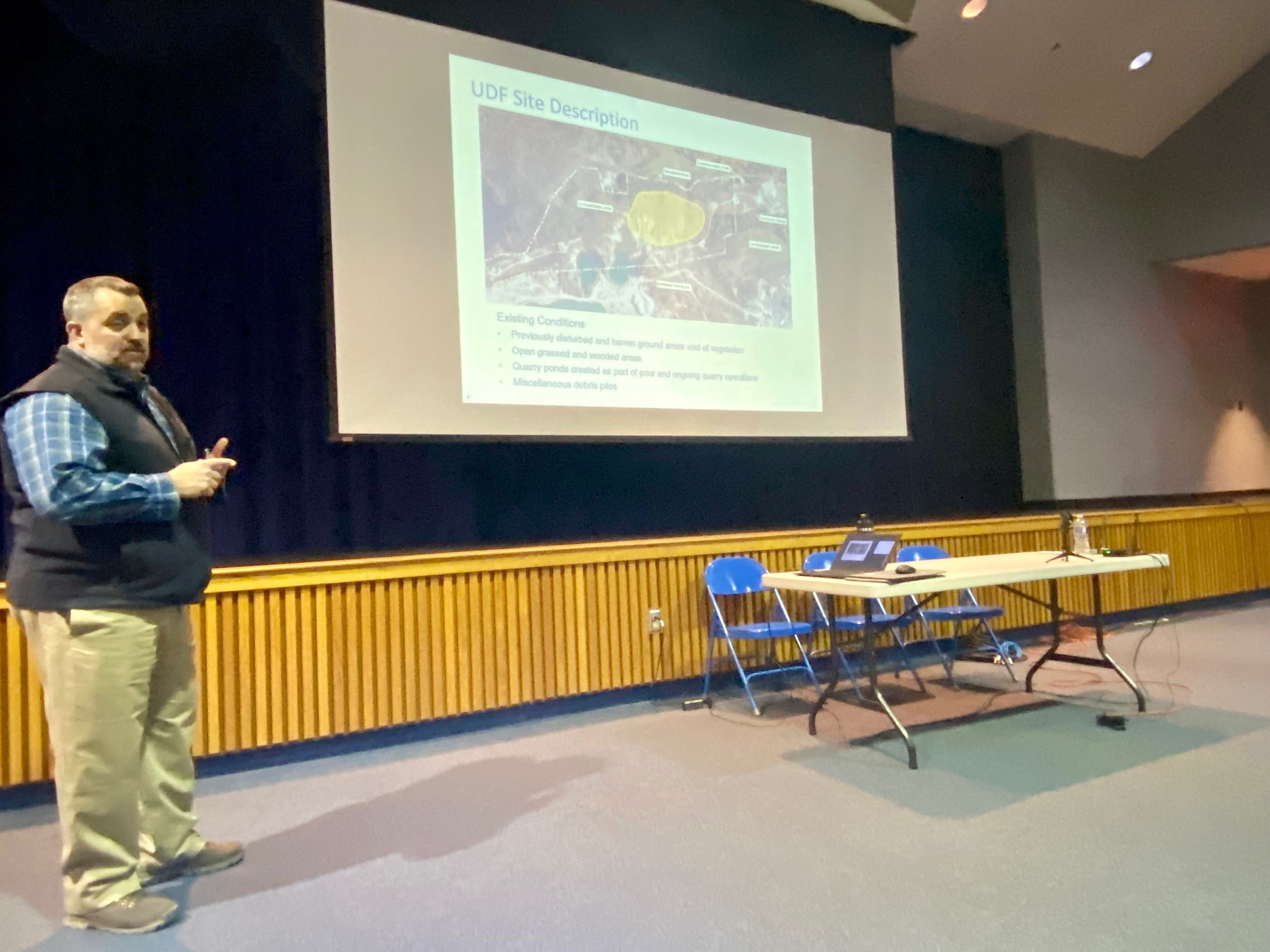
A stormwater-management system will be employed to drain stormwater accumulating within the UDF cap and above the liners to areas around the UDF that are designed “up to a 100-year-storm-event capacity,” Calacone said, a standard that posed an issue for many attendees. Should the water overflow these designed areas, other existing low-lying areas on the site will take on that overflow, he said.
Once the UDF has been filled, the final cover, including its two individual liners, will be placed on top. That cover will be comprised of a layer of six inches of a clean subbase brought to the site, a geosynthetic clay liner, a 60-milliliter HDPE layer, a drainage layer, 18 inches of clean fill, and, finally, six inches of topsoil to help the grass grow.
At the end of the job, the consolidation footprint will be about 13 acres, with grassland established on the cap and surrounding areas, including plant species that draw pollinators as suggested by Lee officials, Calacone said. A project to expand and enhance the wetland and vernal pools existing on site is also in the works, he said.
Timeline and monitoring
Site preparation and earthwork for the UDF will take about a year, Calacone said, “that is, shaping the area to prepare for construction.” The UDF will be built during the second year and can begin operating in the third year, he said. That timeline translates into an estimated facility construction start date of 2025 or 2026, with 2027 serving as the beginning of operations.
“All during that time, we will be managing leachate and stormwater,” Calacone said. Closure at the project’s completion will include ensuring the maximum elevation of the UDF is 1,099 feet above sea level or less, and the stormwater and leachate are handled by on-site systems, he said.
During all phases of the work—construction, operation, and closure—controls will be in place for site access, stormwater, dust, noise, lighting, and site security, Calacone said. Additionally, GE intends to monitor dust, noise, and the conditions of the local roads that support the routes of construction vehicles, he said. During the operations phase, monitoring air and groundwater for PCBs will be conducted, as well as leachate generation.
After the UDF closes, monitoring will continue for groundwater levels and environmental quality, PCBs in the air, the leachate system, UDF cover, and site security, Calacone said.
Questions remain
Although Calacone’s presentation included slides and handouts, attendees lined up with questions ranging from defining a 100-year-flood plain in today’s climate crisis to how transport trucks will be sealed, the accuracy of the calculations determining the seasonal height of the groundwater below the UDF, the contractors who will be involved in the UDF construction and depicting a visual of the height of the UDF once it is constructed, ascertaining whether it will stand out as an eyesore for local residents.
“You do lovely ground plans—how about some elevations?” asked Lee resident Caroline Young. “That’s what we need: to see what this is going to look like.”
When prompted, Calacone said he wasn’t able to measure the top of the UDF in building stories, responding with a comparison of the maximum elevation for the facility relative to the site’s current elevation.
“Without having a visual of that, is that above the tree line?” Lenox Dale’s Robin Bianco asked. She also voiced concern over whether the closing topsoil will erode over time, exposing the UDF site.
Josh Bloom, a member of the EPA-GE Housatonic River Citizens Coordinating Council and former member of the Housatonic Rest of River Municipal Committee, pressed for a response as to whether a canceled tour of the UDF site will be reinstated, with Kittrell responding that the question is outside the scope of the meeting. Bloom followed up with a request for an independent monitoring firm to oversee the UDF site, with Calacone responding that GE typically performs its own monitoring services per the proposal.
Lee’s David Carrington asked for the construction and maintenance costs of the UDF, with Carrington advised to make that request—along with other requests that interested parties may have—to EPA Community Involvement Coordinator Ashlin Brooks who briefly spoke to the group.
Robert Heinzman, a member of Lee’s PCB Advisory Committee, and Jane Winn, a Pittsfield resident and executive director of the Berkshire Environmental Action Team, shared their concerns over GE’s use of a 100-year flood event as the benchmark for the UDF’s stormwater-management system due to climate change. Heinzman inquired as to the risk of the system overflowing. “It’s from an old-world scientific view,” he said of the standard. “We’re not living in an era where, scientifically, a 100-year storm really means anything. We’re not sure what it means, but it’s based upon old data.”
Calacone and Phil Batten, a representative of GE’s consultant Arcadis, responded that the design contains provisions for the overflow to go to on-site low-lying ponds, maintaining the current drainage pattern as much as possible.
But Heinzman persisted. “I’m back, I can’t leave this 100-year-flood thing alone,” he said. “It’s sketchy science.” Heinzman explained that the Massachusetts Department of Transportation projects that the likelihood of a 100-year-flood event in the near term will be 25 percent over what it has been traditionally and 50 percent over in the “not far future.” “We need good science here,” he said.
The Berkshire Edge requested a copy of the slides presented at the meeting from GE’s representative but has not received them as of press time.
The deadline for submitting public comments to the draft UDF design, including the Revised Final Pre-Design Investigation Summary Report for Upland Disposal Facility; the Upland Disposal Facility Final Design Plan; and the Upland Disposal Facility Operations, Monitoring, and Maintenance Plan is May 20. Comments to those documents can be sent to R1Housatonic@epa.