Connections: Love it or hate it, history is a map. Those who hate history think it irrelevant; many who love history think it escapism. In truth, history is the clearest road map to how we got here: America in the 21st Century.
Good Citizens
The Dutch arrived in the Berkshires as early as 1735, just two years after Sheffield was incorporated. When Great Barrington was merely the Upper Parish of Sheffield, Israel Van Deusen and the Burghardts, major landowners, aided Great Barrington in becoming incorporated.
The General Court required a settlement to build a Meetinghouse and hire a minister before it could be incorporated. In 1742, Van Duesen and Burghardt contributed to both the building fund and to the salary for the first minister. When Great Barrington was incorporated, John Burghardt was one of three chosen to serve as a selectman. The Dutch were good citizens, but they were not church members.
Early Conflict
First, they were not Congregationalists. They were of varying sects including Anabaptists, Mennonites, and the Dutch Reformed or Calvinists. Differing Christian sects was not as insurmountable of a barrier as differing languages. They could not understand the minister they helped hire—Pastor Hopkins. At least they could not understand his sermons and were not drawn to Congregational services. And so they were not drawn to Sunday services. Hardly good Congregationalists, they were good Christians, so in the years from 1742 to 1761, they did attend services periodically, and asked that their children be Baptized. They were refused and told Baptism was reserved for church members.
To overcome this obstacle, they planned to bring a Dutch minister to town from New York every fourth Sunday of the month at their own expense. However, they needed a place to congregate and requested that their minister use the Meetinghouse. Again, they were refused.
Unfortunately, this request was treated with contempt as if it were an insult just to ask: “A Dutch preacher in our meetinghouse; that shall never be.” The Dutch felt the insult and ceased to attend church at all.
The Conflict Escalates
At that point, the Minister, Tithingmen, and Sabbath Wardens became involved. Pastor Hopkins called out from the pulpit, “Where are those delinquents?” Because he had called attention to their absence, the Sabbath Warden was duty-bound to report them to the Tithing men and in turn to the Magistrate.
Attendance at Sunday worship was not voluntary; it was compulsory by law. Punishment for nonattendance was also mandatory and not at the discretion of the magistrate. When Peter, John, and Garrett Burghardt and Israel Van Deusen admitted their guilt, the magistrate could not overlook the offense, but he did have a choice of two sentences: a stiff fine or confinement in the stocks. Out of respect for the Burghardt brothers and Van Deusen, the magistrate allowed them to choose their sentence. All four consulted their friend, Judge Timothy Woodbridge of Stockbridge.
Woodbridge advised them not to pay the fine because “it is your money they want, nothing else. If they find they cannot get your money, the business will cease, otherwise there will be no end to it while you have a farthing left.” The four men promptly informed the magistrate that they chose the stocks.
Stocks…
Now there was a problem: All historians agree that there were no stocks in Great Barrington. Some report that the sentence was postponed while stocks were built, and others claim the four men were transported and served their sentence in stocks in Sheffield. Wherever they were, all agree that the eldest Burghardt, Hendrick, came armed. He carried a gun, powder horn, and bullet pouch. He warned the crowd that anyone who hurled insults, jeers, or objects at his three younger brothers or at Van Deusen while they were in the stocks would pay for the temerity.
Judge Woodbridge also attended the men in the stocks. He assured the crowd that their position in the stocks did not reflect poorly on the four men in the stocks but on those who put them there.
After their time in the stocks, they did attend church the minimum times required by law. For this, they felt, they were taunted from the pulpit. Pastor Hopkins singled them out and pronounced, “Every Sunday that you are not in church; you are in hell.”
And a Bond
Finally, in 1762, they got a get-out-of-jail-free card. Jacob Burghardt bonded with 16 other Great Barrington residents. They approached Jacob Davies, an Episcopal minister in Connecticut. On September 21, 1762, a paper signed by Reverend Davies was submitted to the General Court. It stated that the 17 “have put themselves under my care as members of the Church of England … as esteemed members of the Church of England, they are exempted from paying any rates or taxes or being accused as dissenters.” Next, the group raised the money to build their own church.
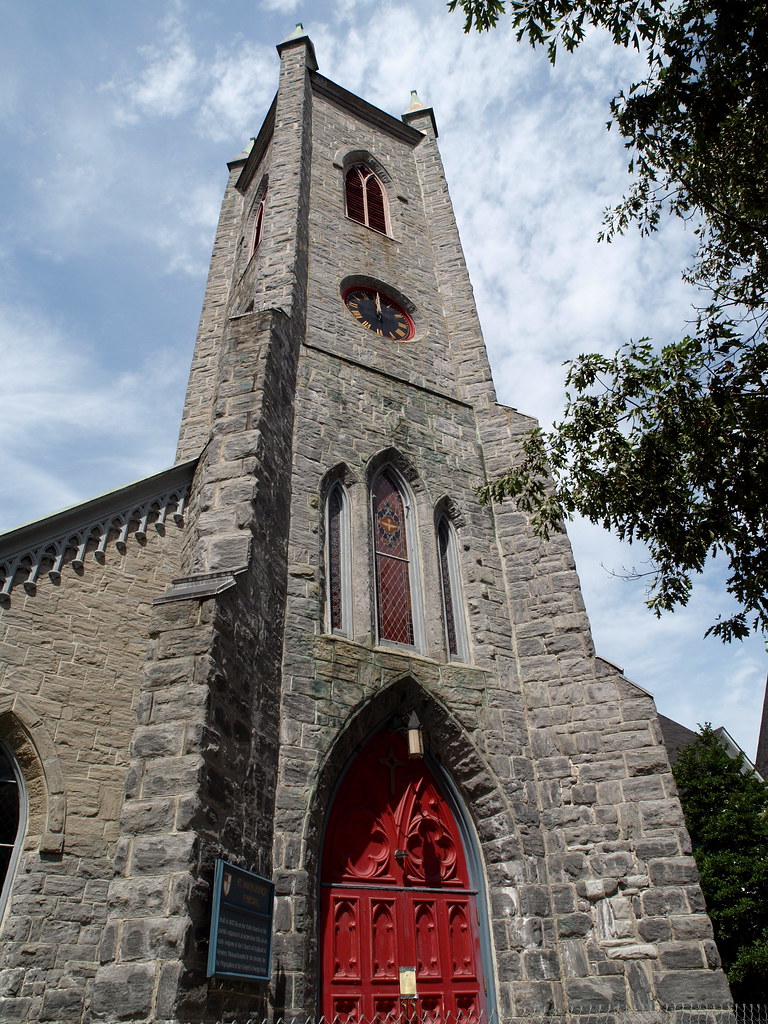
So ends the story of the first Dutch settlers, the stocks, a bond, and the founding of St. James Church, built on Main Street in Great Barrington in 1764.