About Connections: Love it or hate it, history is a map. Those who hate history think it irrelevant; many who love history think it escapism. In truth, history is the clearest road map to how we got here: America in the 21st century.
By request, a reprint of a test from 1885. Can you pass it? Every generation congratulates itself that it is getting older and wiser, improving in all respects, and progressing. The question is: are we?
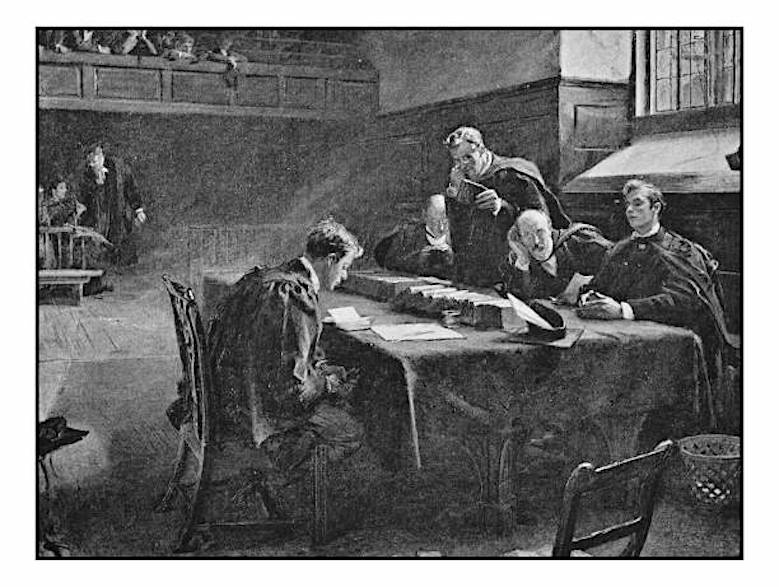
Andrew Berner, library director and curator of collections at the University Club in New York, did research into the requirements for entrance into college in the 19th century. Among the papers he uncovered was a copy of the Amherst College entrance exam from September 8, 1885.
The exam was administered over two days, and the test questions alone (absent required responses) covered 13 pages. Suffice it to say, the exam was difficult. The more important question is: today, who among us, or among current Amherst students, could pass it?
Ready? You may open your examination booklet. Part one, English: you have one hour to “write a composition correct in expression, spelling, punctuation, grammar, and division into paragraphs on one of the following: “Silas Marner, The Weaver of Raveloe” — the influence of Eppie on Silas Marner; Lorenzo and Jessica (“Merchant of Venice”), or the character of Sydney Carton (“Tale of Two Cities”).
Feeling fairly confident? Good. You have 20 minutes to “correct the following sentences and write out each in the correct form.” There are eight sentences to be corrected. Here is a sampling:
- He always read Lord Bryon’s writings as soon as they were published with great avidity.
- These species of flowers are different in important respects to any we have yet seen.
- The guilelessness of his own heart led him to suspect none in others.
- This tone of mystery, disguise, and rapid change of scene, give an element of romance to Lady Morgan’s novels which remove them from real life and the light of common day.
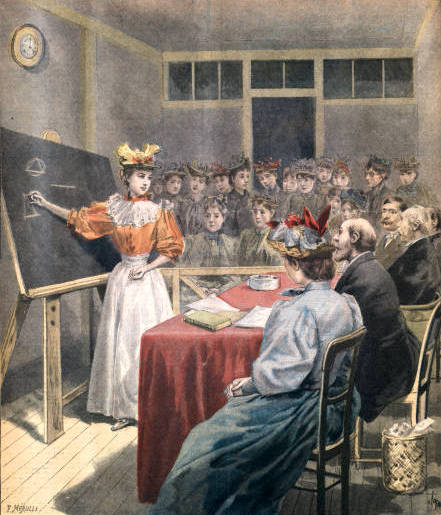
In part two, you are asked to translate 10 sentences from English to French, and then several from French to English. This is followed by questions about French grammar, verb tenses, and noun declinations. There are similar sections on Greek and Latin, including writing a Latin prose composition, translating from Greek to English and English to Greek. These are not simple translations. The passages are taken from Caesar, Cicero, and Virgil, and are followed by questions such as:
- “State how much (of this author) you have read and reviewed.”
- Accompanying a section from “The Iliad,” “who are the people here mentioned?”
- Providing you can do the preceding, you are now asked to “State the various forms of conditional sentences and illustrate each by Greek examples”
- “What are the different ways of expressing purpose in Latin?”
This section of Part Two is now concluded.
You may now move on to algebra, arithmetic, geometry, and ancient history. Please remember, this is the examination to be admitted to Amherst, not the final exams. Recall also that you are to complete these sections without a calculator or Google. Of the 20 questions which follow, here are three:
- “What two numbers whose difference is d are to each other as a to b?”
- “Solve 3x – 4y = -6.”
- “Divide 1/3 by 1/15 by 31/2 -21/4.”
You may now move to geometry. The questions are true/false. For example:
- “A straight line cannot intersect the circumference of a circle in more than two points.” (T/F)
- “In an isosceles triangle the angles opposite the equal sides are equal.” (T/F)
In the ancient history section, you are asked “to name and locate the most important Greek Islands” and describe “The First Punic Wars.”
How did you do? Would you be accepted into Amherst in 1885? Are we getting smarter? There is no doubt we know more about technology, science, and outer space. We have made great strides in medicine. We have tools and gadgets unimagined in previous centuries. We have shrunk the world with our modes of travel and communication. Yet there may be a problem. It may be that we substitute rather than add to our knowledge base. That is, we know far less about the things our ancestors prized, and we know more about things they hardly imagined. Possibly, if we retained the old knowledge and added to it, we would be correct in congratulating ourselves that we are older and wiser. Possibly, if our knowledge were cumulative, we would be correct that each generation is wiser.