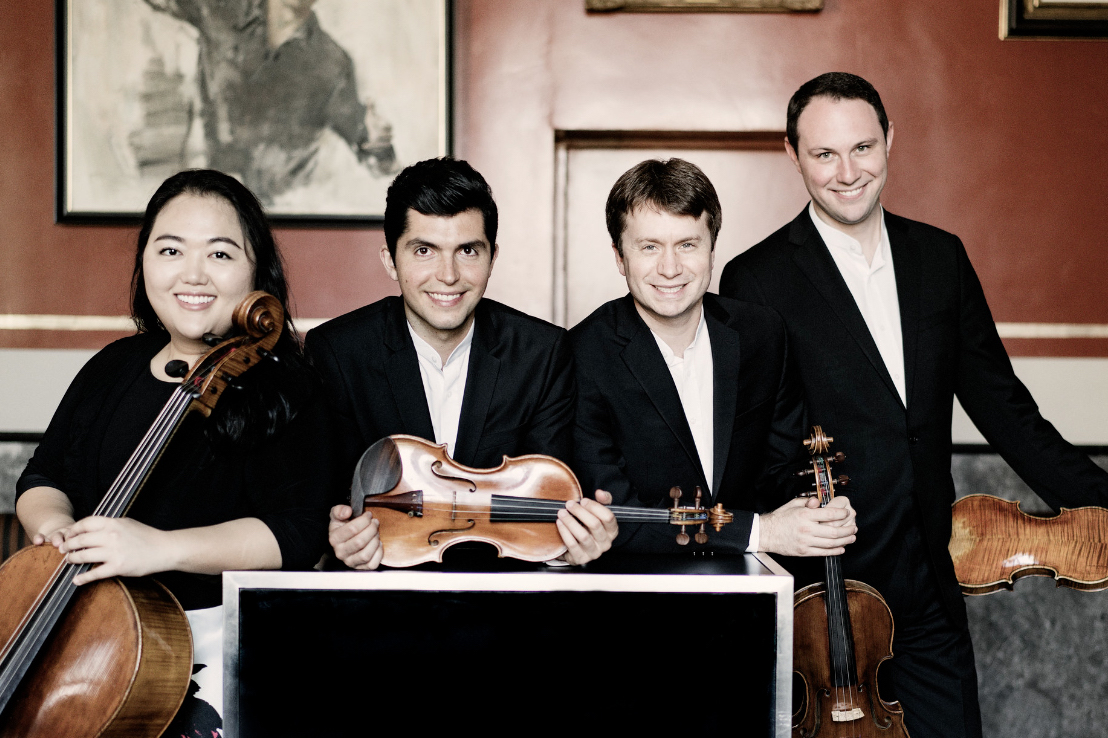
Pittsfield — The Calidore Quartet returns to South Mountain on Sunday, September 11, at 3 p.m. to perform a program of audience favorites from Mozart, Bartók, and Brahms.
The Calidores have been busy since we saw them at South Mountain a year ago. Highlights of their ’21-’22 season include returns to Wigmore Hall, Alice Tully Hall, and the Philadelphia Chamber Music Society. By the end of 2022 they will have appeared at the Library of Congress, the 92nd Street Y, Harvard University, Penn State University and, internationally, in The Hague and Antwerp.
Known for their “understated but relentless intensity,” the Calidores continue to enjoy rave reviews for their concert and studio performances. The Los Angeles Times described the quartet as “astonishing” and their playing “shockingly deep.” The New York Times wrote, “In a scene crowded with excellent young ensembles, the Calidore String Quartet can assert itself with pride.”
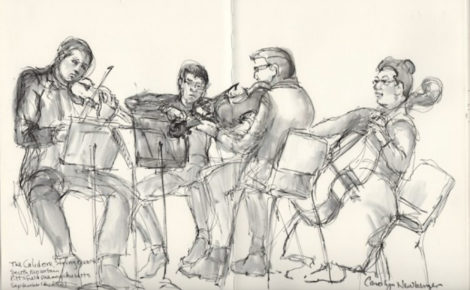
On Sunday, the group will perform Mozart’s playful String Quartet No. 17 in B-flat Major, K. 458 (The Hunt); Bartók’s Beethoven-inspired String Quartet No. 1; and what Johannes Brahms called a “useless trifle” of a string quartet, No. 3 in B-flat Major.
Whoever assigned the fanciful subtitle “The Hunt” to Mozart’s String Quartet No. 17 (the most popular of his “Haydn” quartets) couldn’t have known Mozart very well. Wolfgang was not exactly the outdoorsy type. So he probably didn’t go traipsing around the countryside following a bunch of hound dogs on horseback. The “Hunt” sobriquet was probably inspired by the fanfare nature of the first movement’s opening. It must have reminded someone of hunting horns, which are physically limited to the notes of the harmonic series. Fair enough.
In any case, all we really care about on Sunday is the lighthearted nature of the piece, because that’s what has made it so popular. (Listen for it in Wes Anderson’s film The Royal Tenenbaums.) In the second movement, you can picture stout, gout-prone, middle-aged men in wigs trying to look dignified as they execute intricate dance moves in the gilded ballrooms of Vienna.
Next on the program is Bartók’s String Quartet No. 1 in A minor, Op. 7, a three-movement piece played without breaks. This work is actually Bartók’s second attempt at a string quartet, and it has drawn comparisons to Beethoven’s String Quartet No. 14, Op. 131 because of its intense counterpoint. It’s easy to believe this piece was inspired by unrequited love for a certain violinist, because the first movement’s mood is practically funereal. But it brightens as it goes. And in the third movement, we begin to hear evidence of the composer’s interest in Hungarian folk music. In other words, Bartók had almost settled on his own distinctive style before reaching the age of 30.
Last on Sunday’s program is Johannes Brahms’s String Quartet No. 3 in B-flat Major. It was written for an amateur cellist, Professor Theodor Wilhelm Engelmann, whom Brahms had befriended on a trip to the Netherlands. This is highly useful information, because it gives us more than a clue about the quality of professional string playing in 1875 Vienna. (It was remarkably high, as it turns out, mainly because the Vienna music scene was so brutally competitive.)
But we wonder if Brahms was kidding when he dedicated this piece to an amatuer cellist, because he gave no melody part to the cello. There is, however, a lovely melody for the viola. Perhaps Brahms was joking when he wrote to his friend, “There’s no cello solo in it, but such a tender viola solo that you may want to change your instrument for its sake!”
It’s more likely that Brahms wanted to spare his friend the embarrassment of attempting to play a cello part that might have been well above the skill level of an amateur musician.
On Sunday, listen for that viola solo. See if you think it would be appropriate for an amateur were it transcribed for cello.
We can easily dismiss Brahms’s half-joking claim that his third string quartet was a “useless trifle,” because we know it was useful to Brahms himself. The quartet was the perfect antidote to his somber and monumental Symphony No. 1, upon which he had toiled for over two decades before premiering it about a week after completing his third quartet.
See the Calidore Quartet perform at South Mountain Concerts, Sunday, September 11 at 3 p.m. Find more ticket information here.