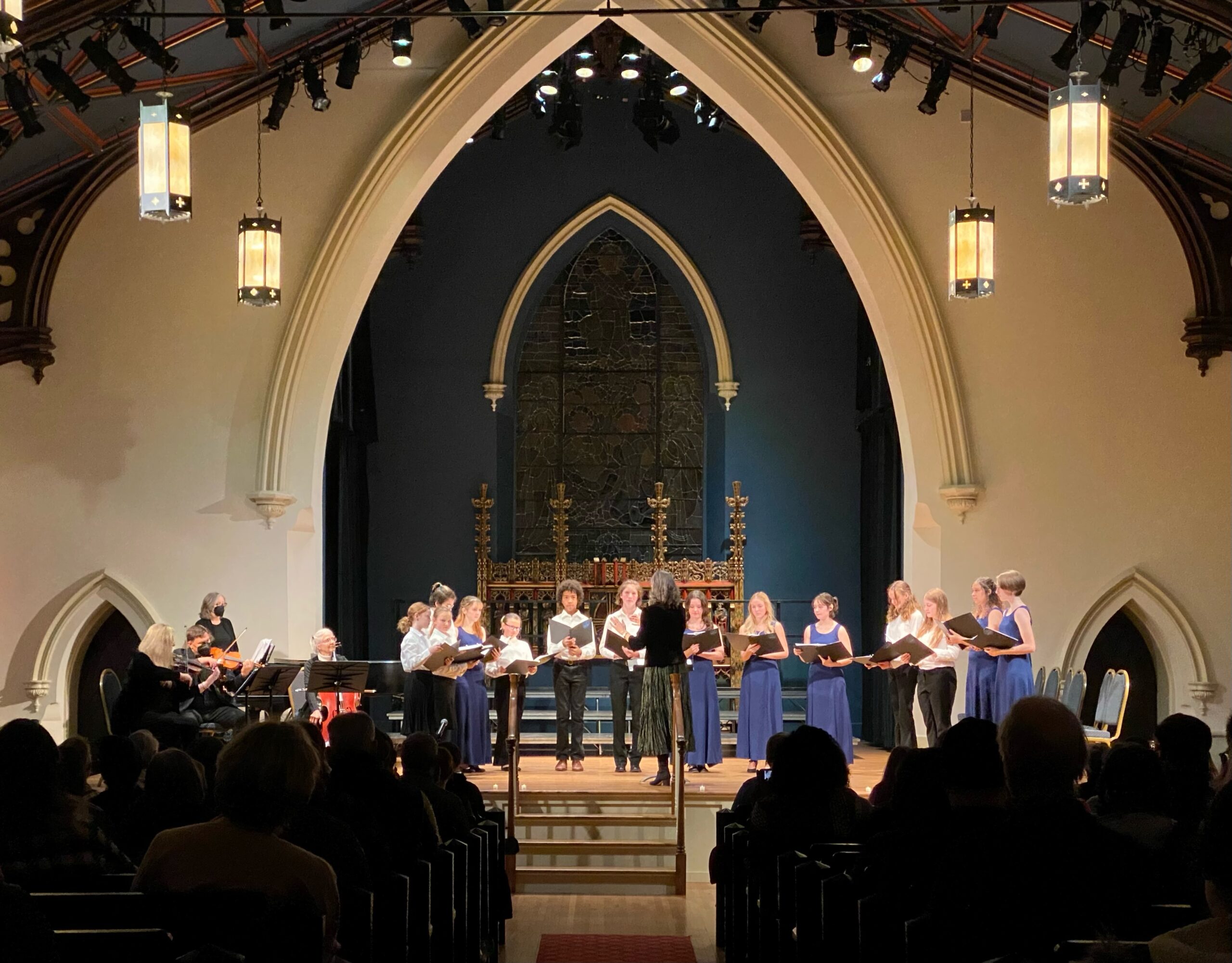
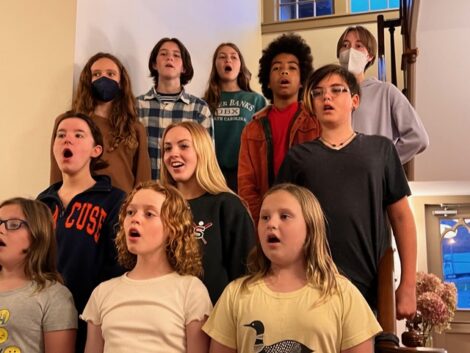
“Ni neart go cur le cheile” (“We are better together”) is an old Celtic saying that has found modern relevance in the young and growing local musical ensemble called Vocalis, which is Latin for “having a voice.” (It also refers to the muscle that, together with the vocal ligament, forms the vocal cords.)
Founded by Julie Bickford in 2021—prompted by the pandemic and developed through earnest hiking discussions among friends—the choral group is based on the belief that developing one’s voice as a young person is an important part of growing up and learning about oneself. “The mission of the Vocalis Youth Choir is to educate young people in the art of choral music while providing opportunities for personal and creative growth, youth leadership, and community engagement,” Bickford explains.
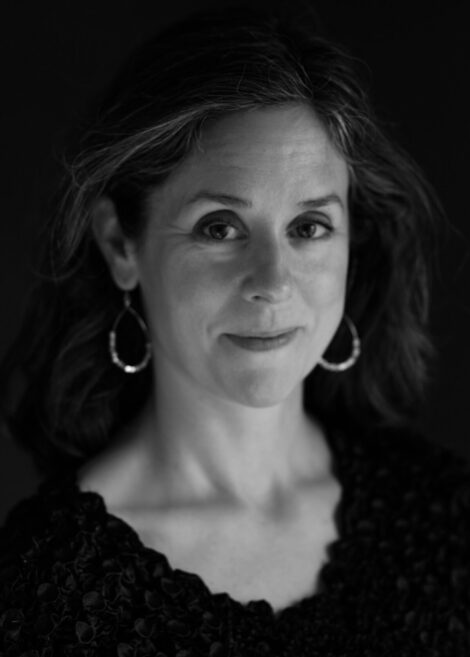
Bickford is the root of this chord—her passion, energy, and gift for connecting with young people set the tone and reverberate throughout the group. Larissa Yaple, founding board chair for Vocalis, was impressed by Bickford’s commitment from the start. “She’s devoted her career to helping young people find their voices—and use them!” she acknowledges, noting her 16 years as choir director at Monument Mountain High School and previous role at Chorus Angelicus in Torrington, Conn. “Her organic group leadership model is equally important to the group’s success,” Yaple notes, explaining the many responsibilities that accompany singing with the choir.
Indigo Travis, one of the many young people Bickford empowers, is an avowed fan. “Vocalis and Julie have helped me quite literally to find my voice! I have been singing with Julie since I was in second grade, and learning from her has helped me become more confident in my musical abilities. Singing in Vocalis makes me feel I am part of a community, and because of that, I have a way to make my voice heard. Both musically and in other ways, it feels like we can achieve more as individuals because we are doing it together.” Ni neart go cur le cheile.
None of this would have happened if Bickford had landed the lead in the Nutcracker ballet as an 11-year-old. Or if her wise mother hadn’t suggested auditioning with Paul Halley for Chorus Angelicus (an internationally acclaimed children’s choir in Torrington, Conn.) instead. She went on to earn a Bachelor of Music in Vocal Performance degree from Ithaca College and a Master of Music Education from the Hartt School of Music at the University of Hartford.
Anyone who grew up performing in a musical group can appreciate the magic that happened during Bickford’s early choral experience. When assorted people (often with seemingly nothing else in common) come together to make music, the intensity of effort and shared awe at a job well-done form bonds as strong as any sports team or school play.
It is especially striking when the music is created by the human voice—the most ancient, simple, and complex instrument. Many consider it the most challenging instrument to master because of how intricate and individual each one is. The human voice is also the most versatile in that vocal cords have a vibrating mechanism for producing instant sound waves and a resonating mechanism for creating such expansive tonal and emotional expressions.
There is perhaps nothing more daunting than trying to get those intricate, individual voices to blend in harmony, however—particularly during the first few rehearsals, when every director secretly harbors “American Idol” judge Randy Jackson-esque critiques of “pitchiness,” losing the beat, and inharmonious blends.
But there is also nothing as moving, soul soaring, or reverent as the last-held note of a final performance, when the conductor lowers the baton and the singers breathe, absorbing the prized nod of deep appreciation and approval.
A choir rooted in music education as well as community involvement
“What began as a mission statement to create a choir that held community involvement in as high regard as performance and music education has grown into a strong choir of 15, filled with kids who possess not only strong voices but curious minds and generous spirits,” Bickford explains. In other words, kids who are passionate about music, eager to learn, and committed to their community.
The younger group, Senior Choir, features treble singers ages 10 to 14 and focuses on learning proper vocal technique, developing music literacy and sight-reading skills, and honing listening and blending skills critical for ensemble work.
Travis, a key mentor to the younger members, shares, “I’ve really enjoyed being the head chorister this year. I’ve known some of the younger choir members since they were four or five years old, and it has been fun to watch them grow in all sorts of ways and help them become more confident performers.” Ensemble, the higher-level vocal group, is structured for treble singers ages 14 to 18 and offers a more challenging and diverse repertoire in three and four parts. Both groups rehearse for 90 minutes once a week.
The Vocalis Youth Choir will perform two free concerts (donations are accepted at the door) in June as part of their Celtic Choral Music Series. The first will open the seventh season of Music at The Southfield Church (New Marlborough) on June 3rd at 7 p.m.—an opening concert sure to lift your spirits and get your toes tapping. The second (home) concert will be held on June 10th at 4 p.m. at Saint James Place (352 Main Street in Great Barrington).
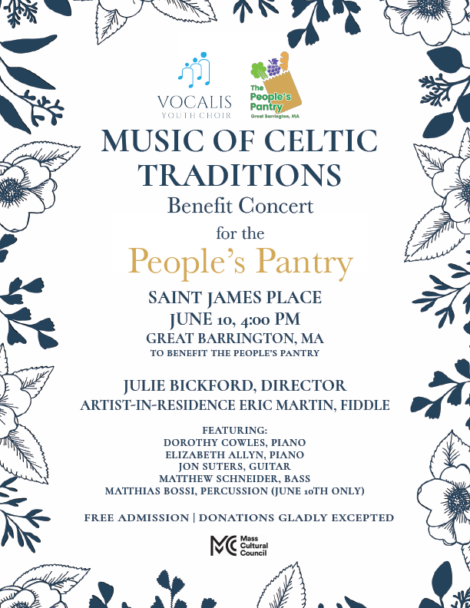
While many know Saint James Place as the year-round, state-of-the-art Gothic revival cultural center in the heart of downtown Great Barrington, it was initially an Episcopal church founded in 1857. As its parishioner count dwindled, the structure fell into disrepair but was lovingly restored and offered to the community as a nonprofit, multi-use cultural entity in 2017 by Sally and Fred Harris.
In addition to being a cultural venue, Saint James is home to The People’s Pantry—a nonprofit established in 1999 in response to an increasing need for access to healthy food by South County residents experiencing food insecurity. As in the past, all proceeds from the home concert will be donated to The People’s Pantry. “This was a natural focus for our community involvement, helping to support People’s Pantry with whom we share a home,” Bickford notes.
What does this mean to the performers? “Because of Vocalis’s connection to the People’s Pantry, I know that when I’m singing, it is actually benefiting people in more ways than just creating beautiful music,” Travis remarks.
Elevating performance through transforming music and close collaborations
Both concerts’ repertoire focuses on vocal and instrumental music in the Celtic style. It features musical collaborators Eric Martin on fiddle, Jon Suters on guitar, Matthew Schneider on bass, Matthias Bossi on percussion, and Dorothy Cowles and Elizabeth Allyn on piano. Each program will include traditional songs from Ireland, Scotland, Newfoundland, and more, showcasing the spring artist-in-residence program with Eric Martin.
Martin and Bickford’s connection traces back to Ithaca’s undergrad days (where they overlapped for two years) and continued post-college when they sang in the same choir (Crescendo) for several concert series. “I hired him to do string trio work for a past concert involving several Celtic pieces and started thinking, ‘It would be cool if he didn’t just show up for the final rehearsals but was part of the whole long process,'” Bickford explains.
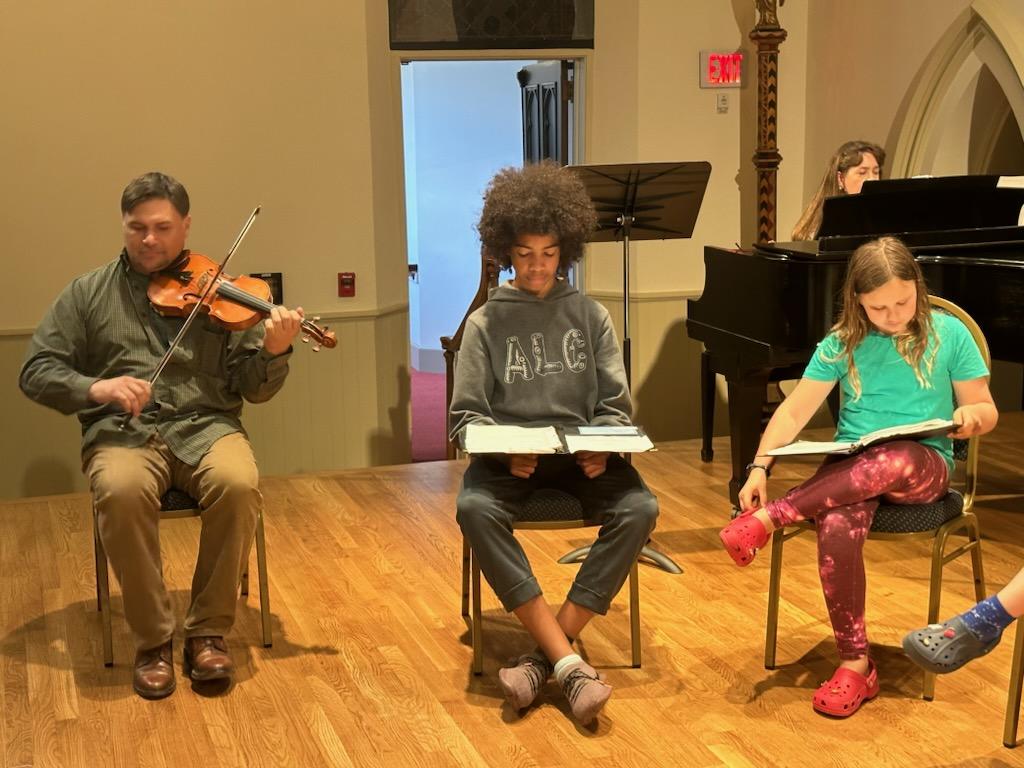
Martin, who sings and plays the violin and viola, is well known in the community as a freelance musician (performing solo as well as with Alchemy, a trio with Karen Axelrod on piano and Rachel Bell on accordion). He is also a music educator, teaching previously at Bard College at Simon’s Rock and currently at Berkshire Waldorf School, in addition to his private studio.
“What was most exciting about his residency was that he was a true partner in every part of the process—helping to curate the program, arranging pieces for the band to accompany the choir, and teaching the singers. “The kids really responded to our artist-in-residence program,” Bickford notes. “It elevated their performance in new ways.”
“Collaborating on this concert has been an absolute joy,” Martin affirms. “The youth singers have been extremely responsive and willing to try new things.”
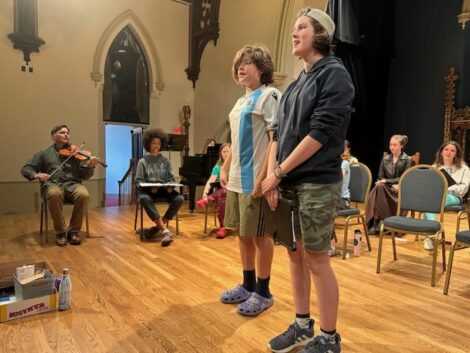
One aspect that was quite different for some of the choristers was learning pieces entirely by ear (using the call-and-response teaching form common in traditional music). “They picked things up extremely quickly, which I feel is a testament to the great training they have received from Julie.”
Lest you imagine choral music is strictly serious, Martin points to a song he describes as “a very rustic piece that is not sung in any particular language but instead uses nonsense syllables (called lilting or mouth music in various traditions),” For him, “It’s been fun watching them let their hair down a bit on that tune, which I think is a nice variation to the beautiful sound they make on the other pieces on the program.”
Travis agrees, “I like that [the song] has a lot of words that aren’t actually words but more like sounds, such as ‘ho ro harra dalla.’”
Current board chair Neel Webber adds, “As an organization, we’re very excited about Eric’s work with the choir. As a community member and musician with incredible cultural knowledge, he’s helped us offer our youth a wonderful opportunity to go beyond any normal choir experience.”
Vocalis benefits its members as much as our community
Although highlighting all the benefits of singing in a choir deserves its own article, the recent Chorus America Study identified at least three: “Children who sing in choir develop advanced skills in teamwork, leadership, and perseverance.” It further states that singing in a choir “not only adds the beauty of music to you and your child’s life but also lifelong skills and character traits that will have a huge influence on the choices they make as adults” (per the Roanoke Valley Children’s Choir website).
David Travis, father to Indigo, affirms the value of the choral experience, saying, “Julie is a true gem—we strongly recommend Vocalis to all parents of budding singers.”
Having succeeded in making the necessary adjustments to rehearse during the pandemic, Bickford now faces new challenges—namely, the singers’ busy schedules and ability to maintain their weekly commitment. What’s more, Vocalis (and most nonprofits in our area) face the challenge of raising funds to carry out their mission. As Webber explains, “Since the tuition costs ($600 per year) cover only a quarter to a third of the operating budget, we rely heavily on individual contributions, Cultural Council grants, and advertising revenue from our programs to cover the rest.”
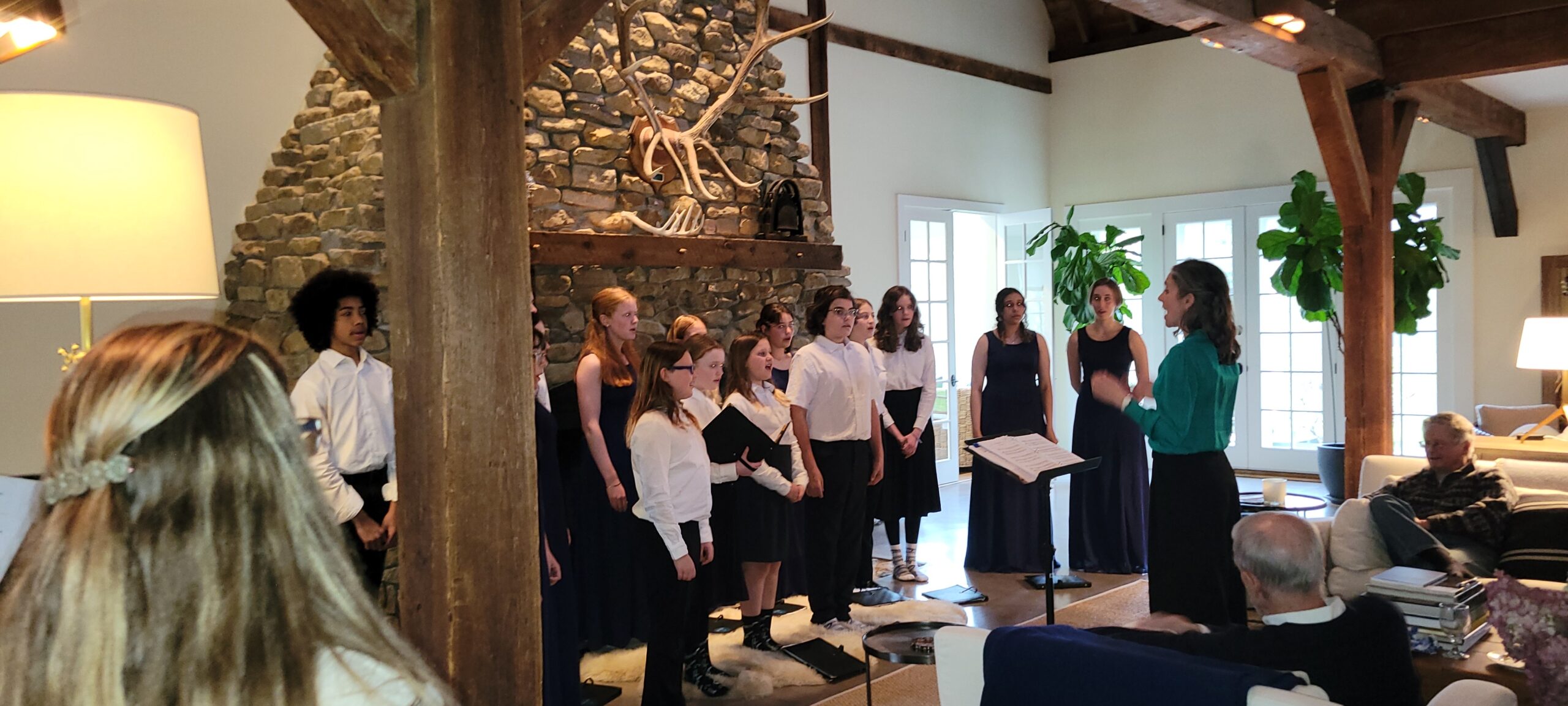
Beyond offering this kind of musical opportunity to the choir members and surrounding community, the board is working to ensure sustainability for years to come. “We feel like we’ve hit a good stride,” says Webber, “but we have a long way to go. We’re learning how essential locally generated private donations are.”
To that end, they welcome one and all to attend one of their upcoming concerts, encourage other young people to join the choir, and consider donating to keep them singing for years to come (see Vocalisyouthchoir.org for more information).
“My mom (Margaret Webber, now 98) sang her entire life,” Webber shares, “so I got to experience her singing on stage with amazing New York artists in opera and community theater up in Rochester, N.Y. Seeing how deeply embedded she was with music and what it has given her is incredibly inspiring for me. It also led my daughter to begin singing with Julie when she was eleven—a passion that I hope will stay with her for life.”