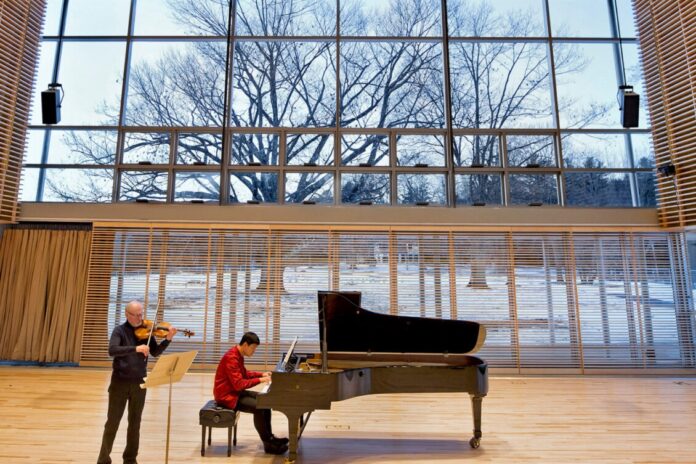
Lenox — At 3 p.m. on November 23 at Tanglewood’s Linde Center for Music and Learning, members of the Boston Symphony Orchestra (BSO) and special guests will present Charles Ives’ String Quartet No. 1 and Amy Beach’s Piano Quintet—two seminal works that illuminate the breadth of early American chamber music.
The musicians performing on the 23rd are:
- Catherine French, violin
- Bernadette Wundrak, violin
- Daniel Getz, viola
- Owen Young, cello
- Jonathan Bass, piano
Catherine French, a Canadian violinist with the BSO since 1994, is an acclaimed soloist and chamber musician. A winner of major Canadian competitions, she has appeared with leading orchestras, toured internationally, and performs widely with ensembles including the Calyx Piano Trio and Collage New Music. She trained at Indiana University and Juilliard.
Bernadette Wundrak is a violinist with the Gewandhaus Orchestra (GHO), appearing in Boston through the BSO’s partnership with the GHO. An accomplished orchestral and chamber musician, she brings the distinguished Leipzig ensemble’s tradition and stylistic breadth to her guest performances with BSO colleagues in chamber and orchestral settings.
Daniel Getz joined the BSO as violist in 2013. A New England Conservatory and Juilliard graduate, he appears frequently in chamber concerts throughout Boston and the Berkshires. He has performed widely as soloist, teaches at NEC Preparatory School, and is an alumnus of major festivals including Aspen, Kneisel Hall, and the Tanglewood Music Center.
Owen Young, a BSO cellist since 1991, is an active chamber musician, concerto soloist, and festival performer. He has appeared on national broadcasts, collaborated with James Taylor, and taught at leading institutions. A Yale-trained musician, he also mentors young players through programs such as Project STEP, Berklee College of Music, and Kids 4 Harmony.
Jonathan Bass is an American pianist acclaimed for his solo and chamber performances across the United States and internationally. A Juilliard graduate and winner of major competitions, he has appeared with numerous orchestras, recorded to strong critical praise, and is a frequent presence at Symphony Hall, Jordan Hall, and Tanglewood.
I spoke via Zoom this week with the BSO’s Catherine French and Daniel Getz to discuss their perspectives on performing chamber music and, in particular, the music of Charles Ives and Amy Beach. Our conversation has been edited for clarity and length.
THE BERKSHIRE EDGE
What do you get from playing chamber music that you do not get from orchestral playing?
CATHERINE FRENCH
Well, I would say many things, but they can also be found in orchestral playing if you know where to look. But chamber music is so much more intimate than what we are doing in the orchestra every day. It’s so nice to get to spend that kind of time with your colleagues talking about music in a setting where you have more input, because on the stage, obviously, we do as we are asked. This way, we get to be a lot more involved in the decision-making process, and I think that can be very fulfilling. Chamber music is such a joyful part of being a musician, to get to make music for smaller groups of people, to have more of a direct interaction with them, there’s something very special about it.
THE EDGE
Daniel, do you want to add anything?
DANIEL GETZ
I agree with everything Cathy said. I think some of the chamber music repertoire is written with that kind of thing in mind. It is so much more intimate. It’s different in the sense that it’s one to a part versus 12 or 15 to a part. In that sense, the composer can write music that is more intimate. We’re not being asked to be an entire orchestra, we’re asked to be a quartet. And so, I think some of the chamber music repertoire that we look forward to playing has those kinds of elements to it, and that’s what makes it so different from, for example, a Mahler symphony, where you have all these extra elements in it. It’s different, it’s a lot more intimate.
THE EDGE
How can listeners new to Charles Ives’ music find their way into his first quartet, and what do you most want them to notice when they hear it performed live?
FRENCH
Daniel, should I talk about it a little bit first, since I picked it?
GETZ
Absolutely. Go ahead.
FRENCH
I’m very interested to hear what Daniel thinks about it too, though. I had the pleasure of performing it previously—it was a long time ago now—but I’m very happy to revisit it.
In terms of your question about the audience, I think this piece, which is a very early work of his—my understanding is that he at least started it when he was still an undergrad at Yale. So in the context of his overall output, this is an early work.
I think this piece is a great gateway into the work of Ives. It’s very accessible in many ways—a lot of it is very tonal. And for anyone who grew up going to church or is just a little bit familiar with hymns, you’re going to hear a lot of melodies that make you say, ‘Wait a minute! I think I’ve heard that somewhere before!’
I’ve read that there are at least eight hymns that he quotes in there, so it’s almost like a little treasure hunt, trying to pick out things that you’re familiar with, that you’ve heard before.
He actually writes beautifully for strings. It’s very idiomatic—not awkward the way… Some pianists, when they write for strings, you can tell. You think to yourself, ‘I wouldn’t have done it that way.’
But I don’t find that with this piece. I find it quite beautiful. For anybody who likes Ives and is hoping to hear him really go nuts: He goes a little bit nuts at the end of the last movement, and he brings a couple of hymns together in different meters, and then he resolves the whole thing in a very traditional way. So the fact that he’s a contemporary composer shouldn’t scare anyone away. This piece is very beautiful and very accessible.
THE EDGE
You’re playing a piece by Amy Beach as well. What contrasts in American musical identity do these two works reveal, given they were written only a decade apart?
GETZ
The Beach—it almost takes on the style of German romanticism. Would you agree with that, Cathy?
FRENCH
Absolutely. Even though she was largely, I think, self-taught and did not study in Europe. But I agree—it has that Brahmsian feel, doesn’t it, Daniel?
GETZ
It does. It sounds like it could have been written in the mid-19th century. And the Ives, as Cathy said, is very American in the sense of very recognizable American church tunes, hymns, so it’s almost unavoidable to notice that, I think.
FRENCH
I found it very interesting to note that the pieces were written only about 12 years apart. These two New England composers… It’s fascinating how completely different they are in every way. But they were very much contemporaries. I don’t know if they knew one another at all—I didn’t run across that anywhere.
With the piece by Amy Beach, once the piano enters, you have this almost orchestral element to it. It is my understanding that she was a tremendous pianist, and I think you can tell that by the writing in this quintet. It is a tour de force for the piano, and Jonathan Bass just sounds fantastic on it.
It’s been such a pleasure to learn about Amy Beach and become more familiar with her compositions. She was very much a product of her time. She married young, her husband was very successful, and he didn’t want her performing. But I think about all that energy. I think she was a terrific pianist, so she took all that energy and she really poured it into her composing.
Her husband didn’t want her teaching, either. He felt it would be inappropriate for their standing in the community, because he was a doctor, a successful fellow. So I think all her artistic energy—everything she felt she needed to express—went into her composing. I think you can feel that in her piano quintet. It’s only three movements, not a particularly long work. But it is epic in its scope. And then you have Ives with these little church tunes, as Daniel says. The contrast is staggering.
THE EDGE
What threads of shared influence—cultural, historical, or musical—connect these composers despite their stylistic divergence?
FRENCH
Wow! That’s a good question! Daniel, do you have a good answer?
GETZ
I wish I did. But musically, I don’t know what I would say. The Ives quartet contains very recognizable tunes. He does a lot with harmony, and he changes up the rhythm quite a bit. He does a lot to make these tunes sound very romantic in style. With the Beach, that was her style, and you can tell she was a pianist—the way she wrote not just for the piano, but for the strings, and she richly orchestrated everything. Ives also did that, but with what I would consider a lot simpler tunes.
THE EDGE
Anything else, Cathy?
FRENCH
I can’t think of any two composers more different than the two of them in their backgrounds and their experiences. I can only imagine how different their influences were. You read about Ives being so influenced by his father, the bandmaster, and loving band music, and this idea of the bands all starting in different locations, playing different tunes, and all coming together, and how he just loved the cacophony of it.
Who knows, but I can only imagine that that would’ve been abhorrent to Amy Beach. She could’ve thought, ‘What is happening? What is going on?’
It’s fascinating, really, to think that Ives and Beach were living these parallel and completely unrelated lives and producing great but completely different music from the same geographic region. That is very interesting.
THE EDGE
What do you hope listeners learn about the evolution of American music when they hear Beach and Ives back to back?
GETZ
Which one was composed first?
FRENCH
The Ives is actually first. It was 1896, and Beach wrote the quintet in 1908. I’m having trouble thinking of prominent American composers who were active before Amy Beach. I know there was a group of them in Boston that she was affiliated with, Chadwick and Foote, and certainly she seems to be of that ilk to me.
With Ives, I can only imagine. It seems like a natural progression. Copland and Bernstein must have been very taken with Ives. I don’t know that, but I can imagine it. I can imagine them finding inspiration and like-mindedness with Ives. But with Beach as well, though.
It’s a good question. What I hope people will take away is this idea that new music—it’s hilarious to think of their work as new music, although I’m sure there are people who would categorize it that way but who feel like if it’s American music or new music, it’s something to be avoided or something to be fearful of, that they’re not going to like it, that it’s something they’re going to have to endure before getting to the part of the program they are looking forward to.
And I hope people will go away thinking the music was beautiful, that it was written right here where they live, and that they feel a connection to it. I’m not a native New Englander, and neither is Daniel, but I feel a connection to it, living here now for a long time. Anyway, I hope that’s what people will take away from it.
Beach was such an impressive person on every level, especially considering the time she lived in, She was the first woman to have a piano concerto or a symphony played by the Boston Symphony. That, in itself, is such a great part of our history.
I wish we played more of her music in the orchestra. Maybe Mark can help us: I forget what it’s called, but there is an initiative now at Symphony to perform more American music. And I thought, in light of that, that this was a nice program for us to reflect that goal as well. I’ve been in the orchestra now 31 years, and the whole time, my dad’s been saying to me, ‘Why don’t you play more American music? You’re an American orchestra.’ And it’s a good point. If we don’t play it, who is going to play it?
Orchestras in the smaller communities, I understand they may have restrictions that we don’t have. We are at our best when we are bringing our audiences great music, including music that they’re probably not going to hear elsewhere. Maybe that’s what I hope people will take away from this chamber music program, too—this feeling of, ‘I heard great music. I didn’t know it, I hadn’t heard it before, and it was written by people in New England not that long ago. How cool is that?’
GETZ
Cathy’s already said this, but these two composers are so different, and I don’t know if it reflects an evolution of American music—from Ives in 1896 to when Beach composed the piano quintet—but when a lot of people, including myself, think of American music, we think of people like Ives or Copland or Bernstein.
Copland, especially, was so good at reflecting that open prairie feel. But by including the Beach on this program, the audience, if not already familiar with both of these composers, might hear that not all American music necessarily sounds like Copland.
FRENCH
That’s a really good point. That’s an excellent point. Well done, Daniel.
GETZ
It reflects the cultural melting pot we have here. We don’t associate particular sounds with German, French, or American romantic music from the 19th century to today; instead, it’s a blend of many composers, influences, and families from different places—and it all comes together in that reflection.
* * *
The Linde Center for Music and Learning is located at 3 W. Hawthorne Rd, Lenox, MA 01240. For more information and tickets, visit the TLI website.