Where’er you walk, cool gales shall fan the glade;
Trees, where you sit, shall crowd into a shade;
Where’er you tread, the blushing flow’rs shall rise,
And all things flourish where you turn your eyes.
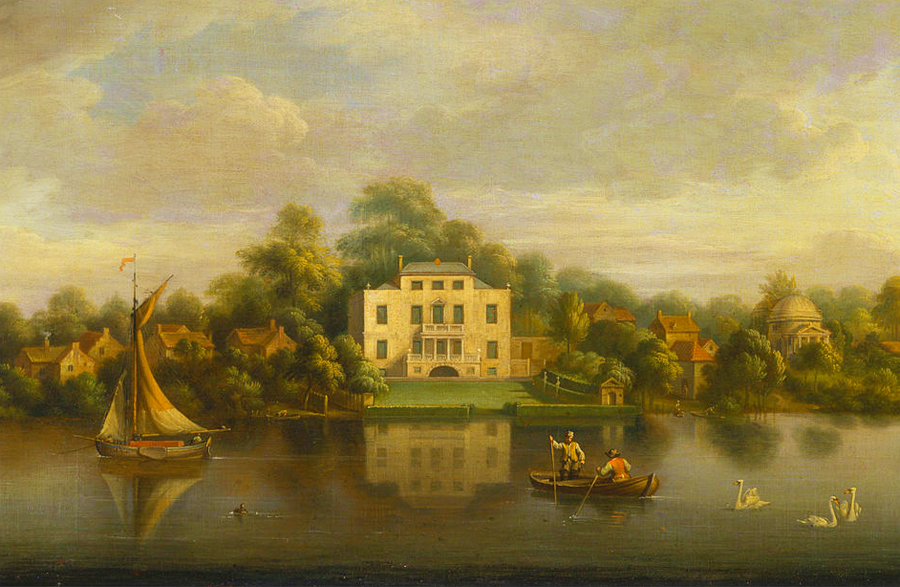
Many years ago . . . Harry Truman was President . . . my older brother Tom and I were making our way up the River Thames west of London to find the villa and gardens where Alexander Pope, the poet, wit and satirist had lived. The town on the river was called Twickenham, and Tom, already an 18th century specialist, reminded me that in Pope’s lifetime (1688-1744) it was pronounced Twit’nam.
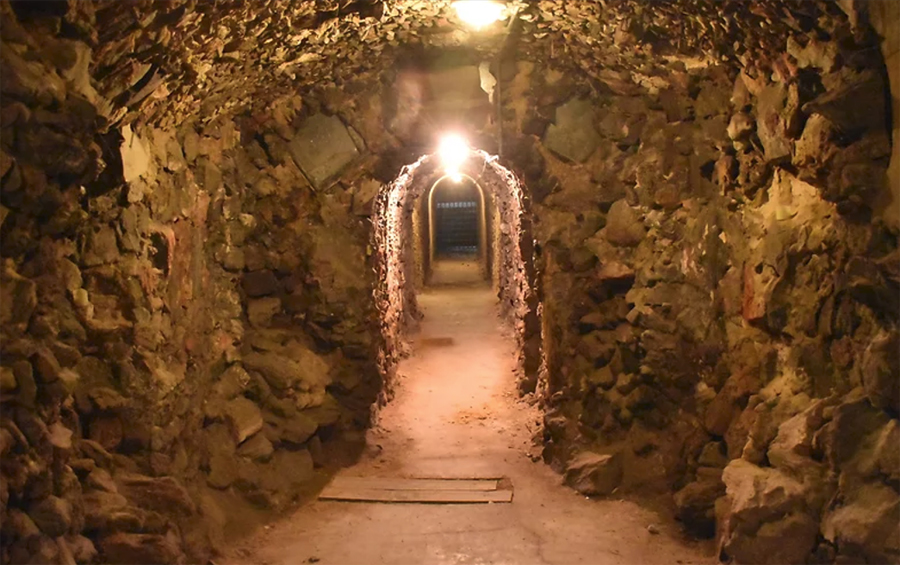
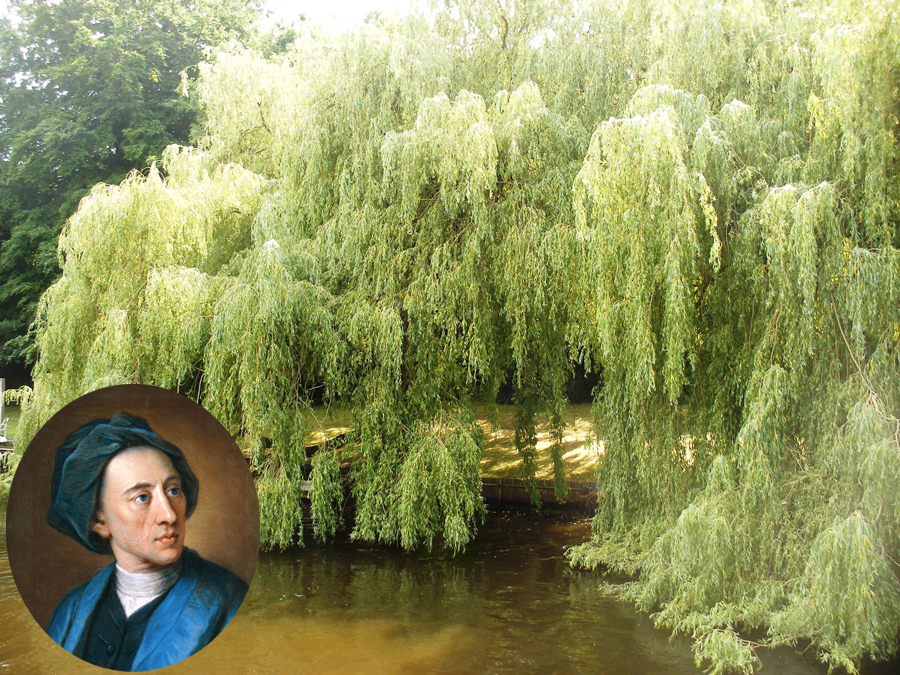
We knew that Pope’s original villa had been torn down and replaced; it was now a convent school. But we hoped that Pope’s famous tunnel/grotto that led from his garden under a road and down toward the Thames would be intact, and indeed it was. Its walls of “shells interspersed with Pieces of Looking-glass in angular Forms” were somewhat jaded but still spectacular to see. And at the entrance was a large tree stump, the original willow tree that Pope was the first to plant but from which willows had multiplied, up and down the river and to places as far away as Catherine the Great’s palace in Saint Petersburg where Pope had sent cuttings. Here is the grotto today and Pope’s description:
You who shall step where Thames’s translucent Wave
Shines a broad Mirror, through the shadowy Cave,
Where lingering Drops from mineral Roofs distil,
And pointed Crystals break the sparkling Rill;
Unpolished Gems no ray on Pride bestow,
And latent Metals innocently Glow;
Approach great Nature, studiously behold
And eye the Mine, without a wish for Gold.
* * *
It’s appropriate that Pope, who grew up in Windsor Forest, should reference Great Nature in his poem, because Nature lay at the heart of Pope’s views on landscape gardening.
To build, to plant, whatever you intend,
To rear the Column, or the Arch to bend,
To swell the Terras, or to sink the Grot;
In all, let Nature never be forgot.
He embraced the idea of following classical gardening practices of ancient Rome with groves, wilderness areas, mounts and scattered statuary, winding paths with shady sections and small rivers. Not for him the studied formality of the French.
First follow NATURE, and your judgment frame
By her just standard, which is still the same:
Unerring Nature, still divinely bright,
One clear, unchang’d, and universal light,
Life, force, and beauty, must to all impart,
At once the source, and end, and test of art.
Art from that fund each just supply provides,
Works without show, and without pomp presides:
In some fair body thus th’ informing soul
With spirits feeds, with vigour fills the whole,
Each motion guides, and ev’ry nerve sustains;
Itself unseen, but in th’ effects, remains.
One might say that Pope brought home the poetry and learning of the ancient world through his translations and imitations, and their principles of landscaping through his garden designs. As fellow-writer Horace Walpole once said, poetry and gardening are sister arts.
To which arts Pope added an element of utility by incorporating a kitchen garden, orchard and vineyard near his villa. And he generally instructed us to “vary the scenes, lights and shades to take in what is agreeable,” which, incidentally, included a bowling green.
He gains all Ends, who pleasingly confounds,
Surprises, varies and conceals the bounds.
* * *
Pope not only made impressive designs for his own grounds, but he freely offered advice to his friends in the Thames valley, particularly the Earl of Burlington at Chiswick House and the Countess of Suffolk at Marble Hill, (mistress to George II) who installed Pope-inspired meandering paths, a grotto and, of course, willows.
* * *
Visitors who were welcomed by Pope at his own villa included Swift and Voltaire, but there were also visitors who came uninvited, especially aspiring poets who wanted to perform for the master. Pope said to his servant:
Shut, shut the door, good John! fatigu’d, I said,
Tie up the knocker, say I’m sick, I’m dead.
The Dog-star rages! nay’t is past a doubt,
All Bedlam, or Parnassus, is let out:
Fire in each eye, and papers in each hand,
They rave, recite, and madden round the land.
What walls can guard me, or what shade can hide?
They pierce my thickets, thro’ my Grot they glide;
By land, by water, they renew the charge;
They stop the chariot, and they board the barge.
All fly to Twit’nam, and in humble strain
Apply to me, to keep them mad or vain.
Arthur, whose giddy son neglects the Laws,
Imputes to me and my damn’d works the cause:
Poor Cornus sees his frantic wife elope,
and curses Wit, and Poetry, and Pope.
* * *
Absent intruders, Pope and his friends greatly enjoyed life at the villa. In his version of a satire by Horace he said:
Content with little, I can piddle here
On broccoli and mutton, round the year;
‘Tis true, no turbots dignify my boards,
But gudgeons, flounders, what my Thames affords;
To Hounslow heath I point, and Bansted down,
Thence comes your mutton, and these chicks my own;
From yon old walnut-tree a show’r shall fall;
And grapes, long lingering on my only wall,
And figs, from standard and Espalier join;
The dev’l is in you if you cannot dine.
Then cheerful healths (your Mistress shall have place)
And what’s more rare, a Poet shall say Grace.
* * *
In recent years, after some period of neglect, there has been renewed public interest in visiting Pope’s grotto and the lavish display of willow trees along that portion of the Thames. Largely responsible for this have been the many landscape and gardening books of Mavis Batey, Honorary President of the Garden History Society and the recipient of an MBE Honor from the Queen. Her best-known book, “Alexander Pope: The Poet and the Landscape,” became a virtual bible for landscape architects in Great Britain. But there’s one more credential that might interest you. In March of 1941, during the Second World War, Mavis Batey, then 19 years old, destroyed the Italian Navy.

* * *
If you’ll pardon the diversion, I guess an explanation may be in order. Mavis was one of the bright young ladies hired to work alongside Alan Turing as a code-breaker at Bletchley Park. In March of 1941, the Italian fleet was using an Enigma Code that had defied being deciphered. Unbeknownst to the Brits, they planned to ambush a Royal Navy convoy that was travelling out of Egypt. At this critical moment, Mavis broke the Enigma and got the news to Admiral Cunningham and his Royal Navy fleet. They swung about, decisively defeated the Italians, and controlled the Mediterranean the rest of the war. Mavis later organized the false coded reports that set the stage for D-Day.
One last sidenote, I promise: When Mavis was being considered for Bletchley, they said they were puzzling over the code word S-T-G-O-C-H and could she help identify this mysterious saint. She said the answer might more likely be Santiago, Chile, and she was right. As for how she got from code-breaking to gardening, well, as Pope might have said (but didn’t):
Search through trees and flowers and you’ll find
Some rivals for your landscapes of the mind.
* * *
Now, these many years later, I’d like to return to Twickenham, revisit the grotto which will formally be opened to the public in 2023, and admire the assemblage of willow trees that line the Thames . . . a living tribute to Alexander Pope.
* * *
VIDEO. We invite you to join Jill Tanner and the other members of the First Poetry Quartet as they present several aspects of Pope’s writing:
His first famous poem, “Ode on Solitude,” composed when he was 12 years old.
A selection of his often-heard quotes, surpassed in number only by Shakespeare and the Bible.
A vigorous dialogue from “Epilogue to the Satires”
And to conclude, a virtual 18th century visit to the Thames at Twickenham with verse from Pope’s “Epistle to the Earl of Burlington.”
CLICK ON THIS LINK FOR VIDEO: ALEXANDER POPE