Berkshires Jazz, the marvelous nonprofit inspired and guided by its president Ed Bride, returned to jazz programming after a COVID hiatus with the multifaceted Pittsfield CityJazz Festival which includes a Jazz Crawl in venues around North Street, Jazz Brunches, and ticketed concerts in the Berkshire Museum and Colonial Theater.
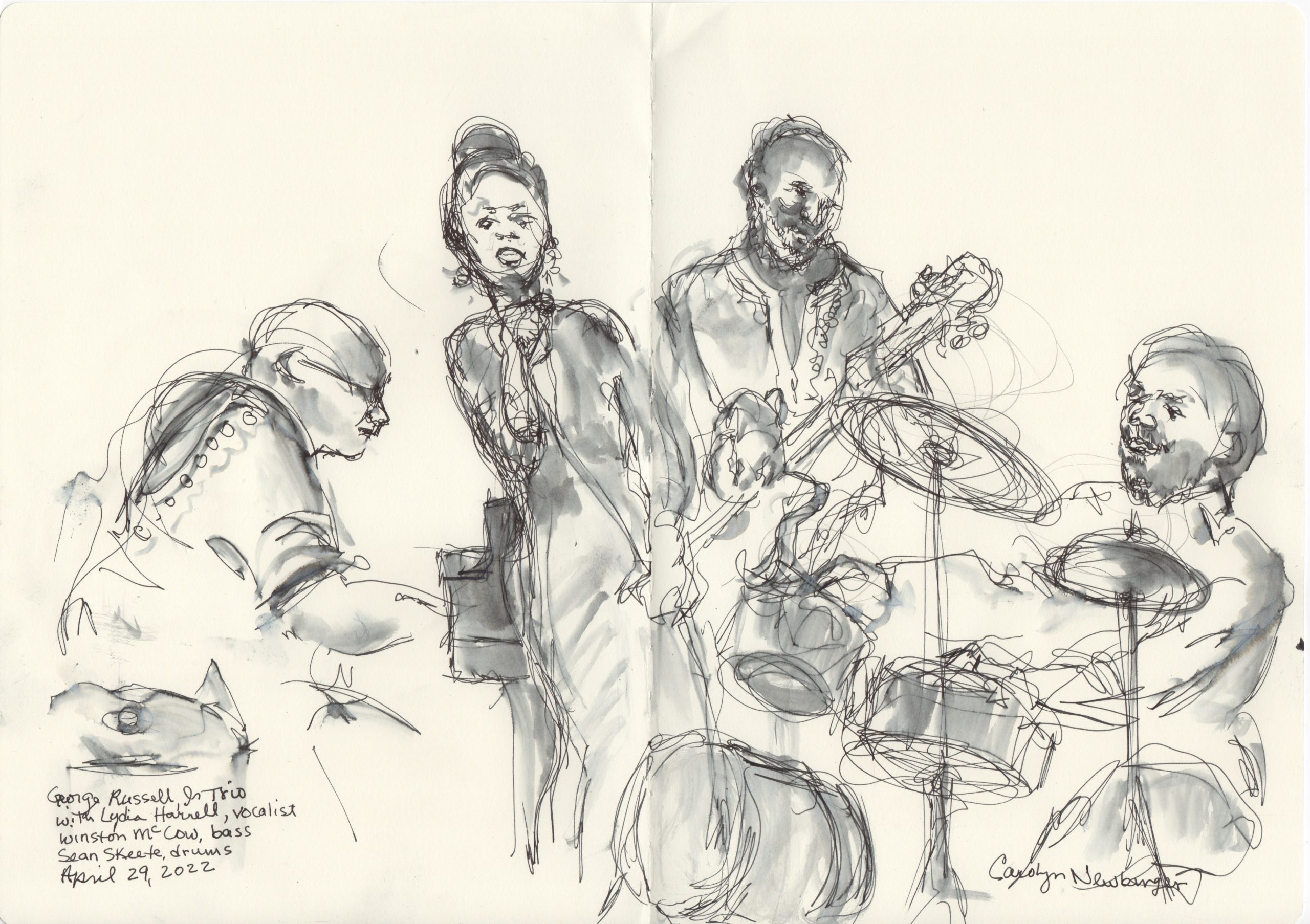
On entering the auditorium of the Berkshire Museum, it was immediately evident that some serious planning went into the event. A full-sized Steinway concert grand piano extended diagonally across the small stage, an electric bass was propped on a stand in the rear, and a full trap set was set up on the right. A forest of microphones, including two recording mikes on a stand before the stage, and large speakers promised a vivid sound experience that would be preserved for posterity.
Each member of the audience was given a shiny 24-page color program with a jazzy cover (with echoes of Dutch artist and jazz fan Piet Mondrian) painted by Pittsfield High School freshman Martin Montero. Renowned Pittsfield artist Marge Bride, also a jazz fan who happens to be Ed Bride’s wife, organized the program and wrote its notes.
Ed Bride welcomed the crowd with tributes to the many individuals and companies whose contributions made the Festival possible, and introduced George Russell, Jr., noting that he grew up here and is now a professor at the Berklee College of Music in Boston. Russell gave an explicit instruction to the audience. He was hoping for a warm vibe, and that the audience would let the band know how their music was coming across. On the theme of “What we do depends on you,” he elaborated eloquently on jazz as a community affair, where the distance between the stage and the listener should disappear in a shared appreciation of the flow of ideas and sounds.
The concert began and ended with versions of the familiar 12-bar blues pattern, redolent with spiritual and Gospel feeling, and astounding contrasts in volume and texture. Russell took the Steinway from powerful bass rumblings, to magnificently swelling, sustained, rattling fortissimo chords reminiscent of Erroll Garner’s classic “Concert by the Sea” recording, as well as the delicate pianissimos of Chick Corea in his duo performance of “Pastime Paradise” with the bassist, Christian McBride. Russell is an enormously coloristic pianist, with quite amazing capacity to translate deep feeling into the sonic landscape. As he improvises, he’ll find a simple single-note pattern and transform it into a repeated pattern (a riff), stick with it for a while and suddenly, within a microsecond, expand it into a vast and swinging two-fisted rhythmic variation.
Such emotional availability and technique is distinctive and rare. One is reminded of George Shearing, whose single-note patterns ascended into “locked hands” expressions, making productive use of chordal melodies with the left and right thumbs adjacent to one another, and of Bobby Timmons, who invented the so-called “soul jazz” style and assembled both his hands, operating independently, into brilliant, blues-inflected propulsions in collaboration with such “hard bop” masters of the 1950’s as Art Blakey and Cannonball Adderly.
Jazz musicians occasionally compliment one another by referring to their “big ears,” meaning that they’re not only listening to one another’s contributions to the ensemble but have in mind the whole jazz tradition associated with the particular composition. George Russell, Jr., one can assert from this performance, is blessed not only with big ears, but a huge heart.
Warm feeling and bursts of passion radiated through his piano playing. His respect for his colleagues manifested in his obvious admiration for their contributions to the concert.
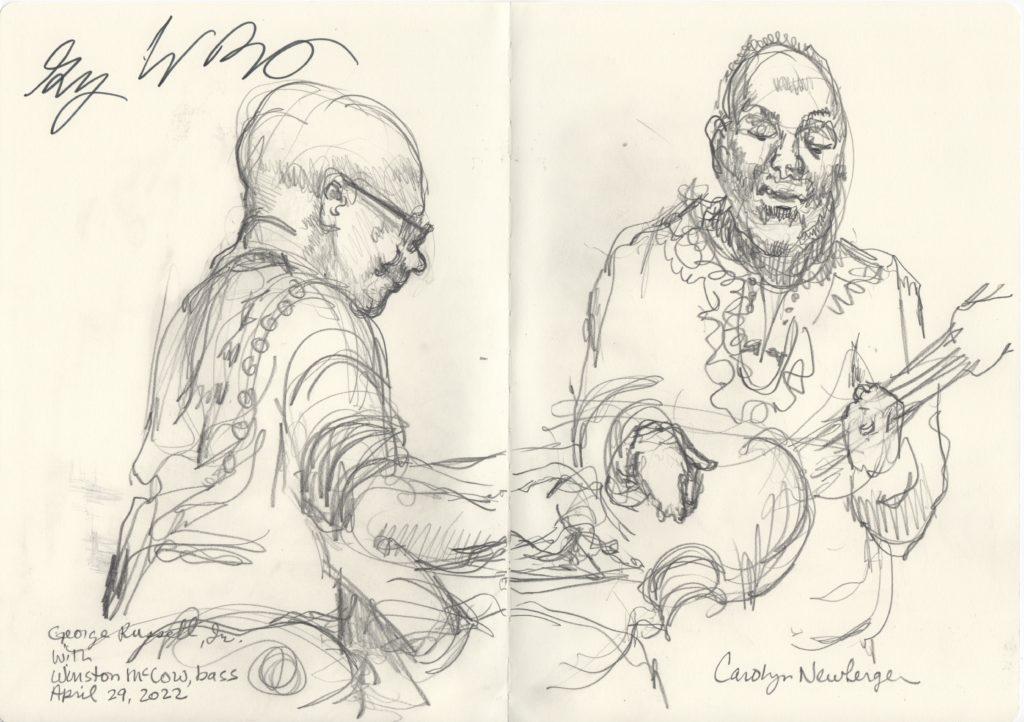
George Russell, Jr. and bass player Winston McCow displayed a particular musical affinity in their swinging rhythmic and harmonic explorations:
The first blues, an original entitled “Nuten But A Big Ole Phat Blues Groove” (Russell humorously spelled it out for the audience) featured brilliant contrasting phrases over Afro-Cuban rhythms, punctuated by straight ahead swinging over a 4/4 walking bass, and astonishing pauses and space for virtuosic solos by bass and drums. Gorgeous rhythmic anticipations and suspensions suggested that Russell’s big ears had embraced the Cuban pianist Chucho Valdés in his listening. Now and again, one had to think to identify the downbeat, so closely did the three musicians adhere to the vibe. The ineffably consistent and subtle guidance of drummer, Sean Skeete sustained the rhythmic flow.
Russell introduced the 1960’s peace anthem “Kumbaya” with a quiet meditation that was suddenly challenged by sudden harsh and dissonant riffs. In his improvisation, he quoted the old Barnum and Bailey march “Entry of the Gladiators,” which introduced the introductory parade of the elephants, acrobats, and clowns. Intentionally or not, the contrast with the familiar campfire song brought to mind the tragic resonances of the war on Ukraine and its inescapable reminders even during this lovely concert.
Distinctive touches of the trio’s treatment of Duke Ellington’s and Billy Strayhorn’s “Satin Doll” included a brief, graceful, solo stride piano introduction, harkening back to the beginning of Ellington’s career as a ragtime-inspired pianist. Thoughtful, meandering, and veering away from the familiar, big band treatment of the song, it explored the internal harmonies with polytonal overlays. Then without pause, Russell launched into “Take The A Train,” where the more familiar Ellington swing was embellished by quotations from “It Don’t Mean a Thing if it Ain’t Got That Swing.” Swinging became the name of this particular game.
Russell presented Dizzy Gillespie’s “Night in Tunisia” in a strikingly vivid arrangement, focusing on the harmonies of the familiar interlude, but without stating them explicitly, alternating long, rolling, sustained chords with exquisite pianissimos.
Russell mused in introducing Richard Rodgers “My Favorite Things” from The Sound of Music whether Julie Andrews would enjoy this particular treatment. Deep and dark in mood, it pondered the value of superficial symbols of happiness.
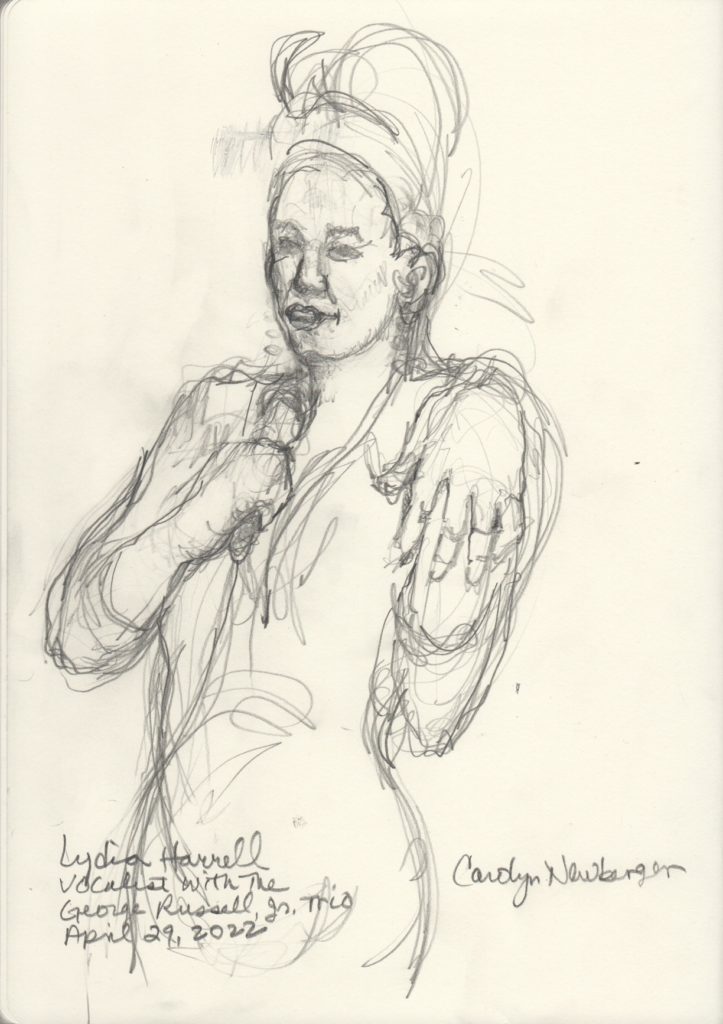
Vocalist Lydia Harrell took the stage elegantly, and spoke thoughtfully of her inspiration, Billie Holiday, whom she was booked to portray at Central Square Theater in Cambridge (Harrell is also an actress). Sadly, the production was cancelled because of COVID, and Harrell never got to play the part. As with her musical colleagues, she is a professor at Berklee. She wears her academic and artistic credentials lightly, noting how much she admires her students’ various creative approaches to “Lullaby of Birdland,” which she sang in a low D minor, demonstrating the depth of her enormously rich tessitura. Perfectly in tune, she improvised with a virtuosity that mirrored Ella Fitzgerald’s, with scat vocalizations that summoned saxophones and trumpets in conversation with one another.
Harrell’s treatment of “Black Butterfly” rang with powerful feeling, while her up-tempo treatment of “Cheek to Cheek” was a dazzling display of supple versification and inventive phrasing.
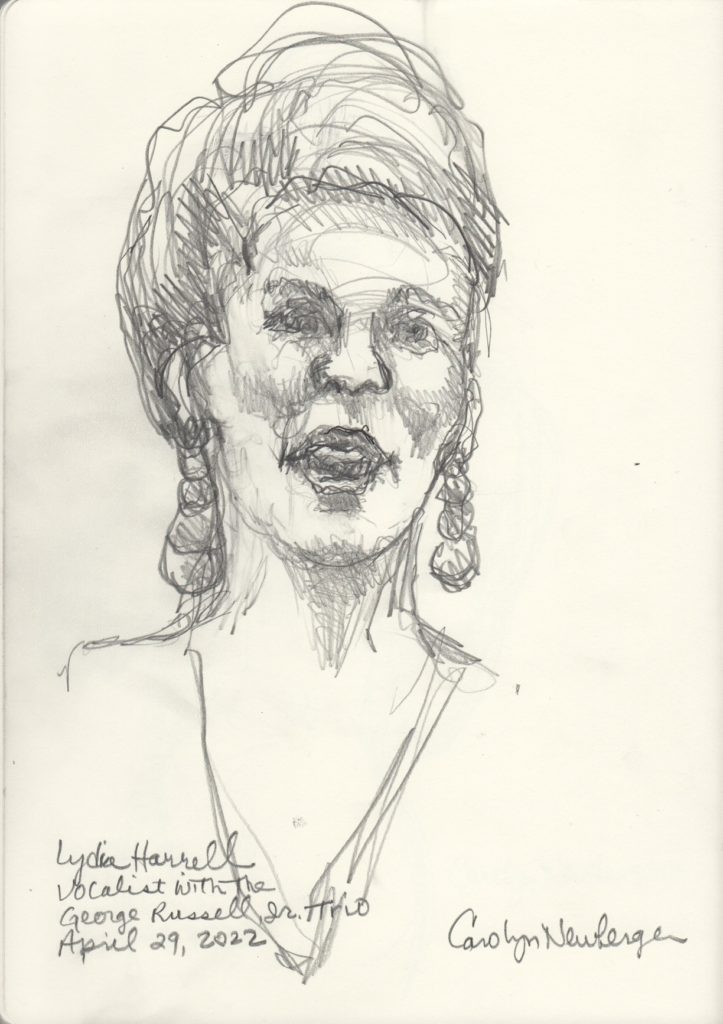
The formal concert concluded with the ensemble’s treatment of “Route 66,” a total diversion from the familiar rocking anthem, with thoughtful and provocative meditations on traveling and playing with the names of cities along the way and beyond in Harrell’s gorgeous scatting and evocations of dreams of finding new and unexpected delights. She brings a special depth and confidence to her art, and her stage presence is powerful and winsome.
The audience insisted on an encore, so Russell and his colleagues graciously took a minute to devise a straightforward head arrangement of the standard, “All of Me.” The music emerged spontaneously and thoughtfully, bringing a relaxed charm and ending with daring polyphony, in perfect intonation. It was a perfect ending to a glorious evening of music.