The Consul, the Tramp, and America’s Sweetheart
By John Morogiello
Directed by Eric Peterson
“United Artists does not want to start a world war!”
Given the opportunity during World War II, Hollywood tended to ignore the realities of international conflict until we were finally in the war after December 1941. In truth our attention had been engaged years earlier through newspaper reports, movie newsreels and the writing of many American creative geniuses including the poetry of Edna St. Vincent Millay. Her radio play “The Murder of Lidice,” about the extermination of a Czech village, made Americans sit up and take notice of the European arena a few years into the conflict, but it was Charlie Chaplin who truly began the movement in earnest with his comedy “The Great Dictator,” released in 1940.
Hitler was considered a taboo topic in the arts, especially in Hollywood. That he wore a moustache exactly like Chaplin’s Little Tramp character’s facial hair was most likely not a mere coincidence. Like so many others around the world, the Germans found Chaplin’s character curiously endearing. Even Hitler’s unproven suspicions that Chaplin was a Jew didn’t discourage the Fuhrer from this bit of “loveable” imitation. It is this ambiguous identity of Chaplin’s that spurs the action in the world premiere production of John Morogiello’s play “The Consul, the Tramp, and America’s Sweetheart” now playing at Oldcastle Theatre in Bennington, Vermont.
The German Consul George Gyssling wielded a lot of power in Hollywood that depended heavily on access to the German market for its international income. In this play, Gyssling has learned about Chaplin’s desire to make a movie poking fun at the Third Reich and its leader and he has come to United Artists to force President Mary Pickford to call a halt to its production. He presumes, correctly, that artistic balances are best effected through fiscal controls. What he doesn’t count on is Chaplin’s considered lack of respect for income (he was the highest paid actor in Hollywood at the time), lack of control (he had been an independent for years) and lack of interest in anything that Hitler may want (not apolitical, he was not pledged to any one set of ideals, either) as his personal criteria for decision-making. Pickford, on the other hand, has bottom-line concerns, investors to consider, and her other partners’ wishes to take into account. As a personal play about issues of this sort, the show emerges as a highly politically charged accounting of historical pressures that have a bearing on the current political scene and our much marred presidential race.
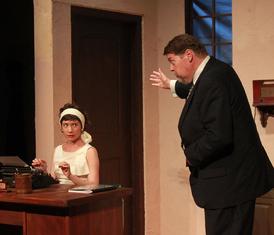
Gyssling is played in this production by Paul Romero. He is firm and presents a demeanor that demands obedience. He represents a government that he believes to be in the right and his attitude toward the American woman who keeps him at bay, the Canadian star who offers him no sense of honor, and the British “Jew” who is beneath his dignity is universal disdain. Understanding the inordinate amount of power he wields through the translation of marks to dollars, he is a firmly ridiculous man who, in Romero’s performance, deserves respect and appreciation even when we hear him being so obstinately wrong. Romero gives the man a factual dignity even when he is humiliated. It is a performance that speaks of truths through fiction and of imagination through diminution of the creative spirit. He is, in fact, almost – but not quite – a sympathetic character, which is as it should be.
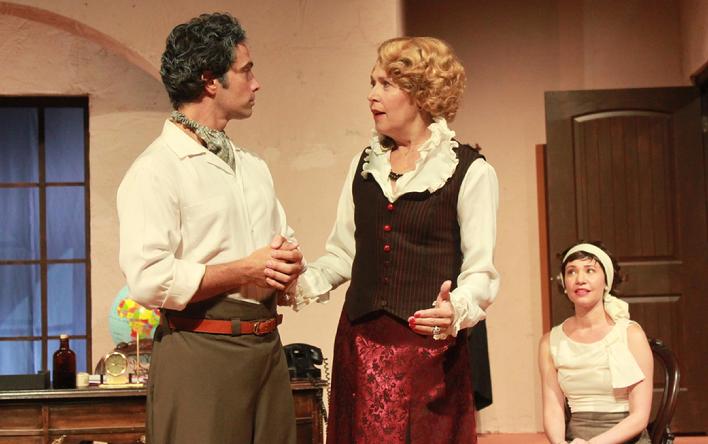
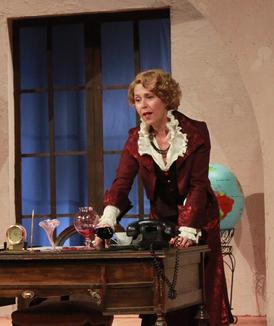
Mary Pickford, in this play, is not the sweet star of romantic comedies and dramas; she is the person with the control of the local purse strings, the commander-in-chief of filmic resources. Elizabeth Aspenlieder gives her credulity as she makes her moves, gives her verdicts, and finds herself in conflict with just about everyone. Aspenlieder, oddly, resembles the Pickford we can see framed on the wall behind her. It leaves open the question “are all Canadians alike?” for she herself is a Canadian actress. The answer, happily, is no. More than Pickford ever could be, Aspenlieder is a personality that dominates every role she plays. She is the strong, adult voice here of the silent movie queen. She is the reasoning brain that hesitates in accepting the strong reality of her fellow star’s fate. Aspenlieder is graceful in her movements and awkward in her spoken words, the perfect early movie star who has to face the actual, living drama being played out in her presence and abusing her star power in an unfortunate, realistic role. She handles every change in her character’s reactions with a visible thought-process that is alarmingly real in a very staged way. To be simple and clear, Aspenlieder is a star who is also an accomplished actress giving a star-maker of a performance.
Lori Vega plays her new secretary, Miss Hollombe, a young woman with a clear vision of her mission in life. Vega is precious, an on-site narrative presence who wants what every girls wants when she goes to Hollywood: to climb the rungs of eventual stardom and its associated power. Her interests are not to be in the Klieg lights, but to own them in some way. Her part in the proceedings provides much of the actual comedy, but her personal revelations are what give the play its particular soul. Vega is a wonderful find and, in this role, she is superb.
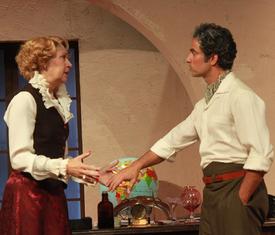
But (a word I rarely use to start a sentence), it is David Joseph’s portrayal of Charlie Chaplin that truly makes this play a wonderful experience. He has the Chaplin voice, the Chaplin movement, the Chaplin looks and the Chaplin timing. When he sits in a chair, his body insinuating itself into the plush becomes a piece of wet pasta. When he dances, his toes seem to leave the floor. When he performs a silent routine from his forthcoming film, he is lithe, blithe and beautifully choreographed. His sense of conviction is perfect. There is a moment — when he hears a reaction to what is going on that is totally unexpected and he turns, leaving his public persona aside for a moment and reacting as a human being accustomed to complete support — that is so chilling and honest that we forget we’re watching a play and, just for an instant, believe we are peering through a time warp into the actual confrontation. That is what great acting can do, and that is what Joseph does.
Eric Peterson has directed this new play with an intensity and mind-gripping reality that, even if the play wasn’t as good as it is, would have seemed to be grand for the time it takes to play it (it is a one-act play lasting about 86 minutes. Peterson has managed to bring back to life three, if not four, people who changed things for the American people in different ways. His actors, if they are true to their director’s vision, have delivered to him just what he wanted to make this world premiere: into a career starter for this excellent new play, a comedy that tugs at the mind’s heart more than at the heart’s mind.
The set, Mary Pickford’s United Artists office, is by Richard Howe, who has brought a California aspect into the Vermont theater perfectly. The costumes by Roy Hamlin and Ursula McCarty speak to the period of the play ideally. Lighting and sound by Cory Wheat are just right for the play.
New plays are a wonder to behold and this one is almost as good as the movie at its core. See the film when you can, but see this play soon; it’s a very limited run.
––––––––––
The Consul, the Tramp, and America’s Sweetheart runs through Sunday, Sept. 18 at Oldcastle Theatre, 331 Main Street, Bennington, VT. For tickets and information, see the Berkshire Edge calendar, call the box office at (802) 447-0564, or go online to www.oldcastletheatre.org.