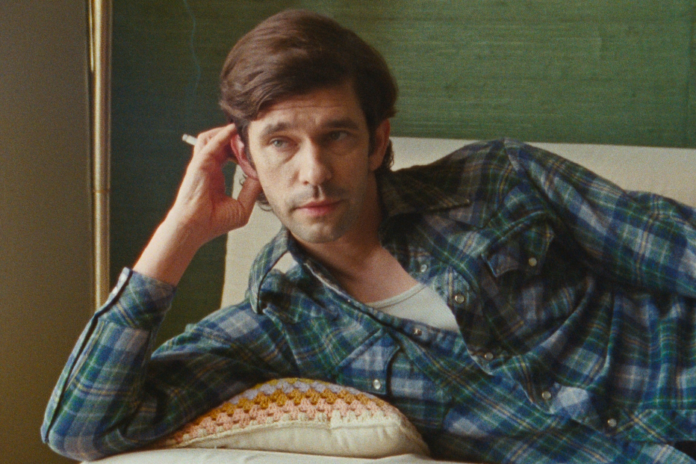
Ira Sachs’ film is built on Linda Rosenkrantz’s 1974 recording and subsequent book “Peter Hujar’s Day.” In the transcript, Rosenkrantz (Rebecca Hall) tapes Peter Hujar (Ben Wishaw), who is her friend and a free-lance photographer, answering her unobtrusive, casual questions about every pedestrian detail and minutia that come to mind about a day in his life. He sometimes digresses into personal tangents or provides a bit of a backstory for his responses. Sachs (“Passages” and “Love Is Strange”) never has his two characters leave the building. He shoots them in different rooms of the apartment and Hujar on his roof taking a smoke break, as well as the two of them lying in bed together talking, providing aesthetic variations to what can otherwise feel like a series of claustrophobic close-ups and two-shots.
Wishaw gives an extremely natural, unforced performance—devoid of dramatic posturing and without a hint of self-consciousness. His Hujar is light and both humorous and serious. Just watch him dancing solo to a record in one scene or interrupting one memory with another while answering questions. Hujar talks about sandwiches he eats, the heat problem with his apartment, calls he receives that interrupt his work, and his chain smoking. But he also talks about his work, which he is very diligent about, and drops a lot of names, some famous (e.g., Susan Sontag, William Burroughs, Fran Leibowitz) and others not—all part of or on the fringes of New York’s bohemian and gay scene of the time.
Hujar talks about a photo session with Alan Ginsberg for The New York Times he had the day before. Hujar is a little frightened about traveling down from his apartment on relatively stable Second Avenue in the East Village to where Ginsberg lived on 10th Street between avenues C and D. In those years, many of the tenements on those avenues were burnt out, and crime was rife. I recall it feeling truly desolate—an ominous wasteland, though one compensation was that housing was very affordable for the city was not yet gentrifying. Ginsberg initially gives him a hard time because he does not want an old-fashioned portrait taken. Calming Ginsberg’s objections, Hujar spends two hours with him and gets the photos he needs, which he ultimately does not like. He is not taken by Ginsberg sitting in a lotus position chanting “Om” and has no interest in Ginsberg’s condemnation of corporate America, but Hujar is a total professional who also must make money to survive.
Sachs uses affecting close-ups of Wishaw with his face enveloped both in shadow and light at the film’s conclusion—possibly prefiguring Hujar’s death from AIDS a decade later. The film evokes a New York City of an earlier era—affordable, filled with junkies and prostitutes, and extremely vital artistically. It is a past that cannot quite be resurrected but still always remains with us. Sachs has made a small, undramatic film that reverberates deeply