
An Iliad
Ancram Opera House, Ancram, New York
Written by Lisa Peterson and Denis O’Hare
Directed by Jeffrey Mousseau
“I told you so!”
On the third night of the Hunter’s Moon, the Poet entered the deserted theater stage at the Ancram Opera House to tell the story of war Homer wrote about in “The Iliad.” This time, she sang the tale of anger, frustration, and regret in a way that is so compelling we couldn’t turn away or ignore the implications about the time we live in, where it seems we never learned the lessons of the past. I have seen this play four times before and it has always impressed me as an accomplishment for the actor, male or female.
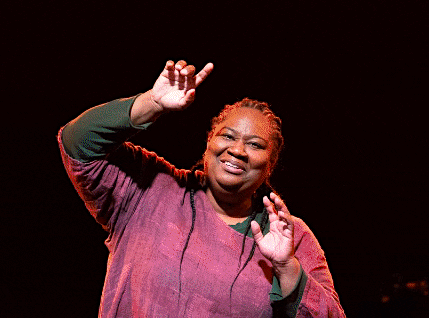
This time, the play felt like reality as MaConnia Chesser undertook the challenges of the storyteller whose vision of complexity was to do just what the story demands: Tell it clearly and contain your emotions, but tell the story of what war is about.
Telling the story is what she does; emotion colors the telling, however, and when she finally reaches the point where response is more important than reporting, the relating of facts becomes the horror story of our life today. The poet’s litany of war and how it has developed through time, ends with Afghanistan. Always the high point of the play for me, this time it was devastating.
The Hunter’s Moon, though not an image within the confines of the theater, should be an image for this play in the future. It is a symbol of the urge to gather supplies to sustain us for the long, bleak winter ahead, just as this script by Lisa Peterson and Denis O’Hare is a symbol of the self-destructive nature of mankind. The unanticipated juxtaposition of the two things brought me up short. I had never conceived of my place, our place, in the world’s tragic history. The language here, both simple yet complex and poetic, provided me with the pain of reality and the beauty of tradition. Chesser makes the language sing as she falls into Greek and Aramaic when she cannot speak in English. Her tongue and her mind wander but always en route to a modern reality. Her Poet has told this story everywhere, all around the globe, hoping to alleviate both our pain at our past and a reluctance to pursue this course in the future.
Chesser is quite an actor. In establishing her role as The Poet, she removes all gender from her being and becomes an entity charged with the Gods-given duty to speak to people for centuries about the essence of war. She becomes the human edition of the book, almost devoid of personality and bias. Her Poet has a responsibility to alert humanity and this is done through the tale itself. She is not involved, though the remarkable use of inflection in the voice shows that to be a lie. We wonder how much longer she can wander the earth telling this story to groups of people who cannot seem to grasp its importance. Chesser compels us to understand the difficulty of preaching to a choir that cannot harmonize with her forceful and straightforward tune. Nothing about the Poet’s frustration is said, but it is felt. Deeply felt. Playing these opposing objects, telling the stories of varied viewpoints, of Achilles and Hector, of Helen and Andromache, of Agamemnon and Zeus, must be exhausting; it is for us in the dark, watching and listening, stretching into the unfamiliar and unknown.
Director Jeffrey Mousseau has worked with the actress to create a reality that cannot be avoided. His stage set, designed by Sarah Edkins shows us the result of our own time and its destruction of a theater in the time of pandemic: stools, chairs, and props are strewn about the abandoned stage; a piano remains unplayed in a corner.
The unsettling lighting of the show, designed by James McNamara, echoes the lighting of that orange moon against the hills outside. MaConnia Chesser’s costume, a traveling shift, has been created by costume designer Denise R. Massman and its color continues the theme of the eternal aspects of the story of an Iliad. The amazing immortal sound design by Alexander Sovronsky may be his finest work to date. Mousseau and Chesser work within these excellent technical aspects and, of course, through the script, to create something very special. “An Iliad” is more than a story; it is an adventure in theatrical terms. This fifth exposure for me to this play must be my last one, for no one can do it better. Ever.
“An Iliad” plays through October 31 at the Ancram Opera House, 1330 County Rt. 7, Ancram, New York.