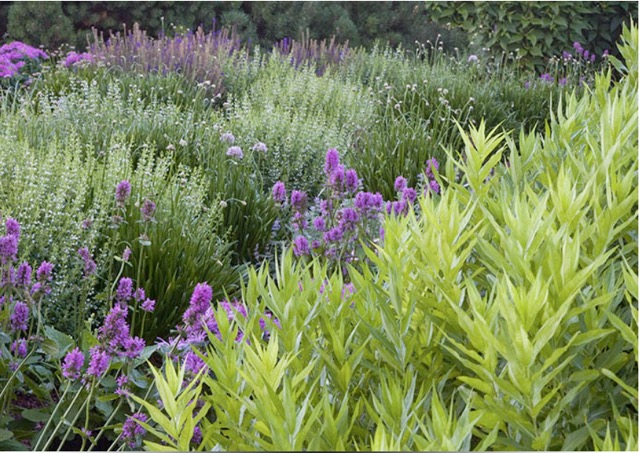
In this age of yelling and screaming to share one’s viewpoint, it intrigues me that a soft-spoken Midwesterner, filled with warmth, humor, and self-deprecation, speaking at the Berkshire Botanical Garden’s “Drawing on the Land” symposium a few weeks back, put forth a most compelling approach to thinking about our gardens. Inside the unairconditioned barn, where the weather was warm but the dialogue was not heated, in a whispered tone Roy DIblik from Northwind Nursery from the other Burlington (Wisconsin, go Packers territory) shared his thoughts on gardening in an ecological age.
The audience was forced to lean in as this horticultural whisperer shared his take on what we can learn from nature to apply in our gardens, which are often anything but natural. Perhaps the most heated Mr. Diblik became was on the subject of wood; he is a fierce opponent of the use of wood mulch in the garden. He quietly asked all of us who rely on shredded bark and wood mulch: when was the last time you were in a woods and saw that trees had toppled over, shredded themselves, and were providing a protective layer over the soil? Leaves and organic material, he argued, are the basis of good soil and represent the ideal pairing with trees and shrubs. And not just decaying plant material, but plants themselves. He advocates for the use of native sedges to protect the ground under shrubs and trees. They have evolved to work in conjunction with the tree’s roots to create a cool, moisture-retentive overlay of the underground systems of woody plants. His argument was convincing, and he applied the same philosophy for beds, borders and even commercial plantings.
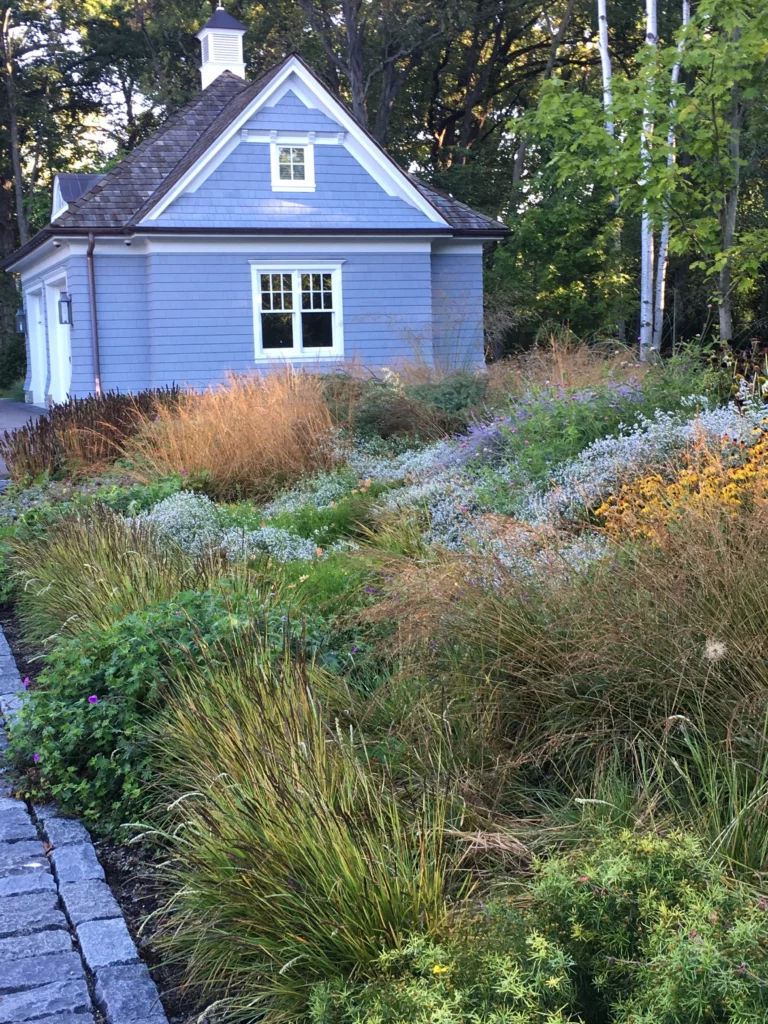
Diblik’s Northwind Nursery is known for its native and prairie plants, and their offerings pretty much define an attractive landscape that, as his book title suggests, is a “Know Maintenance Garden.” As Diblik quietly opined against excessive expanses of lawn, he quietly made the argument for applying to beds and borders the same approach that he advocated for woodland plantings: use the plant matter to provide a protective layer over the soil to provide nutrition, improve soil tilth, and to retain moisture. He identifies two tools to be the best for keeping a garden or landscape looking good: a long-handled hoe and a mulching mower, the latter to be used in the early spring or late winter to convert last year’s vegetative growth into organic matter to feed and protect the soil. Other than the wood-handled hoe that he uses throughout the rest of the season to quickly root out weeds, the woodiest thing in his garden are the shredded stems of thick branched perennials.
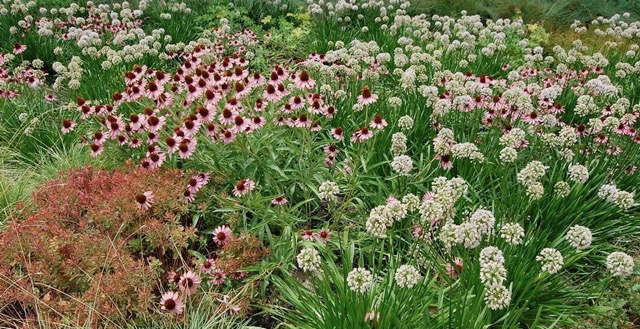
And if you’re concerned that these tasks might be time-consuming, he calculates they take significantly less time than mowing a lawn—and need to be done less frequently. Plants with a variety of root structures can work together to share resources and square footage. When he showed a photo about how to create plantings plans that bring together flowering sages, meadow perennials, and native grasses and forbs, I hoped that BBG will invite him out to teach a planting course. Although the classroom in his photo looked set up to play a game of Twister, it was clear there was more at work with the color-coordinated tiles that together represented planting plans for a sunny border.
And all of sudden, with a reference to our debt to Rachel Carson and to Aldo Leopold, another Midwesterner who defined how to connect nature to our gardens, Diblik was gone with a whisper. But the ideas he softly shared remained with the other people in the audience. Hopefully, they will influence how we all garden.
____________________________________
A gardener grows through observation, experimentation, and learning from the failures, triumphs, and hard work of oneself and others. In this sense, all gardeners are self-taught, while at the same time intrinsically connected to a tradition and a community that finds satisfaction through working the soil and sharing their experiences with one another. This column explores those relationships and how we learn about the world around us from plants and our fellow gardeners.