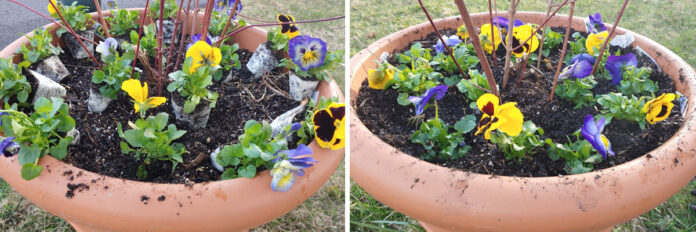
It’s May and many look to their gardens and suddenly feel the need to rush and “get things done.” True, now is when colorful annuals that bloom prolifically are still small and inexpensive. Best to buy those in May. Of course, these plants will be around still in six weeks, but they will have grown and become more expensive. Hmmm, we can still get frost at least until May 20 and sometimes later depending on location. What to do?! Try not to jump ahead of yourself only to be frosted beyond repair.
If you’re itching to plant colorful annuals, put a small container together that’s frost hardy. Or make your container and place it outside only in the daytime, bringing it into an enclosed porch or garage for nighttime protection. I put pansies outside in big pots a few weeks ago and they look perky but cold. Frost has nipped the flower edges, but they still look pretty from a distance. A few annual plants good for cool weather are pansies, violas, snapdragons, and torenia. Another trick is to plant spring perennials in a container now but transplant them to the garden in a few weeks when summer annuals can take that spot in your container. (Remember this when you’re shopping for Mom….)
Quick arranging tip: water the soil in your pot thoroughly; then water the six-packs of small annuals thoroughly; then water the pot again. Remove your small plants (by the leaves, not the stems) and space them around the pot as you please. Then slice the bound-up roots once with a knife from top to bottom or gently loosen the root ball. Make your planting hole in the arranged spaces and press the plant into position to the same depth as the root ball. Press soil firmly around. Continue for all your plants. Water your freshly planted container.
By arranging plants first, you are less likely to dig them up and replant too many times and you’ll avoid damaging your young plants.
Despite our urge to rush, we’re still in the beginning of the growing season and you still have time to plant. Mostly now is your time to make room for the summer growth to come. Moist soil from the days of rain will make those weeds grow but also make it easier to pull them out. I’m making that a priority for my upcoming weekend since every time I’ve tried to do it the last two weekends the weather has not cooperated.
Things to remove ASAP:
Garlic Mustard. This invasive and soil-changing biennial should be pulled out roots and all, especially now as flower buds are starting to appear. Don’t let this one flower. It will also continue to bloom and set seed after it’s pulled. Dig it out and wrap in a plastic trash bag until it rots or dries to a crisp. Then, put it in the trash. Do not compost. Gout weed roots also change the surrounding soil and prevent native plants from growing.

Gout weed or bishop’s weed. This invasive perennial will overrun shady or sunny spots becoming a mat of green. I mow this back regularly and remove the cuttings to starve it of any chance to photosynthesize. If you try to pull it out, the smallest bit of root left behind will grow another plant. My patches are smaller this year but still came back. Seed from other patches on other properties will surely blow in, too. I focus on what I can.
Know the aggressive from the welcome. Wild carrot or Queen Ann’s lace looks similar to gout weed when it carpets an area, but a few will actually help aerate heavy soils with their deep roots. Other plants seem to grow alongside it without much difficulty, and it doesn’t chemically affect the soil.
Also, the pervasive pests of creeping Charlie and crabgrass will need to be pulled out from the asparagus and perennial borders. I try to get at these every few weeks but let them float through my lawn untreated because the grass is growing fine and still soft under bare feet.
Remember to look around for garden ideas. As I’ve driven around Berkshire County this past week, I just wanted to give a shout-out to the native Amelanchier! The what? It’s the native shrub and small tree with bunches of white flowers now blooming that you can see in the wood edges and around ponds. There’s a coppery tint to the leaf stems that indicates it is not a wayward apple or ornamental pear. Fruits form in June and reliably attract birds like robins, orioles and cedar waxwings.
With a number of common names– Serviceberry, Juneberry or Shadbush—Amelanchier is the genus and has numerous named species. Think of the genus as the last name and species as all the distant cousins, aunts and uncles related. Eastern Amelanchier is the species Amelanchier canadensis, that can be found in a single-trunk tree form or multi-stemmed shrub, up to 20 feet in height.
A.laevis is known as smooth or Allegheny serviceberry with edible berries that are sweeter than canadensis and stays narrower while growing taller to 25 feet. The hybrid Amelanchier x grandiflora ‘Autumn Brilliance’ combines the southern A.arborea with A.laevis. It stays smaller and spreads wider with a high tolerance for shade. ‘Autumn Brilliance’ has lovely red-orange fall color as well. This is all to say, there’s an Amelanchier suitable for anywhere and you should have one, too.

This weekend, it’s time to start dahlias indoors for earlier bloom. Dahlias can be planted now in plastic pots and then the whole thing dropped into a decorative container or set into the garden for easier removal in the fall. Cut large clumps from last year into 3-4 tuber clumps. Just take a knife and slice through the stem down the middle. The most successful dahlias come from tubers that still have a piece of stem.
Soak tubers for an hour or so to rehydrate before putting in your pots with well-draining potting soil. Plant stem side up; don’t let the new growth fool you. The stems go to the light. I saved one from last year where the stem had to make a u-turn!
Use pots deep enough for the tubers to have growing room. The junction point between the tuber and the old stem piece should be about 3 inches below the surface.
Keep soil slightly moist and put pots in a bright, warm location. When stem starts to emerge, about 2 weeks, you can start to harden off the pots in late May’s warming temperatures. They like bright light to get growing! Me, too. Hoping for a sunny weekend!

More timely tips:
- Potatoes can be planted out now in the garden.
- Prune forsythia now after bloom to encourage fresh growth and reshape. Pruning now will spur new growth; pruning in October will cut flower buds and slow growth.
- Prune back dead stems of lavender, rose, and butterfly bush AFTER you see signs of growth. Prune back to the emerging bud.
- Pet or gently brush your tomato and other seedlings to strengthen stems.
_______________________________________________________________________________
I call myself the Lazy Berkshire Gardener because I don’t want to work too hard in my gardens. I want to enjoy them. I find it easier to observe my landscape and let the compost happen, the water pool up or daisies to self-sow. I look for ways to do the minimum task for the biggest impact. For example, mulching is better than spraying and much better than weeding all season. I look for beautiful low-maintenance plants that thrive in or at least tolerate my garden conditions. Plus, I’m willing to live with the consequences if I miss something.