February offers gardeners more daylight to work with than January, and that means better flowers on your houseplants. Rather than a bouquet for Valentine’s Day, why not a flowering plant that could bloom for a much longer period of time? After the holidays, I purchased a generously discounted red cyclamen that continues to bloom. It likes my cooler room with western light. I check the surface of the soil and make sure it’s moist every few days. But I chose it for the pretty, variegated foliage. When it stops blooming, I will still have a very handsome foliage plant. It will bloom again.

For years, the specimens in my house were mostly green foliage plants: Spathiphyllum (Prayer plant), African violets, Spider plants and Schefflera. Off and on, I might keep medicinal aloe vera to help soothe kitchen burns. The African violets, the outlier, dried up – whoops – but the green guys heroically weathered my sporadic watering and occasional neglect.
Once my human children could feed and water themselves, I started thinking about expanding my plant nursery. It helped that rearranging rooms led to spots becoming available next to a sunny eastern window and good-sized southern window. Flowering houseplants need light to do well. I am not interested in working hard to keep plants looking good and I prefer to grow things that can handle the conditions I’m able to provide.
One year, I discovered the sweet-smelling Oncidium orchid called “Sharry Baby” and its relative the “Dancing Lady” Orchid. The Dancing Lady thrived next to my small bathroom sink, where humidity was high and she could be easily watered. I proudly brought that plant back into flower after a year. But the orchid’s sink space lost out to the humans’ needs, and that plant sadly dried up beyond reviving. Lesson learned.
Yes, I learned something about my ability to keep certain flowering plants alive. Mostly I learned about the importance of water and humidity, and which plants can suffer yet still bounce back to life. I know houseplants exist that will look good, grow and perhaps flourish in my house with cool temperatures. I just need to stick with those or teach myself to monitor the finicky plants more closely. What I choose to grow depends on the beauty that the houseplant offers, balanced against how much work it takes for me to grow it.
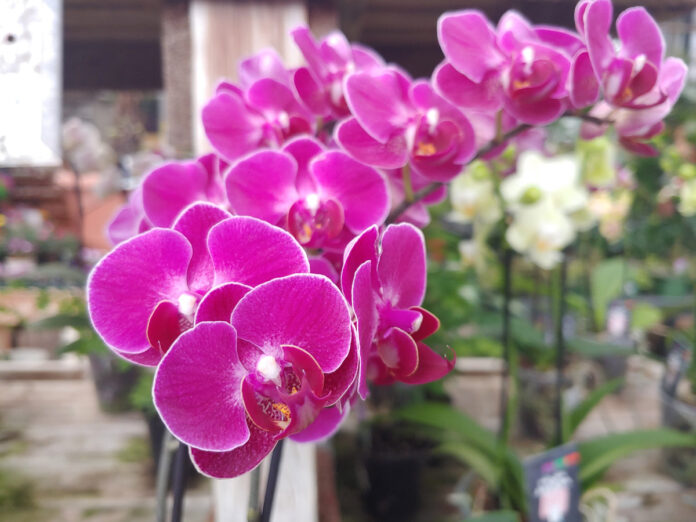
Orchids can be stunning and I love the victory of having multiple stems emerge from the crown of healthy phalaenopsis (moth orchid) leaves. I found the trick to these is keeping the medium around the orchid roots moist, but not soaking. Pour water over the roots every week, and once a month use water fortified with a bloom booster fertilizer. Then those plants will continue to bloom, one of mine did so continuously for 18 months. It now has 4 new budded stems growing in different directions.
Interesting discovery about my orchid stems – they want to grow downward. A friend and I have a theory that they grow towards heat (we have baseboard heat) as well as sunlight. I’ve read that the downward growth can be from too much or too little humidity. Maybe. What’s your experience?

Another favorite of mine is the primrose, Primula acaulis, found in garden stores and floral markets about now. This plant blooms in many different solid and mixed tones. Together on a table or in a small planter, different primrose varieties thrill me with their candy colors. Primrose prefer room temperatures in the mid 60s and soil that’s moist. Check regularly and water when soil surface is dry to the touch. Best part about these? They can move outside in May and join your perennials in a moist part of the garden under deciduous trees. At this point you can mostly ignore them and still enjoy their flowers next year. Another lazy gardener victory!
Now, about my African violet failure. I blame that on the distractions of life and the wrong growing container.

After that lesson, I decided my mom should have an African violet when she moved out of her house with outdoor gardens into a senior living apartment with a small balcony. She always enjoyed checking on her plants and she needed some color in her new home. I potted it for her in a special two-part container. This pair includes a porous terra-cotta inner pot for both soil and plant, surrounded by an outer pot that holds water. The inner pot absorbs water as needed but roots do not sit in a puddle. By lifting the whole apparatus, you can tell by weight if the outer pot needs water. A special watering hole on some outer pots allows you to refill them without accidentally watering the tender water-phobic African violet leaves. My mom loved that plant sitting next to her bed. It greeted her every morning with blooms for six months.
Truly the success or failure of houseplants depends on the attention (and water) you can give. Many types of flowering houseplants are available. Decide what type suits your lazy gardener tendencies and get growing!
_______________________________________________________________________________
I call myself the Lazy Berkshire Gardener because I don’t want to work too hard in my gardens. I want to enjoy them. I find it easier to observe my landscape and let the compost happen, the water pool up or daisies to self-sow. I look for ways to do the minimum task for the biggest impact. For example, mulching is better than spraying and much better than weeding all season. I look for beautiful low-maintenance plants that thrive in or at least tolerate my garden conditions. Plus, I’m willing to live with the consequences if I miss something.