Great Barrington — In the last week there have been several developments concerning Housatonic Water Works, culminating in an angry protest in front of Town Hall by customers on Saturday, September 3.
On Thursday, September 1, company treasurer Jim Mercer issued a press release with its third quarter monitoring results for disinfection byproducts in the company’s drinking water supply. The company reported in its press release that its water quality now meets compliance with the state’s Department of Environmental Protection standards when it comes to haloacetic acids (HAA5).
In January, the company announced that after reviewing an analysis of their drinking water, it violated a drinking water standard when it discovered their water exceeded the standards of haloacetic compounds, known as HAA5. The acid compound could cause cancer in those who ingest it for extended periods.
In the September 1 press release, Mercer wrote that the company’s water quality has been determined to meet the state’s water quality standard for HAA5.
Mercer wrote that it was determined that the Locational Running Annual Average (LRAA) in August is now 55 parts per billion (ppb) for HAA5, which is below MassDEP’s Maximum Contaminant level of 60 ppb. “Historically heavy rainfall in July 2021 appears to have been the cause of the uncharacteristically high HAA5 results experienced in August 2021,” Mercer wrote in the press release. “In response to the HAA5 results in August 2021, HWW lowered the chlorine residual level while maintaining more than enough to exceed all disinfection requirements. HWW continues to evaluate improvements to the treatment system for further reduction of HAAs.”
Mercer added that “in other good news, HWW expects to soon start a pilot study for using GreensandPlus filtration for removing the natural manganese that is causing the occurrence of colored water. The pilot study includes an evaluation of factors affecting the formation of HAAs and how the proposed treatment would impact that.”
Back in late June, the company hired Northeast Water Solutions President Robert Ferrari as a consultant to deal with its ongoing problems with manganese in its system. The company also proposed a pilot study in order to address its long running problems.
However, in order to address its many years of problems with manganese in its water system, the company wants to double its customer rates.
Back on August 1, MassDEP issued a conditional approval for the company’s treatment pilot study. On August 17, however, MassDEP received a letter from the company requesting several modifications to the approval of the study. On Sept. 1, MassDEP Drinking Water and Municipal Services Chief Deirdre Doherty sent the company a letter in response to the company’s various requests.
According to Doherty, one condition of the pilot study for manganese is for it to be conducted during all four seasons. However, Doherty wrote that the company requested that the pilot study only be conducted during the summer under a reduced testing schedule because “The [company] has previously submitted data that indicates that manganese is a summer phenomena and requests that the department consider a reduced testing schedule so that the company can be responsive to its customers and implement a manganese reduction prior to next summer.”
In response, Doherty wrote that MassDEP is rejecting the company request because “year-round filtration is needed for an evaluation at surface water locations” and that a “full-year piloting for new surface water technology is a longstanding requirement” of MassDEP.”
Doherty added, “Given the fact that HWW has not requested an inspection of its proposed pilot treatment system yet, the department is concerned that [the company], despite its statements, is not interested in capturing the most challenging season in 2022. Please notify the department as soon as the pilot system is ready for inspection.”
Later in the evening on Sept. 1, the town’s Board of Health discussed the current situation with HWW. “The ball goes back to Housatonic Water Works to determine whether they’re going to go through with the Greensand filtration testing at this point,” Board of Health member Dr. Ruby Chang said at the meeting. “I’m hoping that they will take action fairly quickly, and start this filtration system hopefully to take away the manganese problem.”
Chang told members of the board that she recently spoke with MassDEP Principal Investigator Marc Nascarella.“The water company mainly deals with water chemical levels, but they’re not really into people’s health in that they don’t have the expertise for that,” Chang said. “Mark’s area of expertise is these contaminants, including how they affect the human population.
So he agreed that once we have the lab work back [on water samples]. He will be available to have a meeting with us to discuss the harmful effects of the contaminants that are found.”
“Who is saying that?” Board Chairman Michael Lanoue asked. “Who is saying they’re harmful? Is he saying they are harmful? Or is it that they could be harmful?”
“That’s what we need to find out,” Chang said in response.
Later on in its meeting, the board approved a letter that it sent to the Select Board and Town Manager Mark Pruhenski with its concerns about HWW operations. “We have received many complaints and are aware of many more that have been sent to [MassDEP],” the board stated in its letter. “We are aware that certain HWW customers are being advised not to drink a product that they continue to be charged for. The Board of Health considers this a public health issue of immediate concern.”
The board stated that “We acknowledge that this water quality issue is a difficult one in which there is no obvious or easy solution.”
The letter requests that both the Select Board, and Town Manager Pruhenski, give the board updates on the possible actions the town is taking against HWW. “Furthermore, we urge the members of the Select Board to seriously consider providing immediate relief to the residents of Great Barrington, particularly those most vulnerable, who are impacted by this growing public health concern,” the board wrote. “We request the attendance of members of the Select Board during one of our upcoming meetings in order to address this public health issue.”
On Saturday, September 3, hundreds of residents, including customers of HWW and friends of customers, gathered in front of Town Hall to protest the company.
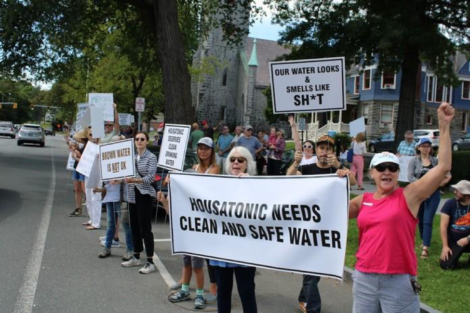
Residents were holding various protest signs, including signs that read “brown water is not ok,” and “our water looks and smells like sh*t.”
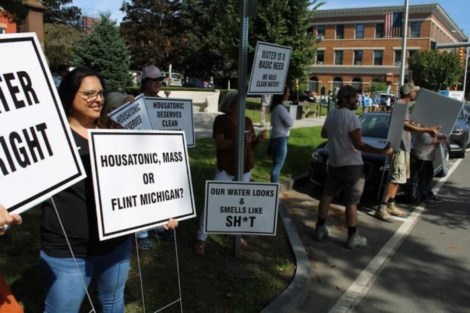
“Something has got to be done,” customer Maria Spratt, who has been a customer of Housatonic Water Works since 2013, said as she held the sign “Housatonic, Mass or Flint Michigan?”
“I was diagnosed with stage one breast cancer in November,” Spratt said. “I don’t know if it’s from the water. I guess we’ll never know.”
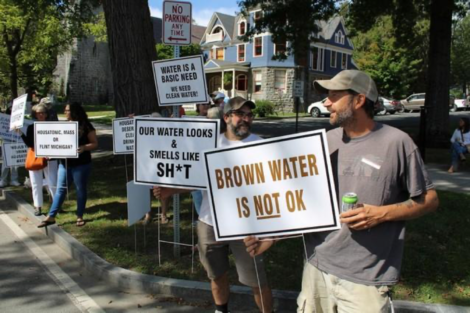
Jack Curletti said that he has been a “customer for five years, and a paying customer for three-and-a-half years.”
Curletti added, “I stopped paying the company because the water is toxic, brown, and gross. I have children, and they have to bathe in it and drink it. I have to buy water from other places.”
As for Mercer’s September 1 press release, Curletti said that “[what] I found kind of enlightening is that it said the water is safe and clean now. This, to me, is an admittance that it wasn’t before.”
Curletti’s friend, Mark Caiola, owns The Brick House Pub in Housatonic and has been a customer for 17 years. “There have been several dozen nights we have had to close the pub because we couldn’t make ice cubes,” Caiola said. “I can’t give a customer brown water. We’re not asking for anything except for clean water.”
Select Board Chairman Stephen Bannon was at the protest. “I’m glad to see people who have this terrible water are getting out and letting their feelings be known,” Bannon said. “We want them to know that we are with them. I think it’s very frustrating that we have press releases that say everything is okay when it’s obvious that the water is not clear. We can argue about whether it is safe or dangerous, but anyway you look at it, this situation is frustrating.”
Bannon said that he is hopeful that state officials will start listening to HWW customers and town officials. “If we can get people at the state level to listen to us, then we’ll have some power,” Bannon said. “We have very little power over this. I wish I knew why state officials have not been listening because if I knew maybe I’d be able to get them to listen.”
Bannon said that, while he could not discuss the deliberations during Select Board executive sessions concerning HWW, he said, “everything that we’re doing is very slow, and it’s not satisfying the people whose water is dirty every day, which is why we need more help from people on the state level.”