
The years between the end of the Civil War and World War I were a heyday for the Berkshire Cottages. Each summer, the Extremely Rich decamped from their homes around Boston and New York City and flocked to Stockbridge and Lenox. They built what they called cottages (enormous country mansions, really) for lounging, visiting and entertaining. In 1901, Edith Wharton and her husband Teddy purchased 113 acres in Lenox. There, they built “The Mount”, which today still stands as a paramount example of that period’s architecture.
The estate included a working farm, as well as stables near the house and gardens for riding. A group of outbuildings was added in 1906. The Whartons lived in the house for about 10 years, during which time Edith wrote one of her most beloved novels, The House of Mirth. Once the Wharton family left, the barn, stables, ice house, carriage house and piggery were split from the main property and sold off. Prior to our clients’ ownership, the ice house and carriage house, part of this u-shaped assembly of buildings, had been converted into a rustic residence.

Our clients purchased this property with an eye toward an eventual major renovation project. From the outset, their dream was to convert the buildings into a gracious home for their growing family while retaining the history of the property, the character of the barn and restoring the original structure wherever possible. Crucially, the space needed to fulfill our clients’ desire for a dramatic and welcoming environment that would accommodate the large cultural and philanthropic gatherings they often host. They chose CLARK + GREEN INC. to work with them because they know we are committed to meaningful architectural design, and our mission is to create environments that engage the senses, inspire imagination, and provide clarity and a sense of place.

CLARK + GREEN’s immediate task was to rescue the rapidly deteriorating barn structure, which was the largest and most dominant component of the building assemblage. The southern and western sides of the barn were being ravaged by weather, making the building lean precariously toward the south and risking collapse. We invited David Babcock, master timber frame builder, to join our design and construction team, which also included Barry Structural Engineers and Walter Cudnohufsky Associates Landscape Architects & Planners. Together we developed a stabilization plan to save the barn from self-destruction.

Often when converting a barn to living space, the design dilemma is that these structures are built to house animals, not people. Sties and stalls do not support a commodious existence for those who walk on two legs. We chose early on to expose the structural frame of the barn within the envelope of the exterior walls of the renovated residence.

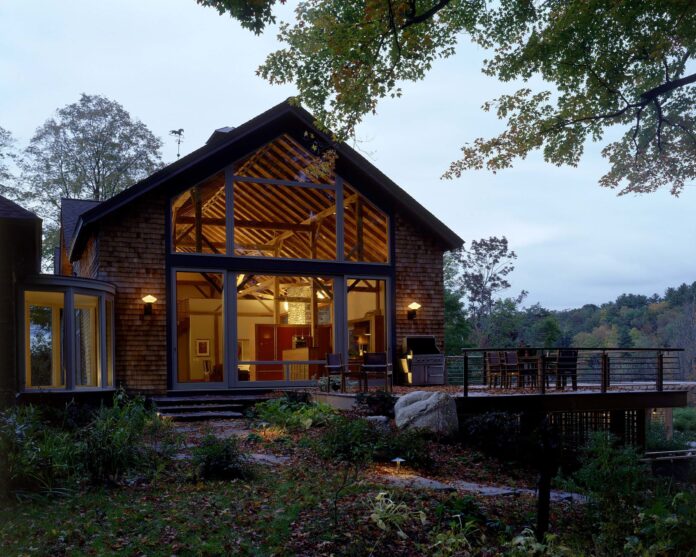
The frame itself became the character-defining aesthetic feature. Having made that important decision, we gutted much of the interior of the original barn. We then restored the preserved portions of the barn, allowing them to contrast dynamically with the contemporary additions made throughout the rest of the renovation. The reconstructed southern and western walls are modern in character and clearly define the historic barn.

All windows and doors were custom-built to meet energy efficient standards and the unique requirements of the barn/residence. On the south wall, we added a large bow-shaped window that overlooks a natural pond. Additionally, an oversized fireplace with a hand-hewed stone chimney was constructed.

The crumbling west wall now features 10-foot-wide by 12-foot-high rolling glass doors which open onto a gathering deck and wooded landscape. The tack room, situated on the eastern wall of the original barn, became an obscure, idiosyncratic element frozen in time. It is viewed through an interior window in the coat room that adjoins the entry hall. The north wall, historically, contained the two primary entrances for horses and carriages. Monumental in scale, one is maintained as the main entry of the residence.

The interior of the space is loft-like. We utilized minimal intervention to shape the space. The goal throughout the project was to distinguish the original barn construction from the elements of a renovated modern home.

The shape and scale are enhanced by the addition of several functional “solids”. For example, the kitchen is an inserted, discrete block of cabinets, appliances and countertops. The master bedroom/sitting room is nestled below a second floor open-spaced balcony.

CLARK + GREEN ’s design work, along with our consultants and the craftsmanship of Babcock and Sons Builders, resulted in a successful marriage between a restored historic barn and constructed elements, the fruit of which is a spectacular modern home.