Riding in cabs through the city’s streets, I struggle to see how neighborhoods change and how traveling more than 10 to 15 blocks can move you into another, sometimes very different world.
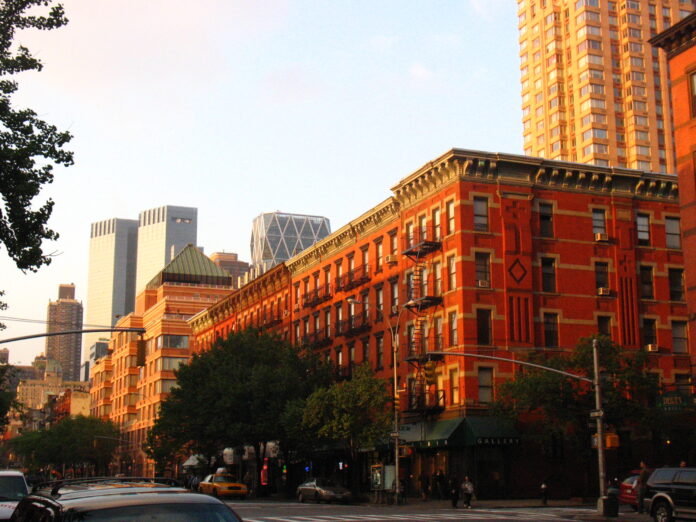
For example, the trip down from Lincoln Center on 9th Avenue moves through various New York neighborhoods from the iconic Lincoln Center complex past Fordham University’s Manhattan campus into a neighborhood once known as Hell’s Kitchen. That name dates to the 1850s, when police used it to describe the then-primarily Irish neighborhood’s slums and gang activity.
The alternate and less sensational name is Clinton, adopted officially in the mid-20th century for planning and redevelopment purposes. It honors DeWitt Clinton, the early 19th-century New York governor and Erie Canal visionary, and is usually used when selling or renting apartments.
Passing in a cab, I can pick up some of the neighborhood’s dynamics looking out of the window. Of course, it is a superficial way of seeing. I observe an eclectic mix of diverse restaurants (from budget to culinary), bars, clubs, and performance venues. Of the new shops that open in New York City, a great many of them are restaurants and food shops. Clinton contains a cornucopia of them.
The neighborhood had long been a bastion of poor and working-class Irish Americans. Most of its housing then consisted of walk-up tenements and pre-war brownstones, but today luxury high-rises can be found throughout the neighborhood, reflecting its rapid gentrification and probably the loss of its distinct character. Though it still can feel gritty in places, it has become popular with young professionals, the gay community, and show-biz people with some spots that have eclectic charm and even a few pockets of affordable housing.
Riding towards the upper 20s, one hits Chelsea on 9th Avenue.
I recall some of Chelsea’s streets in the early ’60s when I was dating a woman who lived there. At night leaving her apartment, I could sense the threat of Hispanic gangs, lurking in the shadows and, at least in my imagination, seeming to rule those empty streets. Chelsea today has been gentrified.
There are still tenements, but some have been replaced by luxury high rises, and the side streets are filled with renovated brownstones and town houses (a historic district has been carved out). This means that the architectural nature of its streets is much more prepossessing than Clinton. I also pass the 10 red-brick cooperative buildings (one of the best of the city’s cooperative developments), constructed in 1962 by the ILGW (Penn Station South) and still going strong. It helped transform the neighborhood in those years. Today, Chelsea contains The High Line, Chelsea Market, and the many art galleries that left SoHo for cheaper rents in West Chelsea. Some of the galleries have already left for less expensive spaces in Tribeca and the Lower East Side. Chelsea also has two low-income housing projects that are being controversially reconceived. But despite Chelsea’s low crime rate, no city neighborhood is without its underside.
I wish I could delve more deeply into the texture of these neighborhoods. I know I am only gleaning the surface, but I love looking and analyzing. So, I will probably continue doing it until my capacity for observation has finally dulled.