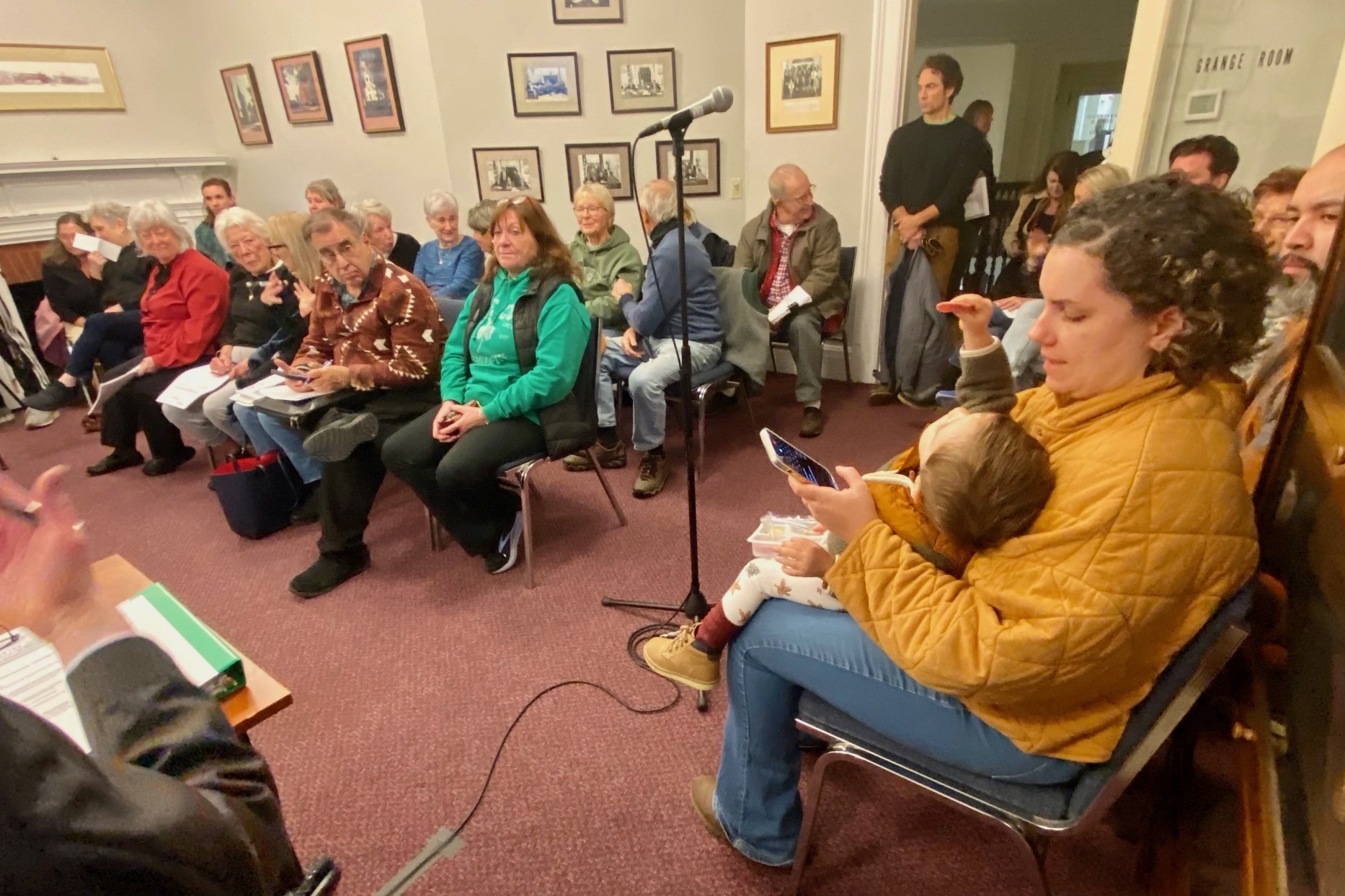
Lenox — With nearly 35 residents packing Town Hall on November 15, the Select Board appeared taken by surprise by the large turnout for such a brief agenda. However, the group wasn’t there to comment on the annual tax classification hearing, but to push the dais to promote unity and solidarity with the four other towns affected by the Rest of River cleanup of the Housatonic River and oppose the construction of a toxic waste facility in Lee or, at least, the use of trucks to transport the waste from the waterway.
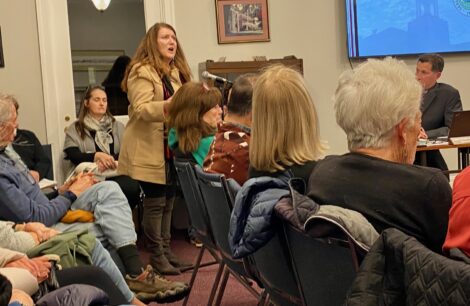
“We come with a very respectful voice but an intense opposition to the UDF (Upland Disposal Facility), or the toxic waste dump,” said Lenox resident Marie Field. “We are here to implore you guys, as our town leaders, to work with [the town of] Lee for the purpose of seeking a better solution.”
The action stems from a remediation plan approved in 2020 by the Environmental Protection Agency following years of General Electric Company depositing the now-banned polychlorinated biphenyls (PCBs) into the Housatonic River from its Pittsfield plant. The plan was agreed to by officials, including a representative from each of five affected towns—Great Barrington, Lee, Lenox, Sheffield, and Stockbridge—during negotiations not open to the public. The plan allows for the most contaminated materials to be transported out of the area, with those materials containing the lowest contamination destined for a UDF in Lee. The Rest of River is the third segment of the Housatonic to be remediated, from the confluence of its east and west branches in Pittsfield to Connecticut.
According to EPA officials, the remediation plan is now in its implementation phase. On October 31, GE released its transportation plan for the PCB-laden soil and sediment, with that plan showing that the products would be mostly moved by trucks and, to a lesser degree, by hydraulic measures. However, during its recent meeting, the Tri-Town Boards of Health, representing Lee, Lenox, and Sheffield, voiced strong support for rail transportation as being safer and less of an infringement on residents.
Lenox recently hired environmental engineering firm Weston and Sampson to help officials navigate the town’s next steps in the remediation process and serve as its point of contact. At its November 15 meeting, Select Board members approved the town meeting warrant that includes an allocation of $100,000 for the firm to oversee the Rest of River plans. Residents will vote on that issue on November 30.
Other residents at the meeting echoed Field’s emotional sentiments while adding some of their own. Marina Smith moved from Pittsfield to Lenox for the school system and was horrified to hear about the need for a remediation plan as she fears for her son’s health and future. “My family and I are counting on you,” she said to the Select Board.
Laura Bergmann moved to Miraval with her composer husband six years ago for the area’s noted devotion to “wellness.” However, she said her family is “disgusted with the fact that this is going in [their] neighborhood.” Bergman insisted the board attend an upcoming transportation plan meeting on November 28, at 6:30 p.m., at Lee High School, that will feature EPA and GE representatives.
Amanda Schenker not only voiced her preference for rail as a safer transportation method for the PCB-laden soil and sediment, but cited a potential decline in tourism resulting from a local Superfund site. Steve Turner spoke about his fear that if the PCB-laced dredged material becomes airborne while being transported, the town’s children may be impacted as school buses travel the proposed route.
Jared Weber, who coordinated the group’s involvement, urged the board to create a “public and ongoing working group” with the Lee Select Board so that members could present a unified response to GE’s transportation plan, a measure he said would carry more weight with the EPA and GE. He cited a recent Tri-Town Boards of Health meeting during which EPA Project Manager Dean Tagliaferro stated that the plan could either be accepted in full, accepted with comments, or submitted for a full rewrite. “The third scenario gives us, the people, and the town of Lenox the best opportunity of delaying GE’s work, which will, in turn, provide us with the most time to create a comprehensive plan to minimize the impact of GE’s project or, better yet, to pursue efforts to rescind the 2020 contract,” Weber said.
Lane responded that he heard the overwhelming theme of the group—that is, a push for the Lenox Select Board to work with the four other Rest of River towns to oppose the projected GE transportation plan and remediation project. Lenox officials have already reached out to the four other pertinent towns and set up a working group with each town providing representation, he said. That was done two weeks ago, Lane said, after the transportation plan was released. “Our goal is to push as hard as we can possibly push to use rail transportation,” he said. “We didn’t get into the UDF yet. That hasn’t been talked about. But that’s our goal is to use rail transportation as much as is humanly possible. And if GE balks about the price, I think it’s incumbent upon us to contact state and federal officials to put a railroad spur in, do whatever they have to do to help that type of transportation be used.”
However, with the UDF in their town, Lee officials have long disapproved of the plan and stated that other town representatives were unwilling to work with them to oppose the project.
Addressing Lane, Weber said he met with Lee Select Board members who approached Lane “a number of times” and his response was that “the Select Board in Lenox does not see value in a public working group with the Select Board in Lee.”
“That might have been previously,” Lane said.
According to Lee Town Manager Christopher Brittain, a meeting was held November 7 between the town administrators and/or managers from Great Barrington, Lee, Lenox, Sheffield, and Stockbridge. The group discussed composing a letter requesting GE to use rail transportation, with all five select boards signing the correspondence at a future public meeting, Brittain said following an email request from The Berkshire Edge.
Lane said he “truly listened to every single word” of the residents at the meeting.
Since the Select Board could not respond to the comments and the discussion not on the evening’s agenda, Lane closed the meeting, leaving only himself and Member Marybeth Mitts behind. That way, the two could conduct a discussion with the residents but without the quorum that would violate the state’s open meeting act provisions.
As a signer of the 2020 agreement, Lane was challenged during that informal session to explain what transpired during the private negotiations three years ago between GE, the EPA, the five town representatives, and environmental groups.
“Part of the mediation process is it’s done, I don’t want to use the word ‘in secret,’ but it’s done just in that group,” he said. The agreement the group negotiated—that includes one UDF—was an improvement over the initial request to house three UDFs in Berkshire County, Lane said.
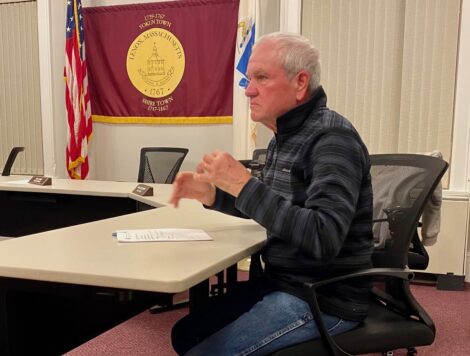
Weber asked if Lane and the others could have refused the offer completely. Lane replied that the group voted to accept the agreement, followed by Mitts who responded that every party agreed to enter mediation, and whatever was agreed to in mediation was the deal that would be reached. “This was done in complete transparency, we walked into this mediation, everybody knowing they were going to have a representative and that this was how it was going to work,” she said.
When pushed as to whether the settlement, with its UDF slated for an area near October Mountain, is good for Lenox, Mitts said that the PCBs to be stored in the UDF in Lee is “the low-level fill.” “I’ve been on record since this whole thing began, since the mediation ended, and no, I don’t think it’s a good thing,” Lane said. “No, I’m not happy about it. Am I realistic enough to realize it’s the best deal we’re going to get? Yeah.”
As part of the settlement agreement, Lenox received about $25 million from GE, funds that Lane said the town hasn’t yet determined how to spend. “I anticipate a lot of that money going toward Lenox Dale, the affected area,” he said. “We haven’t figured out how to go about that. Once we see what the ramifications are once the cleanup starts, we’ll go in that direction.”
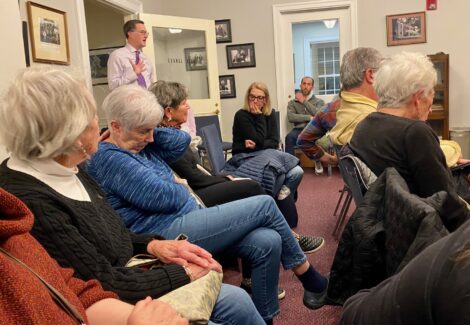
Town Manager Christopher Ketchen, who is also a Lenox resident, reiterated that the validity of the 2020 agreement has already been litigated through federal court and those challenging it have lost, with the permit remaining in effect.
“Rather than rehashing past history, we take this precious time that we have here this evening and we figure out how we’re going to move forward,” Field said.
Ketchen said the town managers have been putting their blood and energy into promoting the use of rail as opposed to trucks as part of the transportation and disposal plan. “That presupposes that there will be a UDF, because there will be,” he said. “There is going to be a UDF.”
With residents advocating for a revised plan, including a possible feasibility study to determine if it is more cost effective for GE to rail the toxic waste out of the area than to carry out the planned UDF, Field said she hopes the working group members don’t feel the remediation plan is “a done deal.” “The will of the people have won many a battle in the history of this country, and what you saw tonight is just a small fraction of how upset the people are,” she said.
For Julia Thomas, a member of the newly organized Clean Berkshire Collective, the meeting was not only productive but “an energizing moment for Lenox residents who did an amazing job mobilizing their community” while speaking personally about their concerns. “Community input is key to the future of this town,” she said.