Berkshire-based collaborative workspaces have been slow to find their footing.
Several have opened recently, including MUSE, formerly the Studio for Integrated Craft, in Housatonic, and the Berkshire Innovation Center in Pittsfield—both of which cater to specific industries and provide access to shared equipment.
But just as many collaborative workspaces closed in the past three years as have launched. Makers’ Mill, a fiber and printmaking makerspace, and Cloud85, a coworking space, both opened in North Adams in 2015 yet closed in 2018 and 2020, respectively. Shire City Sanctuary, a repurposed Catholic church-turned-makerspace and commercial kitchen in the heart of Pittsfield, was sold in 2019 and is now the Alkhalil Islamic Center.
Two proposed coworking spaces in Great Barrington fell through before the projects could be formalized. A plan to convert the former Housatonic School into a business incubator collapsed in June 2019 when developer Bill Nappo was unable to secure funding or selectboard confidence, and a coworking project called Coworking GB succumbed to logistical issues.
Surprisingly, the COVID-19 pandemic was not the catalyst for any of these closures. Instead, it has created an opportunity for coworking spaces that are still operational.
Shuttered offices and new stressors including increased isolation and sharing space with children and spouses working from home have resulted in steady coworking space usage across the United States in 2020. Twenty percent of corporate workers used coworking space at least one day a week, an increase from 14 percent in 2019, according to the Gensler Research Institute, and only six percent of employees polled by CBRE prefer to work fully at the office post-pandemic.
Suburban and rural coworking spaces will be key to the future of employment and business development, as swaths of city dwellers move to areas that provide a better quality of life but may have broadband connectivity delays, as is the case in some Berkshire communities previously reported by The Berkshire Edge.
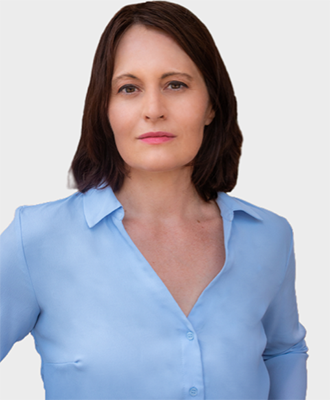
Mara McCann relocated from Manhattan to Becket last June as the pandemic was raging. “I appreciated having a life,” she said about the move, “but I had no idea what would happen to my life without high-speed internet.”
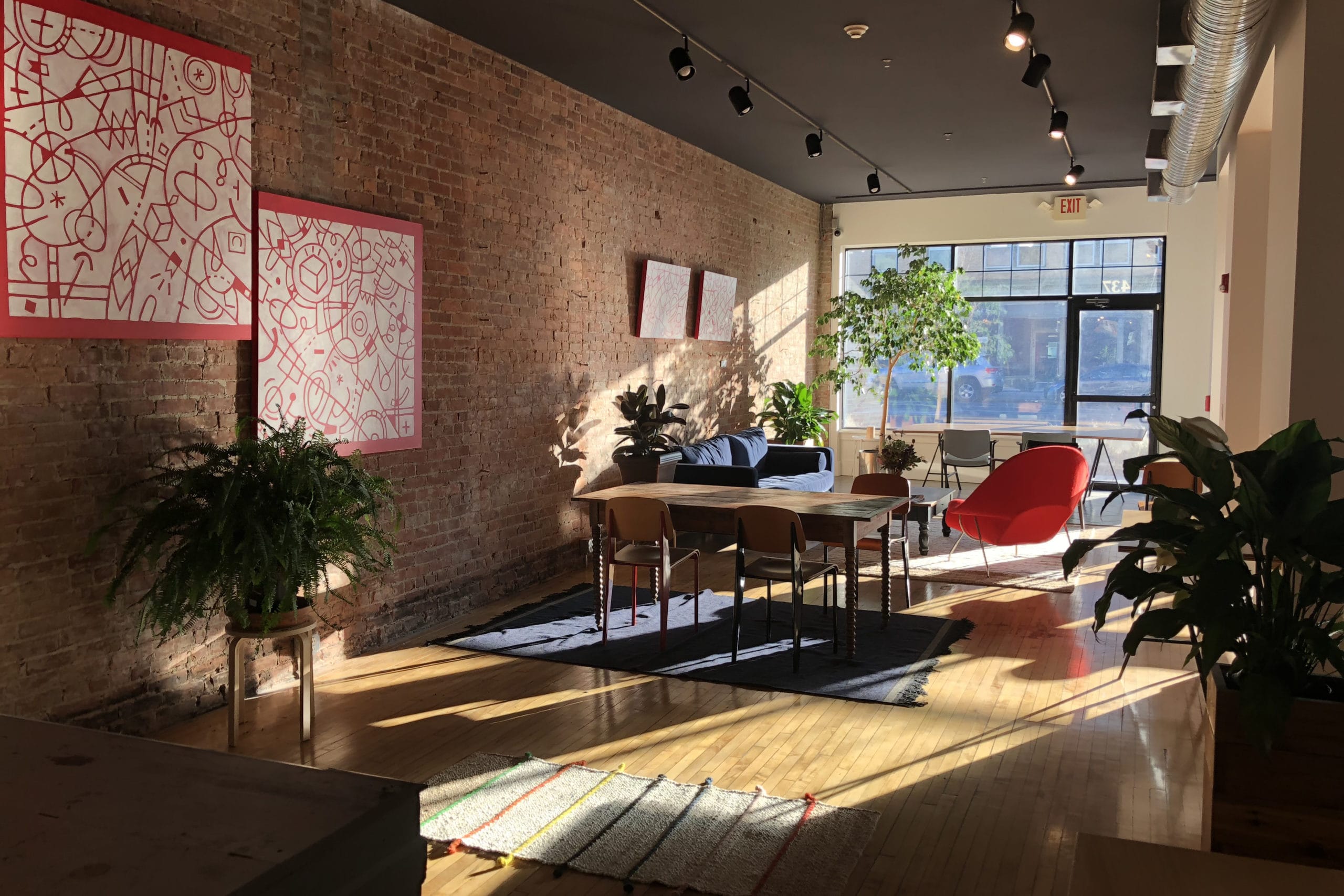
By September, she found Framework, a Pittsfield-based coworking space owned and managed by Mill Town Capital, and began using a shared desk there.
“COVID gave me the space to build a new company,” she said of Everygirl Enterprises, a digital media education company she founded and launched in 2020. “It would not have been possible without Framework. They kept entrepreneurship alive. Kudos to Mill Town Capital for realizing there’s a way to do this.”
Framework was forced to shut down at the start of the pandemic, but reopened on May 25 with new safety protocols that are still in place. Drop-in day passes and open desk memberships are discontinued in order to limit capacity and maintain social distancing, but dedicated desks can be reserved at a lower price of $185 per month. Framework also added a second soundproof phone booth and launched new virtual office and conference room memberships after COVID’s onset.
“The pandemic allowed us to better meet the needs of the community,” said Kathie Penna, operations manager at Mill Town Capital. “The virtual office is good for people who are working from home, and no one offers conference room service closer than Albany or Springfield.”
Membership dropped from 24 full-time users last January to 13 users at all levels today, although Penna isn’t worried about the numbers. With most canceling their memberships when Framework closed, the bulk of her current members are new to the area, and she sees this as an opportunity to grow.
“Some are still working from home, but that’s changing as people are getting vaccinated,” she said. “We have been valuable to people who have come from the city and are without a wifi connection in the hill towns.”
McCann will continue her Framework membership after the house she is renting in Becket is connected to broadband, which she hopes will happen between June and November this year.
“We need that feeling of being part of something larger than ourselves to grow,” she said. “Business doesn’t happen in a box.”
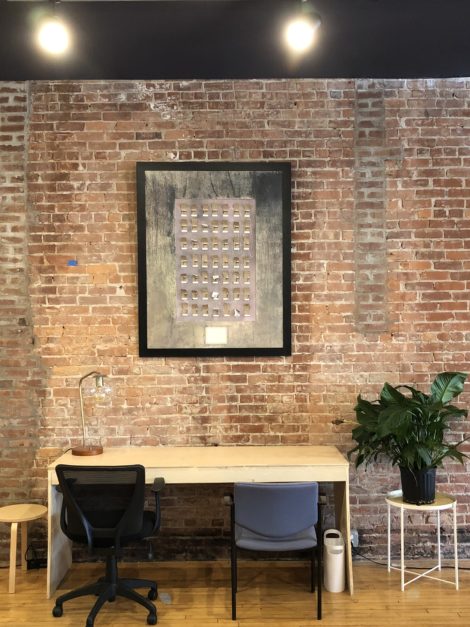
Penna believes that connectivity has been critical to Framework’s success as have the space’s community use, pricing levels, and short-term options. “It allows smaller companies to get their businesses going and move on,” she said. “This starting point has been important for a lot of people.”
Most regional collaborative workspaces are large buildings that share specific amenities such as bathrooms, kitchens, or conference rooms with long-term tenants. Berkshire Design Center in Lenox and the Barrington Berkshire Coworking building in Great Barrington lease private offices to businesses, while The Stationery Factory in Dalton is also building out event spaces and a commercial kitchen.
Drop-in desk space, however, remains hard to find.
In addition to Framework, The Werkshires in West Stockbridge offers a coworking room with four semi-private desks priced at $300 to $400 per month as well as an on-demand private office for as low as $25 per hour, according to its website. But desk availability and COVID safety policies are unknown, and the owner was not available for an interview. Lever, the entity behind Cloud85, received a $24,000 Collaborative Workspace Program grant from MassDevelopment last year as a “coworking space and startup incubator,” although no coworking information is available on its website.
There is a particular need for coworking space in Great Barrington as affordability remains a top concern among town leaders and residents alike.
“[The town is seeing] a common decrease in housing and retail options, yet a real yearning for community and connection,” said Kendra Smallwood, a partner in the Coworking GB project. “From a sustainability standpoint, the more we can share our spaces, the better. The beauty of coworking is its collective resources to split costs.”
Nearly 11 percent of workers in town were self-employed in 2013 and more than half of town master plan survey respondents reported that self-employment accounts for a majority of their household income. While 2020 self-employment data is not yet available from the U.S. Census, coworking spaces can be a lifeline for Great Barrington’s freelancers and entrepreneurs workers who cannot afford to lease an office space.
“People need flexibility,” said Smallwood. “I don’t think an individually rented space makes sense anymore.”
Of course, finding a profitable coworking model is tricky, especially for smaller communities. Workbar, a network of coworking spaces in greater Boston, raised $1.5 million in investor funding last year while CoLab, a coworking space in downtown Albany, closed in March.
Norfolk Hub, a coworking space in the small Connecticut town of about 1,600 people just over the Massachusetts border, remains a thriving community resource thanks to its affiliation with the Norfolk Foundation. Like the foundation, the Hub’s mission is not profit-driven.
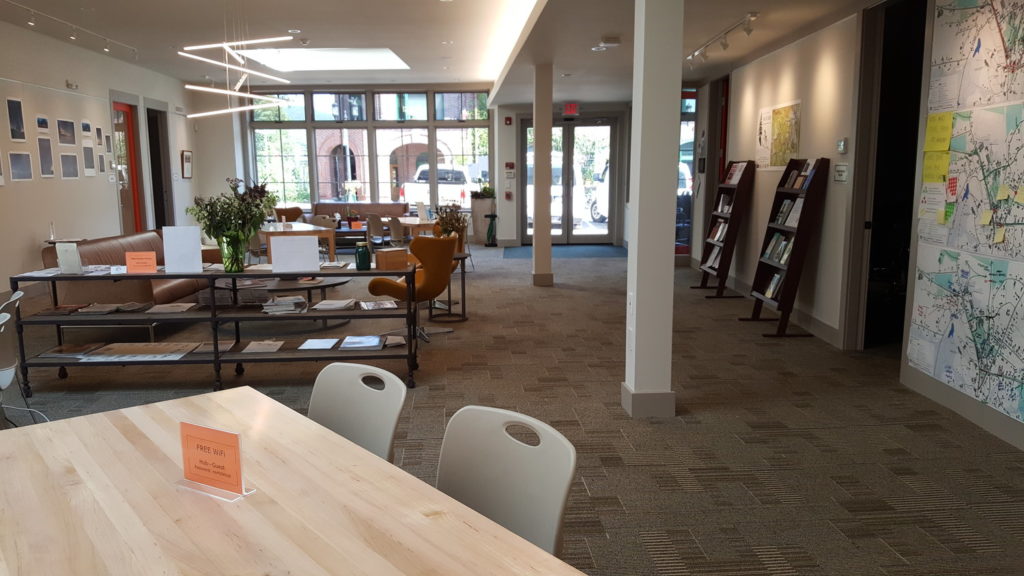
“The whole focus of the foundation is the sustainability of the community and maintaining the character and vitality of the town,” said Dawn Whalen, Norfolk Foundation’s executive director. “When we originally opened [the Hub], it was to support the nonprofits in town. The main space is available to the community for free, and has always been the case.”
The coworking space does have annual fee-based memberships ranging from $100 for a community user to $375 for a local nonprofit, as well as a minimal fee—$10 for four hours or $14 for eight hours—for use of either of its two offices, which have been booked regularly since the Hub reopened on April 6
Like many small New England towns, Norfolk has seen a surge in new residents since the start of the pandemic. Those who need to work remotely and don’t have broadband access have been finding the Hub, which is precisely what the space is there for
“Norfolk is full,” said Whalen. “[The Hub] is meeting the needs of everyone right now.”